

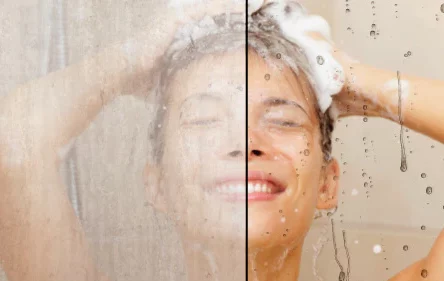
Limescale (also called hard-water scale) is the chalky white film that builds up when water rich in calcium and magnesium evaporates and leaves those minerals behind.
Limescale forms most quickly where water is frequently left to dry, like your RV’s shower glass, faucets, and shower heads. The thicker the buildup of limescale, the harder it is to remove.
Where is limescale most prevalent?
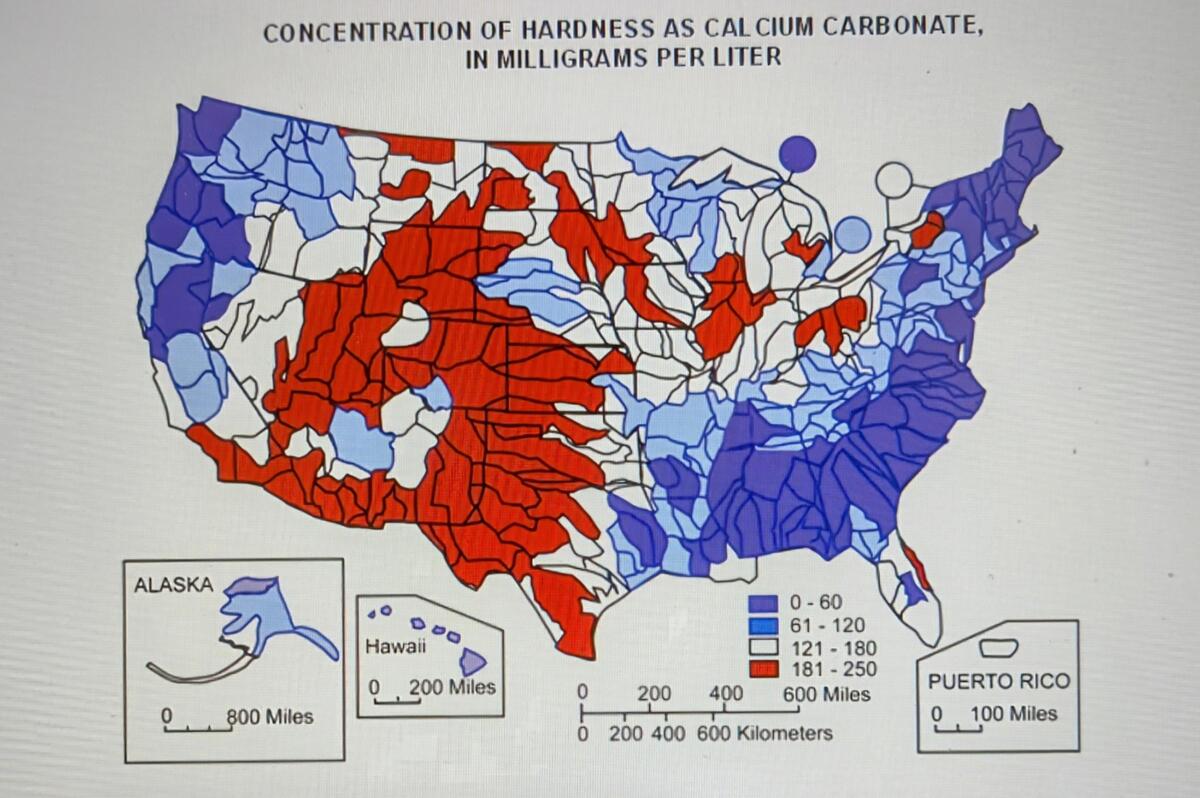
Hard water is not the same everywhere. Large parts of the interior United States, especially the Midwest, Great Plains, and Rocky Mountain foothills, commonly have harder water than coastal areas. Why? Because of local geology and groundwater sources.
We haven’t had much trouble with limescale buildup in the past. This is probably because most of our extended RV stays were in the Southeastern U.S. However, last year we spent six months in Colorado’s western slope at a work-camping site. It didn’t take long for our glass shower doors to become cloudy with limescale.
Note: The USGS water-hardness maps and related guides are a good reference if you want a quick sense of where the possibility of limescale buildup may be worst.
Glass, not plastic!
If your RV shower enclosure is plastic or acrylic, proceed very carefully! Most of the common homemade remedies I recommend below are fine for glass. However, these can dull, etch, or soften some plastics if left soaking too long or used at full strength.
RV and shower manufacturers generally recommend non-abrasive cleaners and caution against harsh scrubbing or very acidic cleaners on acrylic surfaces.
For plastic enclosures, milder cleaning is best (e.g., soapy water, diluted vinegar for short contact times, or a citric-acid rinse at low concentration). Rinse immediately and use soft cloths or microfiber cloths to dry.
If your RV shower enclosure is thin or older and has micro-scratches, stick with pH-neutral cleaners and soft cloths. If the plastic has yellowed or been etched, no cleaner will fully restore it. Replacement may be the only option.
Always test a small, hidden area first.
Best homemade remedies
The following DIY methods work. How? The basic chemistry is fairly straightforward. The calcium and magnesium minerals are insoluble when concentrated on your glass RV shower door. Mild acids will dissolve this limescale back into solution.
Vinegar soak
Vinegar (acetic acid) dissolves mineral deposits but smells quite strong. Repeated exposure can be uncomfortable in small RV spaces without ventilation.
- Heat plain white vinegar until warm (don’t boil).
- Mix 1:1 with warm water.
- Spray or apply with a soaked cloth and let sit 10–20 minutes.
- Scrub gently with a soft non-scratch sponge.
- Rinse and squeegee. Repeat for stubborn deposits.
Citric acid treatment
I prefer this removal technique, mostly because it has a more pleasant smell. I think it works just as well as the more common vinegar technique.
Many cleaning pros prefer citric acid, too. It’s highly effective on scale and biodegrades more readily than acetic acid.
This recipe is great for weekly maintenance or periodic deep cleans.
- Dissolve 2–4 tablespoons of citric acid powder in about a quart of warm water.
- Apply to the glass and let sit 10–15 minutes.
- Scrub with a soft sponge or cloth, then rinse.
Baking soda paste
Baking soda is a mild abrasive that helps mechanically lift deposits without scratching glass. Avoid aggressive scrubbing pads. This mixture is best for spot treatment.
- Make a paste of baking soda and water.
- Apply to small stubborn patches of limescale.
- Rub gently with a soft cloth or the soft side of a sponge, then rinse.
Lemon juice
The citric acid in lemon works similarly to powdered citric acid but is less concentrated. This technique is effective for removing a light film of limescale.
- Rub a cut lemon (or lemon juice) onto the area.
- Let sit for a few minutes.
- Wipe and rinse.
Combined method
This combo can cut through thick buildup but should be used with extreme care on plastics and always rinsed off fully.
- Spray with a warmed 50/50 solution of white vinegar and water.
- Sprinkle or rub baking soda over the area. It will fizz.
- Let that reaction lift the scale for a few minutes.
- Wipe with a damp soft sponge and rinse thoroughly.
Safety notes
- Never mix acids (vinegar/citric) with chlorine bleach. This creates dangerous gases.
- Always work in a ventilated area.
- Wear gloves if you have sensitive skin.
- Don’t use razor blades on coated glass.
- Avoid abrasive powders or steel wool on both glass and plastic, as these can permanently scratch or remove coatings.
- Follow manufacturer guidance for acrylic. Many shower systems emphasize mild detergents, nonabrasive cloths, and testing a small area first.
Prevention
Preventing limescale from forming in the first place is, of course, best. These simple rituals can save hours of elbow grease. Here are some preventive tips.
- Squeegee or towel-dry your RV shower glass after every shower. Removing the water film before minerals dry is the single best habit to reduce scale.
- Switching from bar soap (which leaves more soap scum) to a liquid, low-soap body wash can also cut residue that traps minerals.
- Run a quick weekly maintenance spray of a mild citric-acid solution or a commercial daily shower cleaner to keep deposits from taking hold.
Products and upgrades
Portable RV water softeners can be a game-changer. If you frequently camp in hard-water areas, a portable ion-exchange softener made for RVs is best. Brands such as On The Go® and Camco make compact, salt-regenerable units sized for RV use. These greatly reduce calcium and magnesium at the source, and with fewer minerals in the water, there are far fewer stains later. These systems save time and protect plumbing, appliances, and fixtures.
Protective glass treatments can also help with limescale. Rain-X shower treatments and professional nano-coatings like EnduroShield form a water-repellent layer that makes water bead up and roll off. This reduces the chance for scale to stick.
These treatments don’t make glass invincible, but they can cut cleaning frequency dramatically when combined with the squeegee habit.
Note: Some consumer rain-repellents were developed for auto glass. Choose products made for shower use or professional shower coatings for the best, most durable results.
Have you experienced hard water buildup on your glass RV shower doors? How did you remove it? Do you currently use a portable RV water softener? Tell us about it in the comments.
RELATED
- An easy fix for a shower that won’t drain
- Optimize space in your RV shower to make it feel bigger than it is
- How to make RV corner shower shelves useful
- 11 uses for Windex while RVing that don’t involve cleaning glass
RVT1224

We moved to a new seasonal park last year. The water is much harder than our previous park. We bought a RV water softener. Human power substitutes for the auto-regeneration of residential units. Still not difficult – but buy quick connectors. If you are in areas subject to freeze, understand you will need more than a heated hose; you will also need to keep your softener from freezing. And you can’t just disconnect it – it has to stay at above freezing temps.
Excellent tips! Thank you.
We are FT on the road and have used On The Go water softener for several years. Not only does it reduce water spots on the shower door, it also reduces buildup in the plumbing, toilets and washing machine. Plus a water softener is better for my skin.
I am going to remove the hard water scale on my shower door by having my husband remove the dang thing & add a rod (thanks to the tip the other day in a comment about the Stromberg Carlson EXT-3542 Extend-A-Shower) & curtain. I hate those doors!
The simplest method is the easiest – believe it or not! After you dry yourself – dry down the walls with the same towel. Spend a few minutes wiping the walls and door(s) or spend hours trying to chemically clean everything!
Thank you for the recipes and discussion, Gail! We have hard water at home in East Tennessee and have considered getting a water softening system for the house, but have not … yet. Meanwhile, I bought a portable one for the RV. It works fairly well. I was partially successful in attempting to recharge it. I will try again in the coming weeks. Have a great week and safe travels!
A product called Lime Free from janitorial supply works better than anything else we’ve tried.