

By Chuck Woodbury
Once, long ago, cars went slow and “super” highways were two lanes.
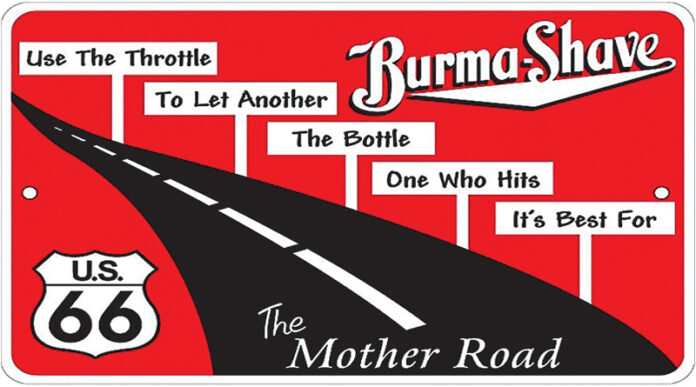
One of the joys of driving back in those good ‘ol days was reading the Burma-Shave signs by the side of the road. One after another, they told a little upbeat story, all with the punch line “Burma-Shave.”
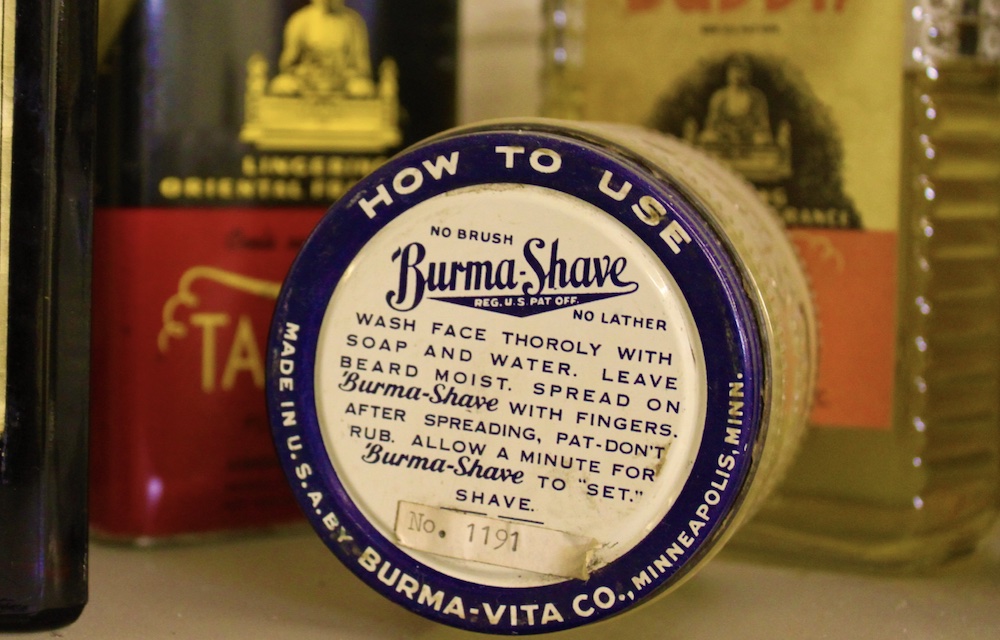
For those too young to remember Burma-Shave, it was a brushless shaving cream. Today, you’d need to be at least 70 to remember seeing the red and white signs that advertised the product along America’s rural highways and byways. On a nondescript stretch of road, where the best scenery might be a pasture with cows, the sight of Burma-Shave signs ahead was reason for celebration — the monotony broken.
Special Seats
Reserved in Hades
For Whiskered Guys
Who Scratch
Their Ladies
Burma-Shave
The first Burma-Shave signs debuted along the American roadside in 1926 in Minnesota, home of the Burma-Vita factory. They were hardly impressive. “We lettered them rather crudely, and tested them on two highways,” said Leonard Odell, the younger brother of Allan Odell, who conceived the signs as a way to advertise the then-little-known shaving cream. “The first batch didn’t even rhyme.”
Shave The Modern Way
Fine For The Skin
Druggists Have It
Burma-Shave
These first signs were simply wood planks. Allan Odell had talked his father and company founder Clinton Odell into investing $200 into building them. “But, by golly, it wasn’t long until we were getting orders from those signs, so we concluded that their placement had value,” Allan Odell recalled years later. “In a few months, we switched to folk humor and verse.”
And so began one of the most successful “guerilla” advertising campaigns in history. In 1926, Allan and Leonard set up their first sign shop, painting each sign with a slogan they had composed with their father. Alan hit the road to find locations for the signs, paying farmers $5 to $25 a year to place and maintain them in their fields. Later, the company held contests, offering cash prizes for winning jingles. Entries poured in from across the nation.
Your shaving brush
Has had its day
So why not
Shave the modern way
With
Burma-Shave
At first, the signs were purely a sales pitch. But soon they found their sense of humor, sometimes including a safety message. Signs were most often clustered in a set of six, placed 100 feet apart, each offering a single line of a jingle. At 35 miles per hour, it would take a motorist about 18 seconds to read a message from start to finish.
At the height of the signs’ popularity, about 7,000 stretched across 45 U.S. states. Families who drove past would often read them aloud, soon developing favorites. The signs’ upbeat messages cheered travelers during the otherwise bleak Depression years and then again later during World War II.
From New York town
To Pumpkin Holler
It’s half a pound
For
Half a dollar
Burma-Shave
The signs catapulted the tiny Burma-Vita Corporation into a household word. Little known even today is that the company never had more than 35 employees, yet it was perceived as a corporate giant. Employees either worked in production at the Minneapolis factory or in the field erecting signs. Yet even the road crews, thought to be numerous, never exceeded more than eight vehicles. Crew members were called PhD’s, short for “post hole diggers.”
If your hubby
Trumps your ace
Here’s something
That will
Save his face
Burma-Shave
But as cars got faster and roads evolved into wide superhighways, Burma-Shave signs lost their effectiveness and ultimately their popularity. In 1963, the Phillip Morris Company bought Burma-Vita. The last sign was pulled from its stakes three years later.
And, as you might expect, as the signs went down so did sales of Burma-Shave. And like the signs, they never went back up.
MORE NOSTALGIC POSTS
- Cassette tapes, Burma-Shave signs, CB radios and more: Take a trip down memory lane
- Discovering America’s soulful history along the Blues Highway and Mississippi Blues Trail
- The history of the glove compartment: What’s in yours?
- Totem pole history and facts for the Alaska and Pacific Northwest traveler
##RVT1202


In the early 50’s, going up and down the East Coast every August on U.S. 1, Burma Shave signs were the outside entertainment.
On many trips when I was growing up and later as a young adult I enjoyed the Burma Shave campaigns. Today, I’ve encountered a few local communities that have one or two of them as you drive through their town. Story City, IA had one the last time I visited, not sure if it’s still there though. Could be something city fathers might consider to make their town a little more ‘unique’…
Burma Shave!
Between Kingman Arizona and Seligman Arizona on Route 66 there are miles upon miles of Burma Shave signs!
What a walk down memory lane 😁
interesting article I enjoy the burma shave memories. I have a complete set going up my rural drive way with correct spacing between them . fun to see peoples reaction to them
said farmer brown
who was bald on top
wishing he could
rotate the crop
burma shave
If you find yourself on I-90 in South Dakota, you will be entertained by the roadside signs for Wall Drug. I lost count of how many signs we eagerly read but I assure you, there was no way in the world I was gonna drive past without seeing what all the signage was about!
It is a great stop….
Hi Vince… yeah for sure, this all started with a “Free ice water” Wall Drug signs. It is a great experience especially with the museum they have added. (Don’t miss Badlands Ntn’l Park either!).
Oh how well I remember those signs! Crossing ND many times – they sure broke up the monotony and put one in a good mood with a smile, along with getting a safety reminder too! Might even work better today as we rush thru the country side.
We’re happy to see Buc-ee’s has picked up the torch (sort of). Love their signs!
Great stuff! Lots of fond memories.
I’m 76 and grew up in San Antonio, Texas and we had relatives all over Texas and Oklahoma. I remember reading these signs going to visit and reading them to my little brothers who could have cared less until they started to read then it was a contest as to who could read them as we drove past.
Chuck, you should update this to mention the small nostalgia collection along Route 66 out of Seligman.
MY favorite set read “Our factory workers jumped for joy, the stork just delivered another boy”
Not all have been pulled up. They still have them on RT66 in Arizona. Between Kingman and Seligman, AZ. Saw them a couple years back on the way to the Grand Canyon.
Thank you for the historical essay, Chuck! As I am a comparative youngster in these parts (~age 68), I do not recall any of this and it is fascinating. Have a great weekend and safe travels!
I read a book called “Verse By The Side Of The Road” back when I was a kid, about Burma Shave jingles. I even remember one that was a PSA: “Don’t Stick Your Elbow/Out Too Far/It May Go Home/In Another Car!”