

A while back, I wrote about the true mother of the “Mother Road.” One of our readers, Steve H., commented and suggested that perhaps there’s a “Father Road,” as well.
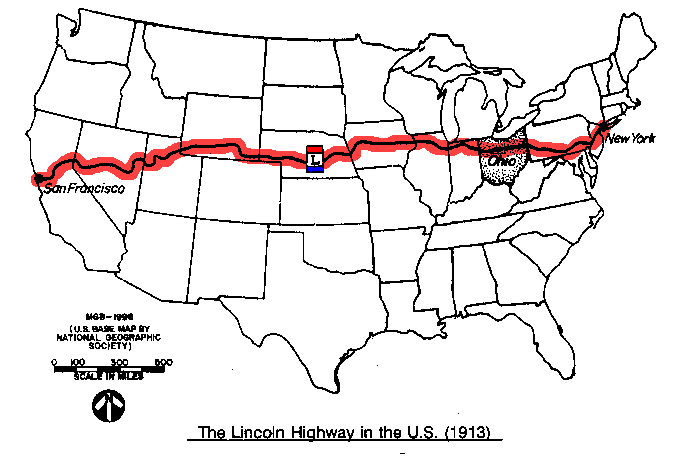
Turns out, Steve has a valid point. The Lincoln Highway has a strong claim to being America’s “Father Road” because it opened in 1913. Route 66 did not officially begin until 1926. Want to learn more about the “Father Road”? Read on!
A bit of history
The idea of a cross-country roadway began with Carl G. Fisher. Fisher was not an engineer or government official. He was a businessman, entrepreneur, and visionary. Fisher believed the automobile would completely change American life. (He was certainly right!)
Fisher understood that cars would never reach their full potential if Americans were still trying to drive through mud, ruts, and disconnected local roads. Fisher envisioned a durable, improved road stretching from New York City to San Francisco. He called his idea a “Coast-to-Coast Rock Highway.”
Fisher already had a reputation for turning giant ideas into reality. He helped create the Indianapolis Motor Speedway and later became one of the developers responsible for transforming Miami Beach into a famous resort destination.
The Lincoln Highway may have been his boldest project because, in 1912, the United States barely had interconnected roads outside cities and towns. Most “highways” were dirt and often impassable after rain. Cross-country travel was dominated by railroads.
To make his dream happen, Fisher gathered support from some of the most powerful names in the automobile world. Industrial leaders, including Henry Bourne Joy of Packard and Frank Seiberling of Goodyear, joined him in forming the Lincoln Highway Association in 1913. The organization’s mission was simple but ambitious: Create a continuously improved highway from the Atlantic to the Pacific that would be open to all travelers without tolls.
Funding the highway
Funding the highway was a massive challenge. Some major figures supported the effort, including Theodore Roosevelt, Thomas Edison, and President Woodrow Wilson. Henry Ford, however, famously refused to contribute because he believed roads should be funded publicly rather than privately.
Even though the association never raised enough money to fully build the highway itself, it succeeded in something more important. It convinced Americans that modern paved roads mattered.
The Lincoln Highway Association promoted “seedling miles.” These were short stretches of concrete road built in rural areas to demonstrate how much better paved highways performed compared to dirt roads. Once people experienced these improved sections, pressure grew for states and the federal government to invest in better highways nationwide.
The Lincoln Highway helped pave the way for the American road-trip culture. Without the push from Fisher and the association, the United States may have taken much longer to develop national highway networks.
ENJOY STORIES LIKE THIS? Never miss out! Since 2001, RVtravel.com has been the #1 website for RVers in North America. Written by the RVing experts, for RVers. Learn more or subscribe to our newsletters here.
Why “Lincoln Highway”?
The Lincoln Highway was named after President Abraham Lincoln as a patriotic tribute. When the highway was announced in 1913, the country was approaching the 50th anniversary of Lincoln’s death. Organizers wanted a name that symbolized national unity from coast to coast.
“Father Road” route
East of the Mississippi, the Lincoln Highway was stitched together from existing roads. In the West, it followed older travel corridors such as the Mormon Trail, the Overland Stage Line, the Pony Express route, and Donner Pass. That’s why the Lincoln Highway feels a bit more adventurous than the numbered highways that later replaced it.
Today’s Lincoln Highway
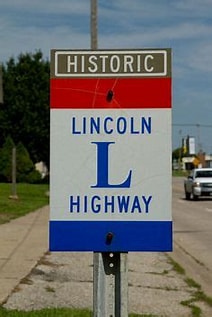
If you live in one of the Lincoln Highway states, it’s worth checking your own backyard for a surviving segment. The “Father Road” is an easy add-on to a weekend drive or a full-on bucket-list trip. Who knows? You may discover a museum, a monument, or a town that still leans into the old road’s history. You can find resources for each individual state here.
You should go!
Route 66 may be the better-known “Mother Road,” but the Lincoln Highway got there first. If Route 66 is the classic American road trip story, the “Father Road,” or Lincoln Highway, is the earlier draft. It proved that a coast-to-coast auto route could actually work.
Have you traveled along the Lincoln Highway? Tell us in the comments below.
RELATED
- Driving America’s first coast-to-coast road: the Lincoln Highway
- The real ‘mother’ of the Mother Road
- 10 Eastern Sierra must-visit stops along California’s U.S. Highway 395
- Are blue highways best for RVers?
- How the Muffler Men keep watch on America’s highways
RVT1262

We took the section of the Lincoln Highway that runs on the south side of Chicago. Don’t do that. It is a narrow 4 lane city street that is full of pot holes.
My wife teases me as we drive about ‘the old road’. I’ll try to follow where the older version of the road lead via tree clearings, etc. as we roll down the newer road. I’m sure you have seen spurs of the current road signed as the “Old [current road name]”. Or see abandoned narrow bridges over waterways while you cross the newer bridge.
I’m the same guy who takes notice when sections of our current path are marked with signage about the Lincoln Highway or Route 66. When you cross the Mackinaw Bridge between Michigan’s two peninsulas, you can still see remnants of the old ferry docks.
Grew up driving on it all the time in Ohio, never knew the real roots. Thank you for the history lesson!
I’ve traced both Rt 66 and US 30 (Lincoln Highway). .
To me the Lincoln Highway is hands down more interesting, scenic, and enjoyable.
The Lincoln Highway also has more original drivable pavement than Rt 66.
It also includes parts of the Pony Express trail, Mormon Trail, Oregon Trail, and California trail with its rich history.
I highly recommend it.
The Lincoln Highway through the Tahoe region of Northern California is spectacular! I often get off 80 and take it when going to Tahoe.
We’ve travelled over what remains of the Lincoln Highway through Wyoming
According to Highway History ( a page by the Federal Highway admin.) US1 stretches 2321 miles and was used as a way to travel up and down the east coast as early as 1631 (obviously not paved), so it would have to be a contender for the Father Road title
I agree. It originally called Ye Olde Kings Hiway up north.
Then there’s US 101 in California: El Camino Real.
It’s an old mission road from the 1400’s I believe.
I’ve driven 101 from Salinas to northwest Oregon. It’s the most scenic route I’ve ever been on.
The Amercas were not even colonized during the 1400’s. Columbus’ expeditions were in the 1490’s.
Columbus never set foot on the American Continents.
You are right about the years, though. Columbus reached one of the islands in 1492. It was certainly well after that when the Spanish reached California.
Another great article Gail!
For more immersion, I recommend Cold Springs, Nevada where you can see not just the Lincoln Highway but the old Overland Trail and Pony Express Trail as well.
There’s still structures standing from the old Pony Express stations where tired horses were exchanged for fresh. Driving up the old Overland Road to Smith Creek station is best done with a Jeep but wow, you can experience what those early travelers endured with their quest for western expansion.
Theres tons of BLM land for boondockers and the OHV friendly Cold Springs RV Park has full hookups for those who prefer connections.
I’ve driven that. It was the first alignment of The Lincoln Highway.
The stretch across the Goshute Indian Reservation requires a permit and 4-wheel drive. It’s worth it seeing wild horses.
Thank you, Gail, for following up on my suggestion! I realized that “Father Road” could be applied to the predecessors of US 1, the Cumberland Gap “road”, the original Pennsylvania Turnpike, the Oregon and Santa Fe Trails, or several other trails. But none of those, including Route 66, went from coast-to-coast. The Lincoln Highway was the first to do that, so probably deserved the title.
Sorry, but none of those roads predate Ye Olde Kings Highway, part of which is US 1 up north.
Kings Highway (I live near parts of it in Massachusetts) may be older, as perhaps also the El Camino Real, but neither of those (or any of the older roads) could be considered “improved”… and the old side-by-side log or “corduroy” roads were, at best, very minor improvements (they could tear a wagon or a car to pieces at anything above a crawling speed, and the wood rotted over time… creating what might have been the first potholes in a “paved” road)…
Kings Highway from Boston to North Carolina was eventually paved.
I’ve driven Route 30 from western Iowa to Ohio a few times. And, if Interstate 70 is part of the Lincoln Highway, I’ve taken a Greyhound from New York to Reno.
My bad, I meant Interstate 80.
I think the Lincoln Highway went through Elkhart County, Indiana, so anyone familiar with the hometown of RVs should be familiar with it.
We’ve driven a number of areas of the Lincoln Hwy but never knew it was considered “The Father Road”, thanks for that!
Kirhersville, Ohio where we lived for three years on a horse farm sits right on the Lincoln Highway (US 40). Our driveway took us right down to the highway. Motorcyclist, sports car enthusiasts, bicyclists and local farmers all frequented the road. It was a quiet pleasant road to ride down, having done it many a times on bicycle, horseback, car and truck. There are many lovel rural communities where the slower pace of life make for a relaxed pace of living along the Lincoln Highway.
Lincoln Highway and Route 66 intersect in Joliet, IL of all places!
Been on many sections of Rt 30 across the US. West of Chicago, it’s been moved around some, even have a section called Rt 38 that used to be called ‘Alternate 30’. Franklin Grove IL has a national office on part of the old Rt 30.
I grew up on Lincoln Highway in Starke County, IN. The “father road” was preceded by the “Yellowstone Trail”. Every year, Hamlet hosts the Yellowstone Trail Festival. This year will be extra special because we are also celebrating America 250!
What about route 20 ?
Went to college in a small town in Iowa on the Lincoln Highway.
I’m a truck driver, so it’s rather easy to claim I’ve just driven on it, but I’ve stopped at the rest stop on I80/US30 near…rawlins WY I think, the rest stop that has a giant Abraham Lincoln head
Great article on the Lincoln Highway. Funny, I grew up a few miles south of Route 66 in Countryside, IL, but I wrote a song called “Interstate 80” that references “those Lincoln Highway tales are good as gold.” You can find it on YouTube under “Bill McAlister & I 57 South” (I also wrote a song about I 57, since the Route 66 song was already taken…..).
There is an earlier highway than the Lincoln Highway. The National Road (also known as the Cumberland Road) was the United States’ first federally funded interstate highway. Authorized by Congress and signed by President Thomas Jefferson in 1806, it stretched 620 miles from Cumberland, Maryland, to Vandalia, Illinois, fueling 19th-century westward expansion and commerce.Today, much of its original path is designated as U.S. Route 40.–Federal Highway Administration
The Kings Highway from Boston to Charleston S.C. is the oldest highway in the US. It was commissioned by King Charles the 2nd. It was built from 1650 the 1730s. It was usable for horse drawn carriages and stagecoach by 1735. It was paved in the early 1900s.
Thank you for the informative discussion, Gail. No, don’t think that I have driven any part of it, yet. Have a great day and safe travels!
Any north and south roads worth mentioning, like I-35 ?
Nobody has mentioned the first transcontinental highway, The Yellowstone Trail, conceived on April 23, 1912 by Joseph W. Parmley and other community leaders of Ipswich, South Dakota. It was tagged as, “A Good Road from Plymouth Rock to Puget Sound.” Much of the original route of this road still exists today as U.S. Highway 12. Joe Parmley faced the same hardships of driving from Ipswich, SD to Aberdeen, SD, the same as mentioned in this article, that served as inspiration for the Trail. For more info about the Trail and the grassroots efforts to get the road built see the book written by Alice A.Ridge and John Wm. Ridge, “The Yellowstone Trail” published 2000 and http://www.yellowstonetrail.org
The transcontinental highway didn’t go to Puget Sound. It ran from Times Square in New York to San Francisco. And, it didn’t run through South Dakota. East of the Rockies, it ran through Nebraska, Colorado and Wyoming. Then through Utah, Nevada and into California.
I would think that much of the trail is now Interstate 90, which is the longest Interstate in the US. But, the original highway in the US is The Kings Highway from Boston to Charlotte North Carolina. Much of which is part of Route 1.