

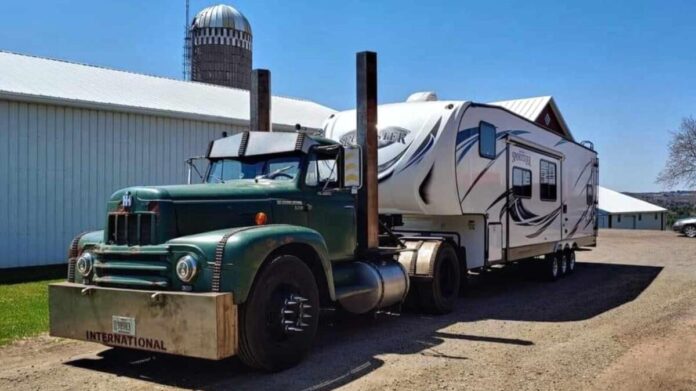
Have you ever sat back and wondered how your RV got from wherever it was made to the dealership where you bought it? I thought I’d share some insights. This also translates into some reasons your poor RV didn’t arrive in one piece.
Transporters
Once your RV leaves the factory, assuming you’re not picking it up there, it typically goes to a holding pen. From there, a transporter picks it up and delivers it to the dealership.
If the RV is a motorized rig, then it gets driven to the dealership. When you buy it, the odometer will show those miles from where the RV was stored waiting for the transporter, to the dealership.
Towables are a different story.
If the RV is larger, oftentimes a transporter is someone with a larger (typically one-ton Ram) pickup truck. They simply hook the trailer up and haul it to the dealership, just as you would tow it to the campground.
If you are looking at smaller trailers, these can be hauled in multiples, where several smaller trailers ride on one larger flatbed trailer. The advantage of this is that the trailers don’t have any real miles on the tires. Also, in winter, salt hasn’t been sprayed on the undersides by driving on salty roads.
Did you ever wonder why your RV’s frame rusts so quickly? I’ve never seen a dealership wash off the road grime. However, I’m sure some do, especially in areas where salted roads are a thing. I just haven’t seen it happen.
Having multiple trailers on the back of another trailer has another distinct advantage. The transportation cost is split among those smaller trailers rather than being incurred by just one trailer. Oh, we’ll get to the cost soon enough, my friend.
There are really only a few RV transporter companies, with Horizon being the largest.

Who are the transporters?
Transporters are typically independent contractors. Essentially, it’s someone with a larger-capacity pickup truck, but not always. Some transporters have commercial driver’s licenses (CDL) and larger rigs. Some have delivered RVs for many years, sometimes even decades.
It wasn’t unusual that we saw pickups with many hundreds of thousands of miles on them show up at the dealership with a shiny new trailer in tow.
This is why every RV dealership has a Rolodex (there’s a term that dates me!) of transporters. So, if you ever need an RV moved and don’t have the truck to do it yourself, your local RV dealership will likely have more than a few transporters that will gladly do the job.
Interestingly, many transporters only make money going one way—from wherever the RVs are manufactured to the dealership. While there are cases where an RV is hauled back to the factory or from the dealership to another dealership, many transporters are only paid to go from the factory to the dealership. They then return empty to pick up their next load.
They use their own vehicles. Also, they pay their own tolls and fuel costs, and the rate the transporter company pays them is expected to cover these costs, and does, or they wouldn’t be back for that next load.
Also, they are usually paid by the mile, so the sooner those miles click off, the sooner they get paid. In other words, they’re not paid for a leisurely journey, and won’t choose smoother back country roads over those pummeled by freight traffic. Your RV will see some road conditions that you may personally choose to avoid. See why I’m such a nut about RV suspension and tire systems?

Your RV is unused
One of the things that is a hallmark of these transporters is that they do not use the RVs as RVs themselves. While the driven RVs are obviously occupied in the front/driver’s seat for the duration of the journey, towables are often locked before they leave the holding pen and not unlocked until they arrive for inspection at the dealership.
So, don’t be concerned that the transporters are using the kitchen, bed, or bathroom in your RV—they aren’t. The RVs are arriving essentially unused, except for towing or driving.
In fact, on more than one occasion, we would open up a just-delivered RV at the dealership and find defects. The transporter would be surprised because he or she had never seen the inside of the RV.
There were plenty of times, too, where the transporters wanted to peek inside the rig at the dealership just to see what it looked like.
Why can’t I just pick it up?
It is certainly possible to pick up your new RV from a dealership close to where it is built, but most RV manufacturers don’t offer direct pick-up from the factory. There are exceptions, but they’re rare.
In fact, some of you may know I have a direct relationship with Rockwood and Forest River. But the three trailers I have purchased under that agreement were all picked up at a dealership not far from where the trailers were built.
Warranty concerns
I’ll share more details about how RV dealerships work, but do know that RV warranty work is typically a loss for many dealerships. Also, there continues to be a shortage of technicians. So it could be that your local RV dealership won’t provide warranty service to an RV you didn’t buy from them. RV dealerships don’t have the same agreement as car dealerships do. Therefore, they aren’t specifically required to work on an RV that wasn’t purchased there.
Again, this is a broad generalization, and we did help people who were traveling and had a repair needed to continue their adventure, even if they didn’t buy from us.

Don’t forget the forklift
One of the unsung heroes of RV transporting is a forklifts, believe it or not. Many dealerships and storage lots have these workhorses on-site. They have a modification so that the forks can be used with a trailer ball or cup to move towable RVs around the lot.
Sure, some do the job with tractors. But the forklift is common and works really well.

Transporting is expensive
In the past few years, like so many other things, the cost of transporting RVs has gone uppity up up. Remember, you have to pay someone well enough that they can buy a pickup in these times where pickups are like Cadillacs and priced accordingly. You also have to cover fuel and insurance, and nobody will do a job where they don’t earn a living.
Plus, of course, the company that oversees the transporting also makes a profit. That’s why they’re in business and invest in scheduling systems and all the other infrastructure they have.
When you see transportation or delivery costs as a line item when you’re buying your next RV, know that this is likely just a direct cost that the dealership is passing along. And, yes, it can be many thousands of dollars.
In fact, many RV companies, including Keystone and Forest River, have manufacturing plants on the West Coast just because the area is such a huge market and the shipping costs can be nuts.
The dealership where I worked is in California. The fifth wheels we had at the time came from Indiana, so shipping costs were high. We also sold Flagstaff trailers, which are only made in Millersburg, Indiana. Many of the Keystone and other brands came to us from Oregon.
I can’t imagine people buying a Lance or Outdoors RV camper on the East Coast, for example. That’s because the cost to ship it across the country would be significant, since these are both built on the West Coast.
Did you know there was once a huge RV industry in California with names like Aristocrat, Alfa Leisure, Fleetwood, and others? Forest River also closed its Southern California plant. Yet, California remains an enormous market for RVs.
Want to be a transporter?
If you read all this and thought, hey, I want to be a transporter, know that these companies are always looking for new people. A good thing about being a transporter is you can essentially choose your loads based on your schedule and location. However, know that most of the loads for RV transporters originate in Indiana, with there also being a lot of shipments out of Pendleton, Oregon.
Other transportation opportunities include moving cargo trailers, work trailers, and more. You can also partner with local dealerships to help move their inventory, although this isn’t as regular as you may need. There are also dealers, like Best RV in Turlock, Calif., that have their own transporter fleet.
Lastly, I’ll share this little joke with you.
What’s the difference between you and an RV transporter? About 30 miles an hour.
MORE FROM TONY (AND RELATED ARTICLES):
- It’s true: RVers are encouraging bad-quality RVs
- How performing a simple 90-day seal check helps with warranty claims
- You’re not alone on the road. How to find your community
- Ever wonder what the inside of a semi-truck sleeper cab looks like? Here you go!
- RVers discuss the pros and cons of using truck shops for RV repairs
RVT1247

We live in Michigan and had purchased two Lances over the years and the transportation wasn’t really any more than the general rate. However, they do ship them in twos and threes to share the cost. We just bought an Escape Trailers Industries Model 23 from Chilliwack (Vancouver area) Canada and paid $2500USD to have it shipped anywhere we wanted in the U.S. They shipped it with one other trailer, as well.
We have an Escape 19 in production, and are having it delivered to NM, at the $2500 price. I calculated the cost of going to pick it up, and for the difference in cost (hotels, eating on the way, campgrounds on the return, time, and possible weather issues in Feb/March), it’s worth it to us.