

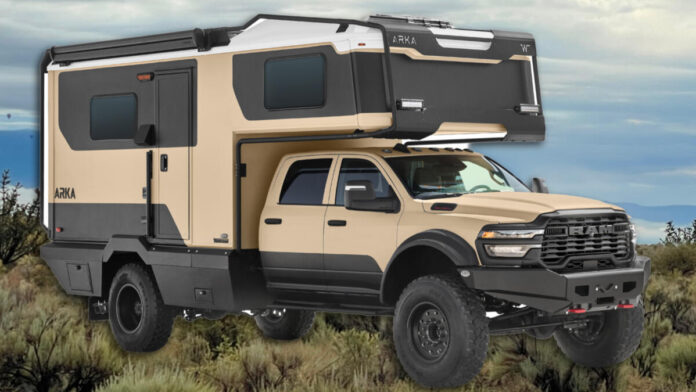
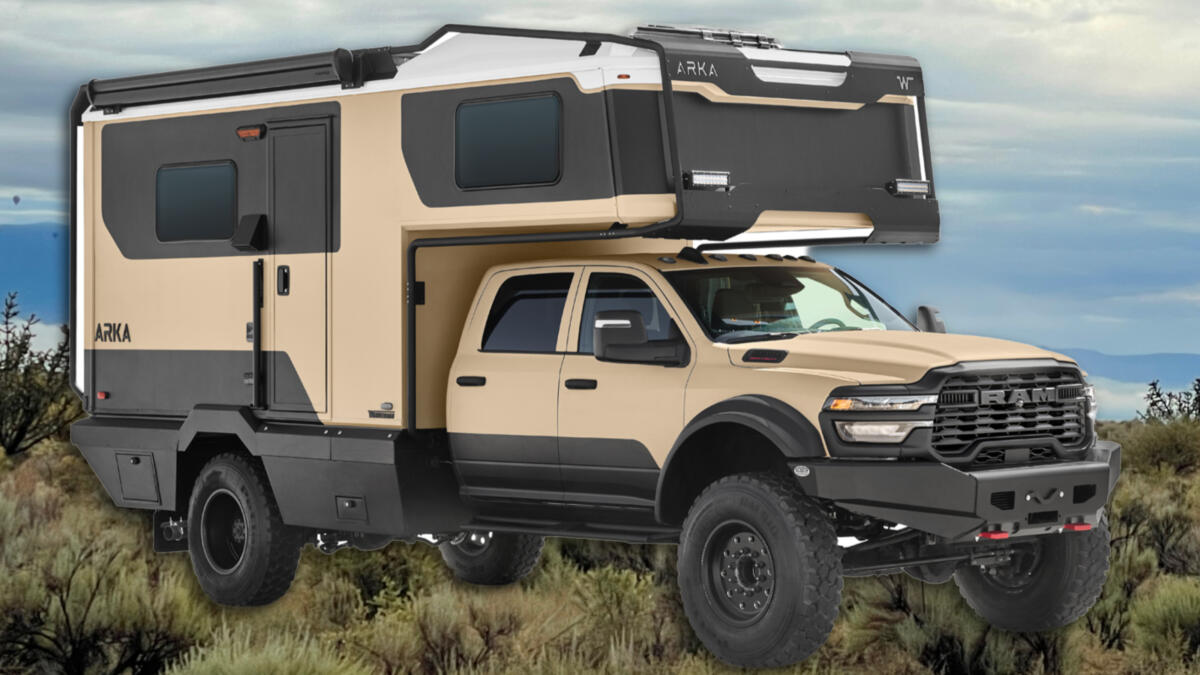
Today’s RV review is of the new-for-2027 Winnebago ARKA 20Z, an off-road-capable, adventure-ready overlanding RV that is based on the Ram 5500 chassis, which has been modified for extreme capability. There are a number of this type of overlanding rigs out there, typically from smaller companies. But this one breaks a lot of new ground and really has hit the mark quite well.
How the Winnebago ARKA™ 20Z is built
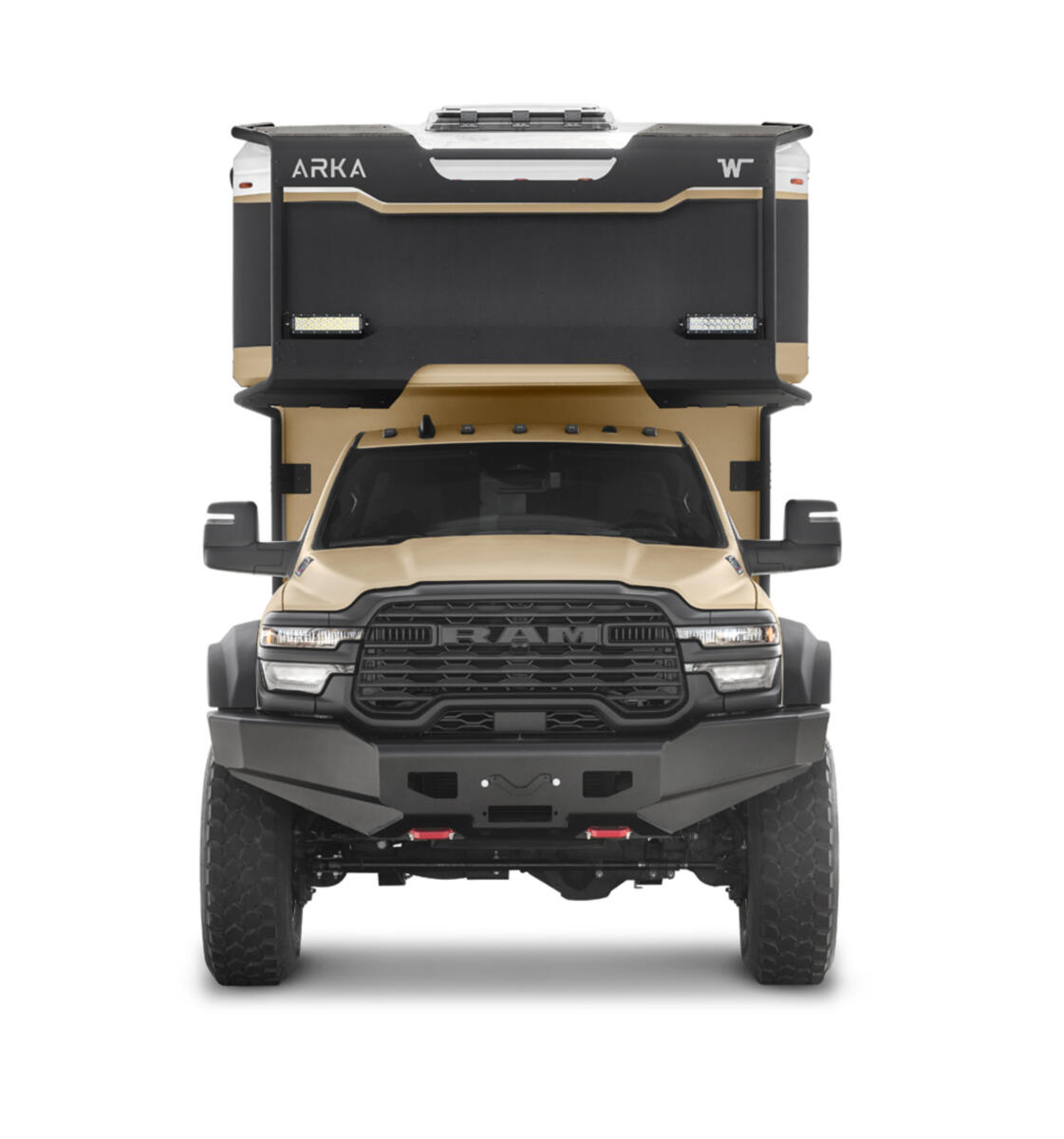
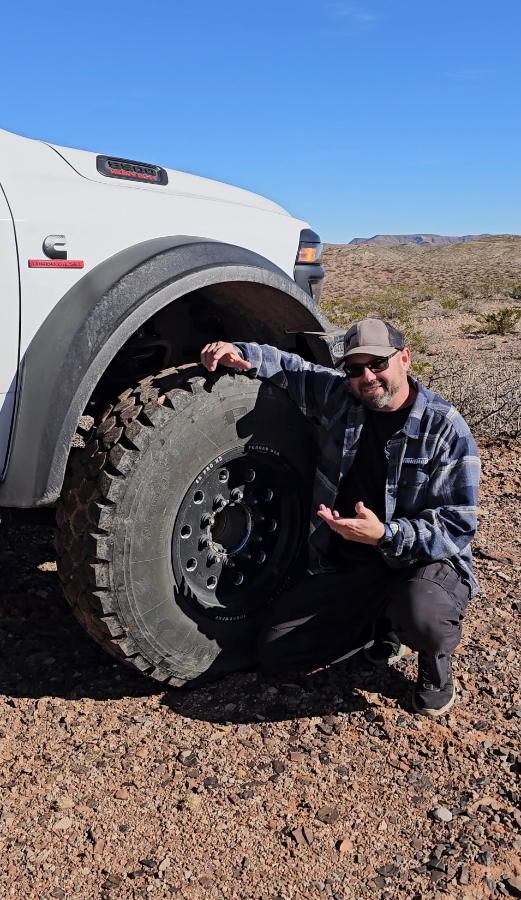
From the stock Ram 5500 four-wheel-drive, Winnebago has upgraded the suspension, tires, bumpers, and more. The chassis has been upgraded with BuckStop™ components, including suspension and bumper that can be set to easily accept a winch. This rides on 41” off-road tires that both accentuate the rugged appearance of the rig and also provide additional capability off-road.
It might seem odd how much distance there is between the cab and the RV box, but this was intentional to allow the vehicle to flex in extreme off-road conditions.
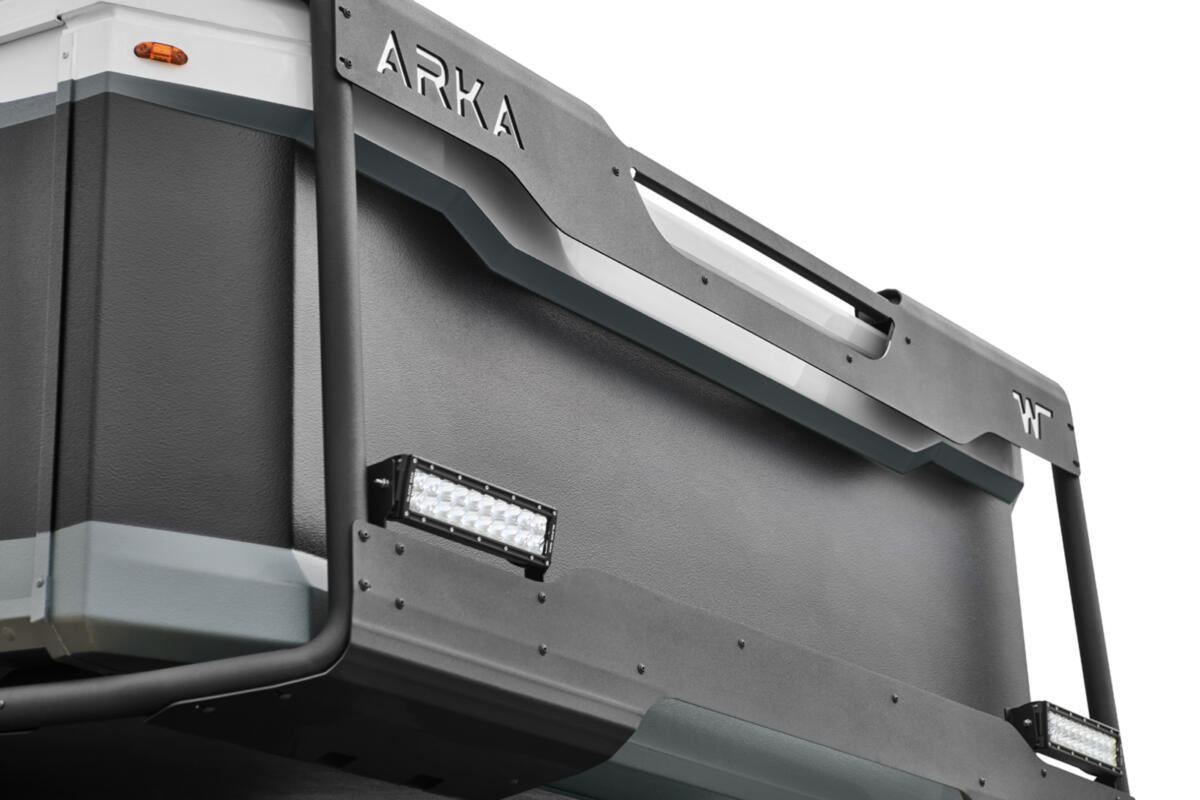
The RV portion of this rig has a metal brush guard around it for added protection. There are some pretty intense lights on the exterior, too.
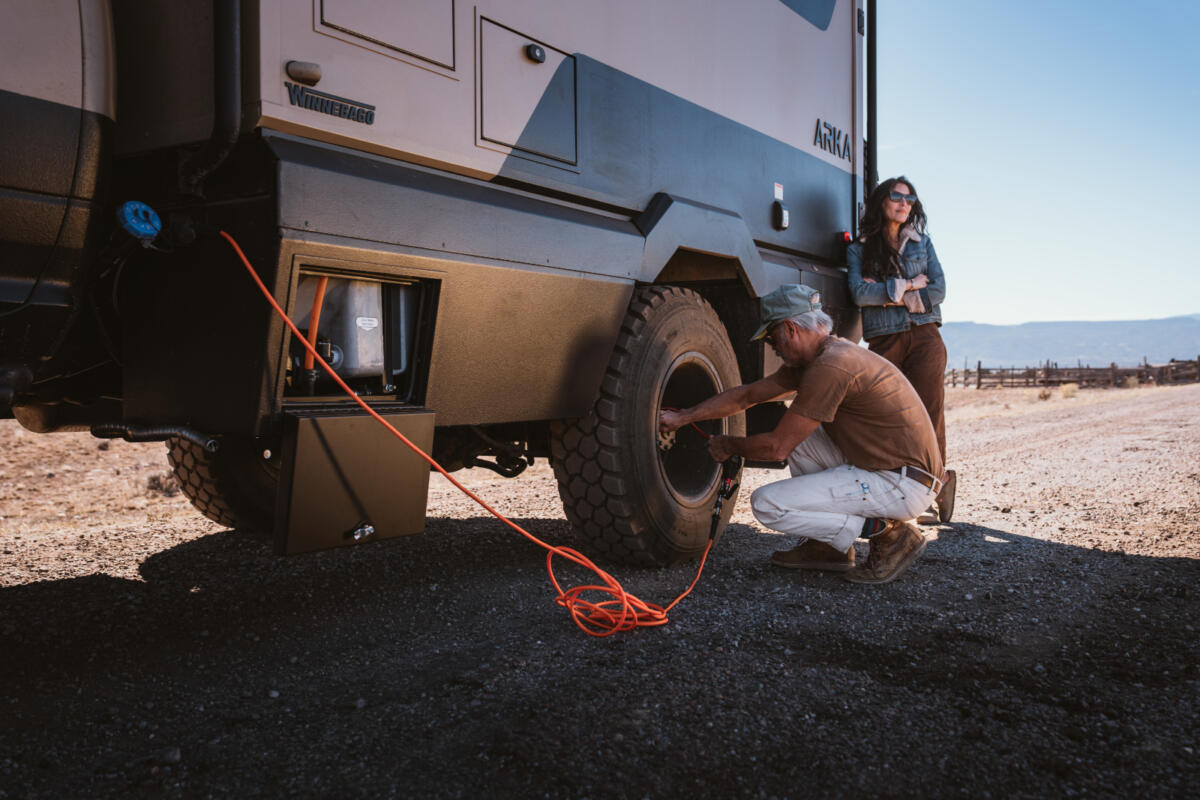
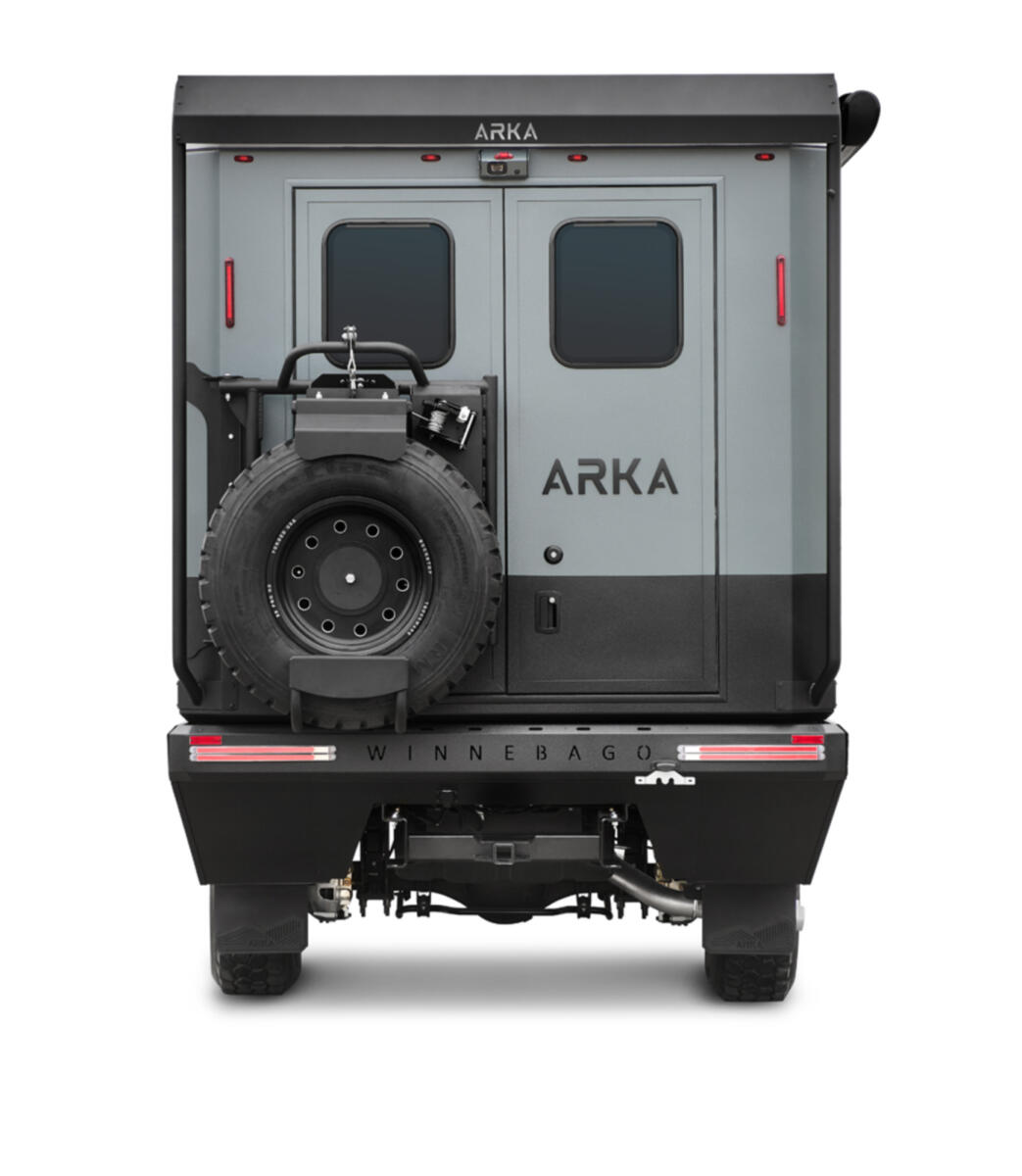
On the lower portion of the rig are aluminum gearboxes. Out back is a full-sized spare tire, and there’s even a winch to lift it onto the carrier—a very nice touch. These big donuts are weighty.
I really like that this uses a SmartPlug® power system. All the exterior cabinet doors are very thick. This is well-suited for colder climates.
In fact, I got to speak with Kenny Phillips, who is a Winnebago Brand Ambassador and the co-host of the Beyond the Wheel podcast, about his experience testing a prototype of this RV back in January.
His impression was that this rig is extremely well-suited to off-road adventures. He and his wife, Sabrina, took a prototype into the snow and found it to be exceptionally capable to the point that he remarked, “You could almost use the ARKA to help recover lesser vehicles.”
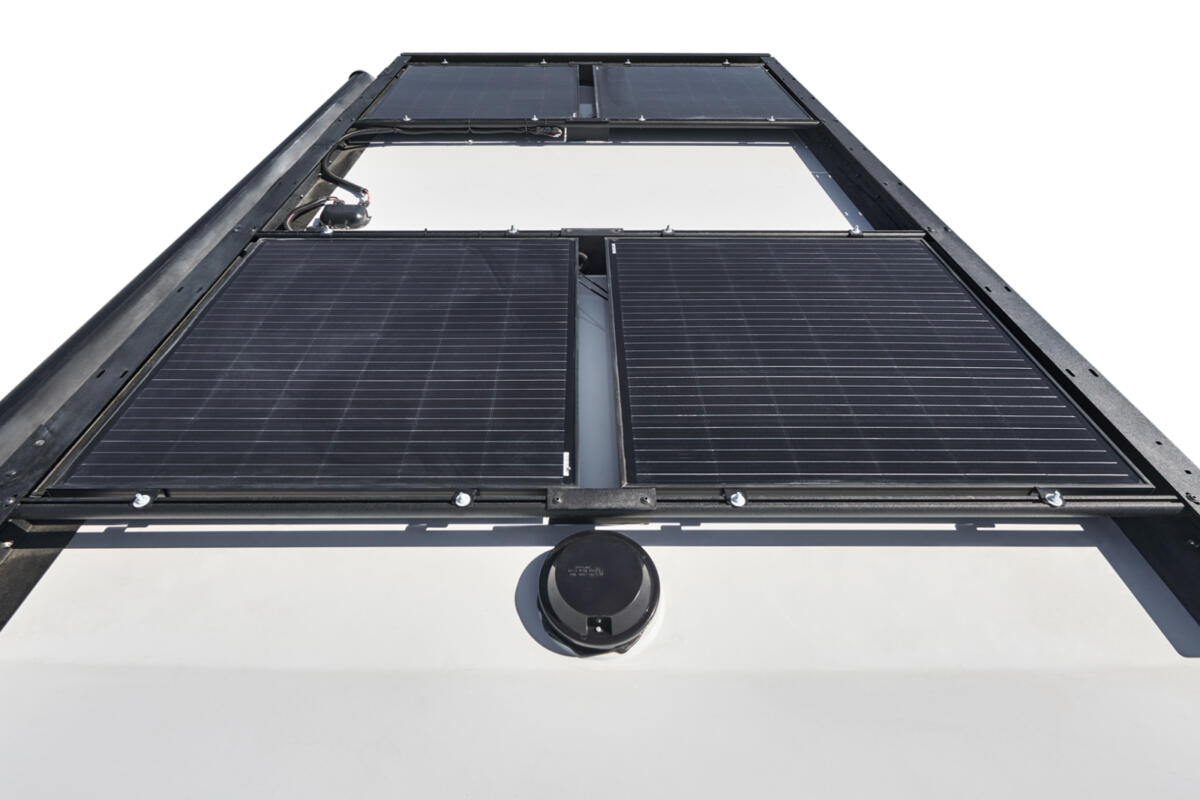
The roof-build on this RV is a vacuum-bonded fiberglass structure with raised sections where there was going to be a hole (such as a vent cap, etc.) so that water is better able to run off.


Living in the Winnebago ARKA
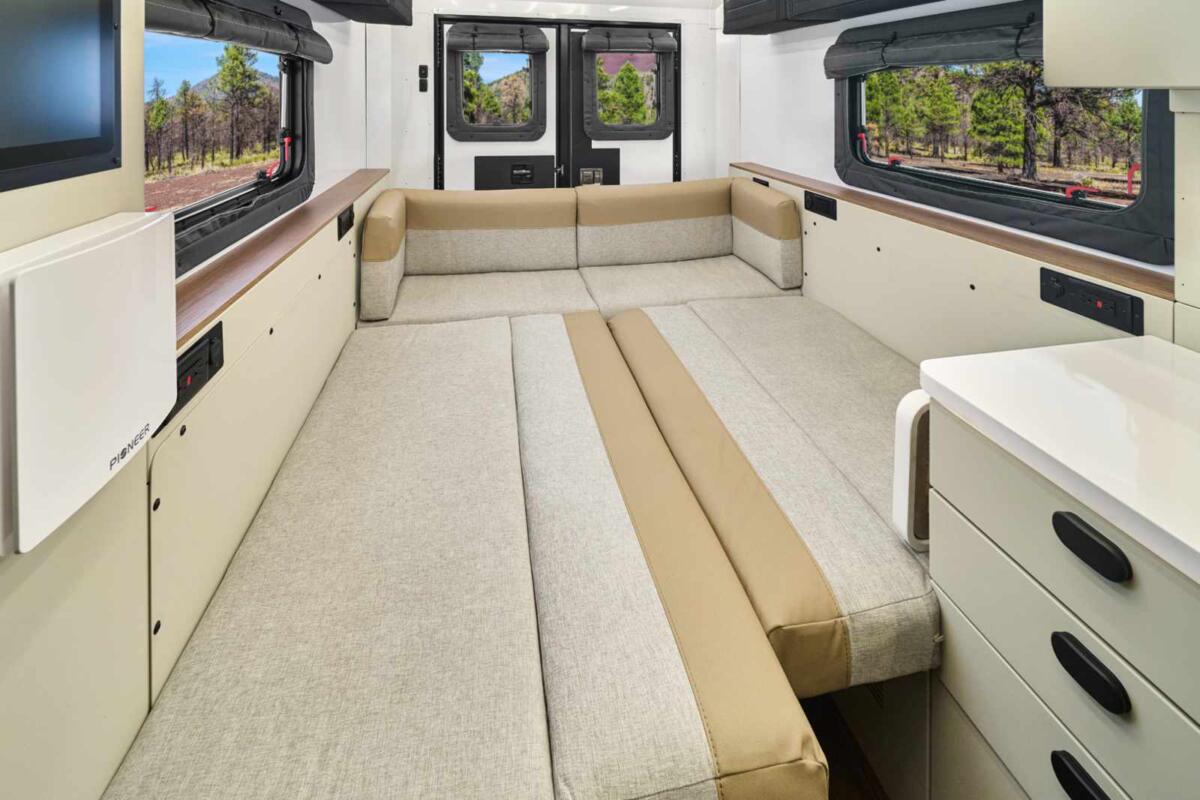
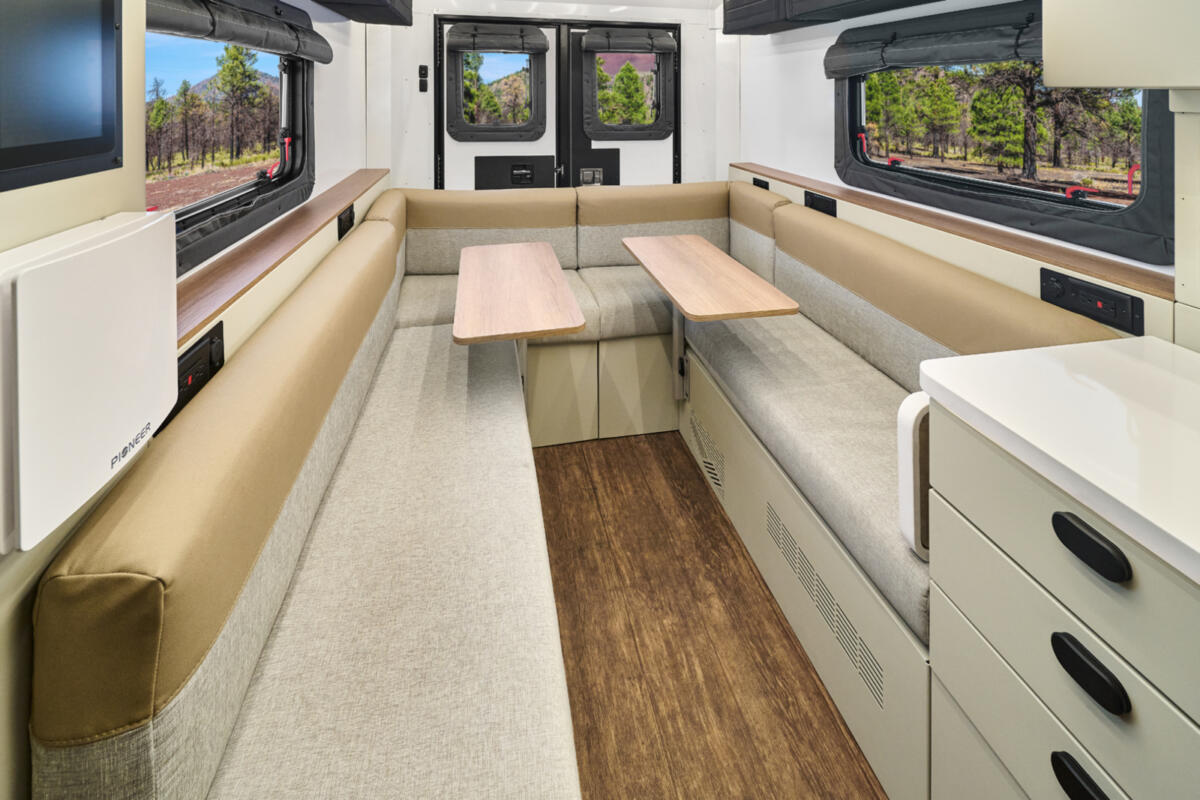
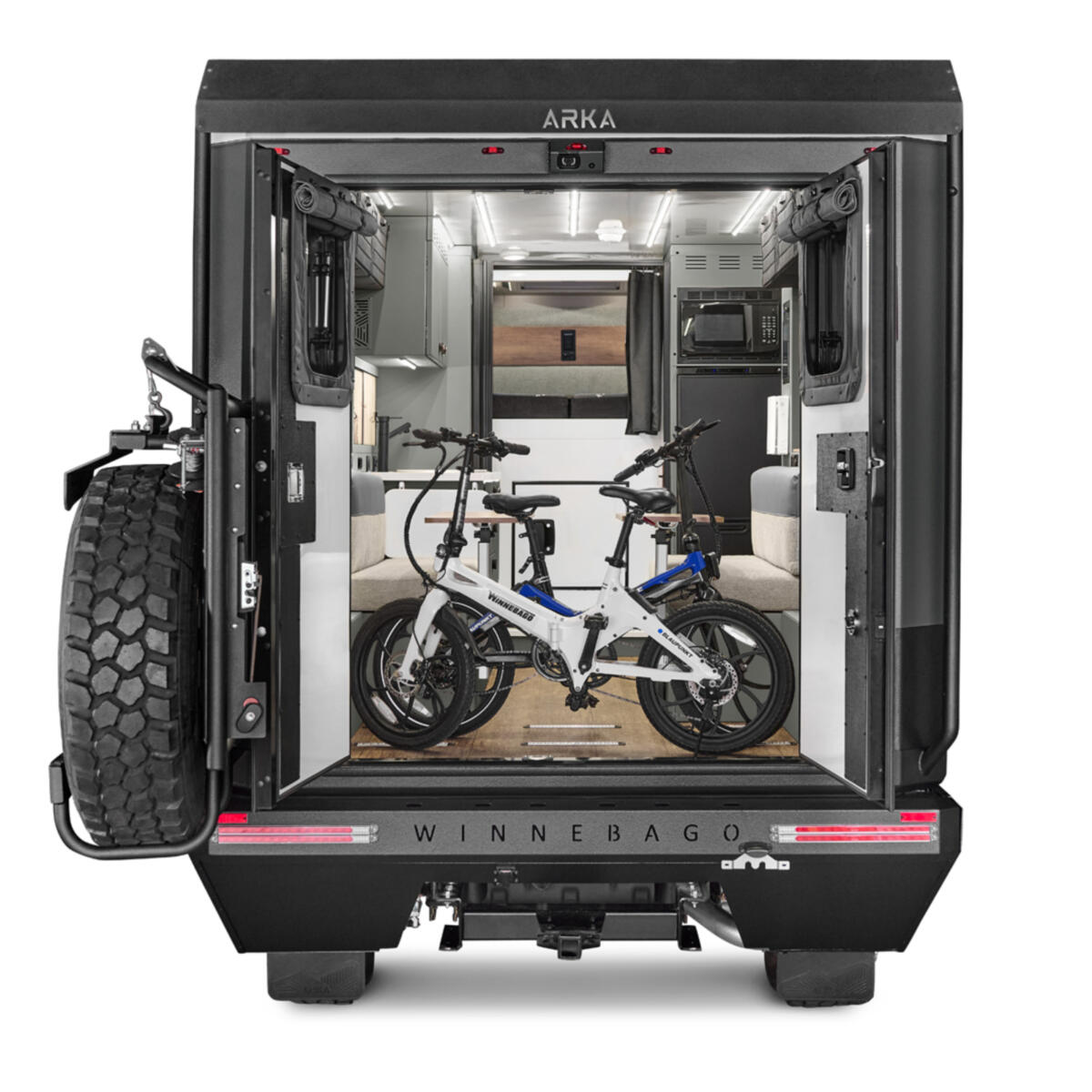
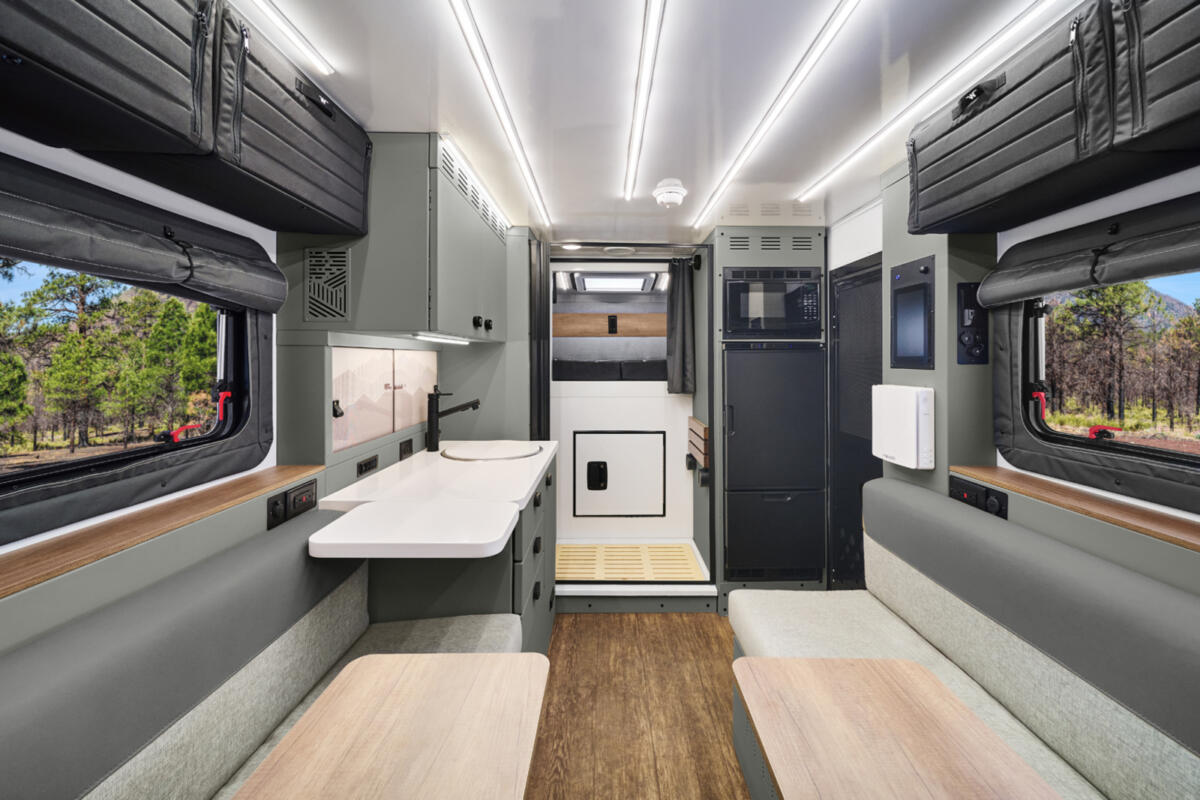
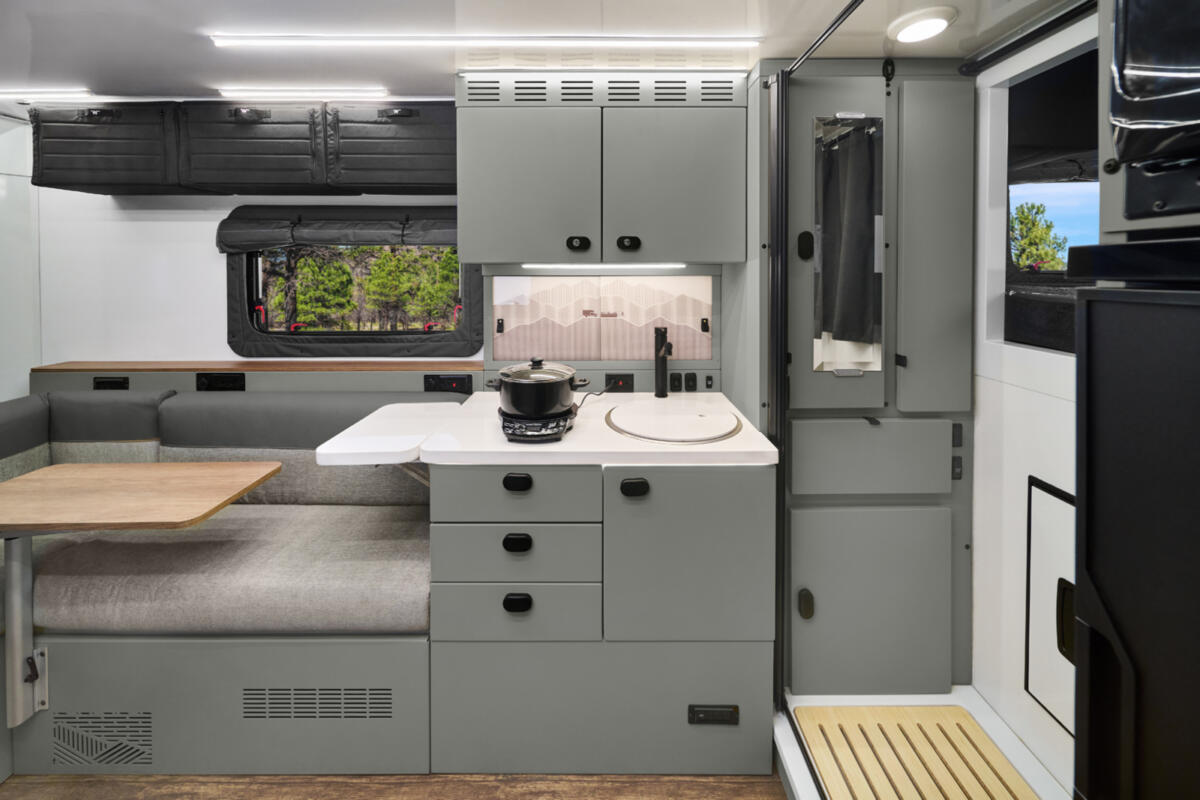
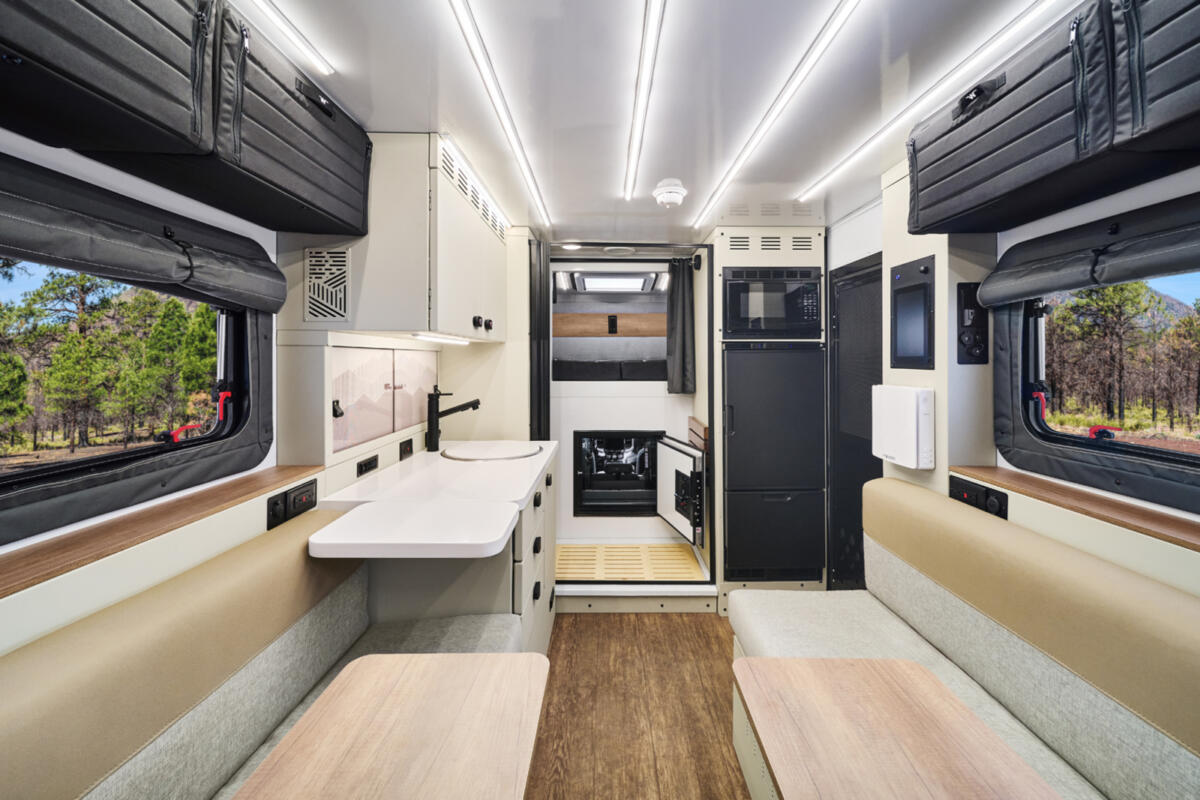
The floor plan of this RV is almost like a large camper van; there are double doors in the back, along with an included ladder to get in, if need be. There’s a reconfigurable rear seating area that can go from U-shaped seating to dual benches and, of course, it can fold down to gain additional sleeping space.
Phillips indicated that, when he was testing the prototype, it was able to swallow his e-bike, tools, and recovery gear and still leave the seating area intact. But you can also configure the space to accommodate a large kayak or the like. There are built-in L-tracks in the floor to tie things down.
The cabinetry is all aluminum with compression latches that won’t pop open during transit. But the aluminum cabinetry is also likely to have no issues withstanding the kind of off-road shenanigans owners will put this through.
I love the fact that the storage above the dinette/seating area is a soft, almost luggage-style container that can be removed if one wants to. The window coverings are roll-up zippered panels, which really help with the ability to withstand weather temperature extremes.
The lounge in the back features two Lagun tables.
Something that sounds terrific is the heated floor in this RV. “I thought this was going to be a gimmick, but it turned out that we really liked this feature,” said Phillips. “The heat it provides was so even and pleasant.”
Unusual bathroom in the Winnebago ARKA
The bathroom in this RV is really different in that it’s set between the cab-over bunk and the main living space. The whole room is a shower when that’s what you want, and there’s a medicine cabinet.
The toilet is a cartridge model, but the unusual thing about the way it’s built is that it can swing into a cabinet. Therefore, even though this is technically a wet bath, it doesn’t feel like a wet bath and really almost performs like a dry bath. It’s well-designed.
There’s also a provision for hanging wet clothes and such in this space. And there’s a waterproof, magnetic curtain between the bedroom and this shower. I also like that there’s a seat in here that doubles as the step up into the bedroom.
Bedroom in the Winnebago ARKA
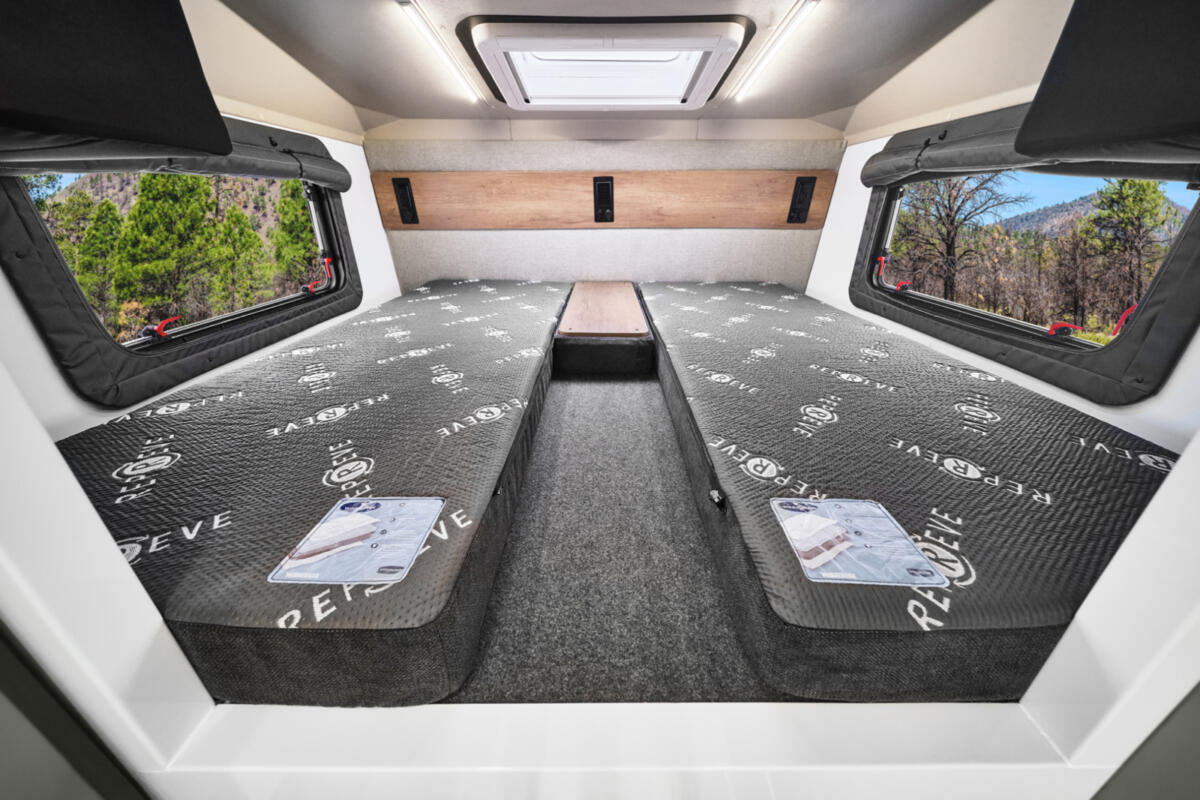
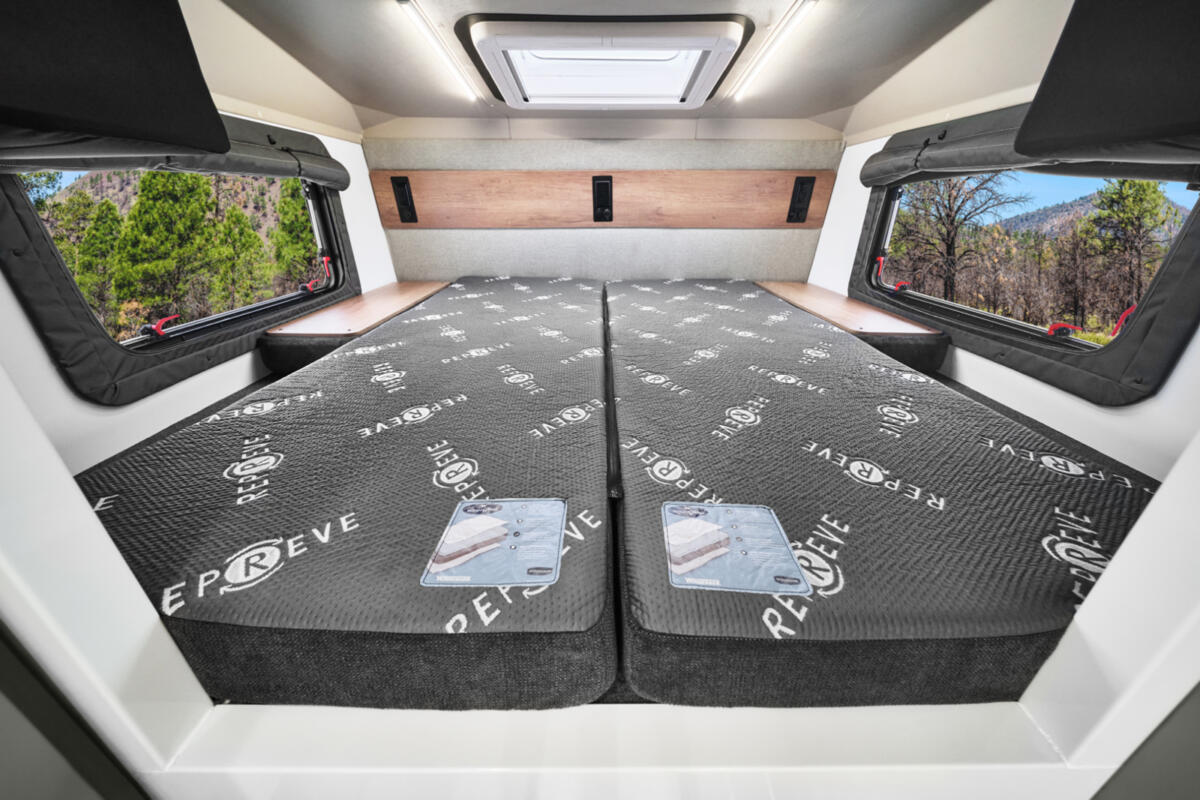
The main sleeping space is over the cab. This, too, has been done very well. There are essentially two mattresses here, so you can configure the space to have two individual beds or push them together and have a single large sleeping space.
There are also reversible nightstands that can be placed on the outside of the bed as nightstands or flipped over and used to add even more sleeping space and make the surface of a king-sized bed.
Interestingly, Kenny Phillips said that the mattresses are made in-house by Winnebago and are very comfortable. “These aren’t the typical RV throwaway mattress, at all.”
There’s also a skylight with a cover, and that skylight can be opened. Again, the window coverings are the thermal material with zippers to be able to control temperatures more easily.
Boondocking and off-grid camping
This is truly meant to be a boondocking rig. It comes with 800 watts of solar, with an additional 400 watts available as an option.
One of the most unusual and useful features built into this RV is a Pioneer® air exchanger that does a number of things. Most importantly, it is a dehumidifier that removes a lot of humidity from the cabin. The process is very efficient and can substitute for using the A/C in some conditions. In addition, it can help the A/C work more efficiently.
While Kenny Phillips was able to use the RV during winter and didn’t take full advantage of this feature, he did say that it seemed to improve air quality even in drier places.
The walls are two-inch-thick insulated walls. The structural aluminum isn’t the full width of the interior space, so that eliminates the heat loss of aluminum studs on the outside surface. If you’ve ever seen laminated RVs in the winter, it’s really easy to spot where the aluminum studs come into contact with the exterior, as aluminum is a terrible insulator.
The standard power system in this RV is a 48-volt system and uses a 165Ah Lithionics battery pack. The system is recharged through the standard 800 watts of solar and can also be charged using the 6500-watt alternator. In other words, there’s no specific generator aboard, nor do you need one with this many ways to recharge the battery.
You can also add a second Lithionics battery and 400 additional watts of solar.
My thoughts on the Winnebago ARKA™
Quite honestly, I think Winnebago totally nailed it with this design. I’ve seen a lot of this type of vehicle, and the compromises are usually pretty evident. It seems that Winnebago has really worked around a lot of those compromises in this RV and created something that is flexible and durable and hits the mark.
Something else they’ve done is provide metal panels behind the interior walls so that you can add things like MOLLE (modular lightweight load-carrying equipment) panels or other things to better configure the RV to your style of adventure.
In speaking with Kenny Phillips, he said that his wife, Sabrina, was particularly happy with the quality of the ride and comfort in the Ram pickup cab, so it would seem that Winnebago has struck a good balance between capability and comfort.
On the subject of capability, this is also designed to tow up to 15,000 pounds, so you’re in Super C territory here.
The air conditioner standard on this RV is the SDG split system A/C that runs on the native 48-volt power. I would imagine this is very similar to the unit used in the Grand Design Lineage Class B RVs, and it’s a great system.
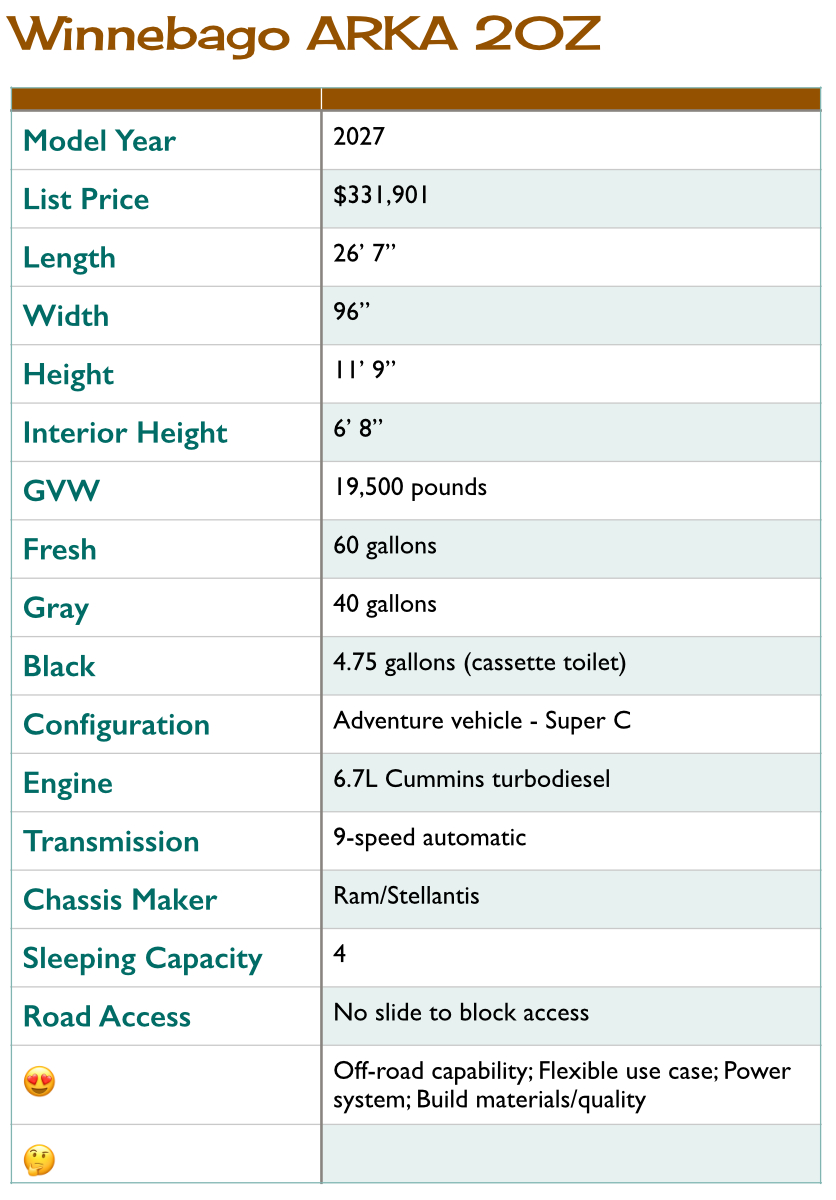
These aren’t going to be cheap. However, compared to similar vehicles, I don’t think the price is out of line. I’ve seen some of these approaching and even exceeding half a million bucks, but the MSRP of this unit is $331,901.
A potential “drawback” of owning an ARKA
One of the biggest problems owners might have is one that Kenny and his wife experienced. “When we would walk out into the parking lot, there was a crowd around this RV, and people would be asking all kinds of questions.
At last year’s RV open house, my wife and I saw the Dynamax Isata 5 Explorer Edition, and we were pretty impressed with that. However, quite honestly, the ARKA would be the rig I would choose just because of the ruggedness as well as the clever ways they’ve done things, including that dehumidifier and the heated floors.
The Winnebago ARKA debuted this weekend at Overland Expo West. If you’re there, seek it out. I think the company has done an exceptional job with it.
An honest look at RVs from RV industry insider Tony Barthel, where you learn the good, the bad, and the intriguing about RVs, including travel trailers, fifth wheels, Class A, Class C, and Class B RVs, as well as some interesting class-breaking RVs. You can find more reviews online at StressLessCamping.com.
P.S. No, you’re not going crazy. Russ and Tiña De Maris wrote about this RV earlier this week. But Tony has a different take.
RELATED
- Truck camper review: 2026 Northern Lite 10-2EX LE—a ‘right-sized’ option
- First look at the 2026 27North TR27 Trekker on Ram 5500
- Review: 2026 Winnebago Navion 24T— on our ‘downsize RV’ list of options
- 2026 Dynamax Isata 3 24FW— A compact Class C that doesn’t skimp on amenities
- 2026 Thor Omni Trail X32: A hit-and-miss Super C
- A smart, spacious Class C: The 2026 Winnebago Sunflyer 26FE
RVT1261

$331K. Nuff said.
Yeah but many comparable rigs are well into the half million dollar range with a few coming closer to a million bucks. This is a relatively good deal.
Interesting that Sabrina thought the Ram 5500 cab was comfortable and the ride quality good. Not a comparable-size truck, but our Ram 2500 diesel crew-cab 4wd with coil springs was, by far, the most comfortable and easiest-to-drive of the seven trucks I have owned over the past 50 years. And, living in Colorado, the diesel exhaust brake was the greatest safety feature ever for a truck repeatedly towing a fifth wheel over the Rockies. If I were in the market for a new truck, it would definitely be a Ram diesel.
Please tell me how this makes sense. You have a vehicle designed for extended use off-road. It comes equipped with a 60-gallon fresh water tank, a 40-gallon gray water tank, and a 4.75-gallon cassette toilet???
Are you supposed to carry an additional 3-5 cassettes? Where do you put them, especially when they’re full? The “clever” disappearing toilet seems more like a major design flaw, or an afterthought.