

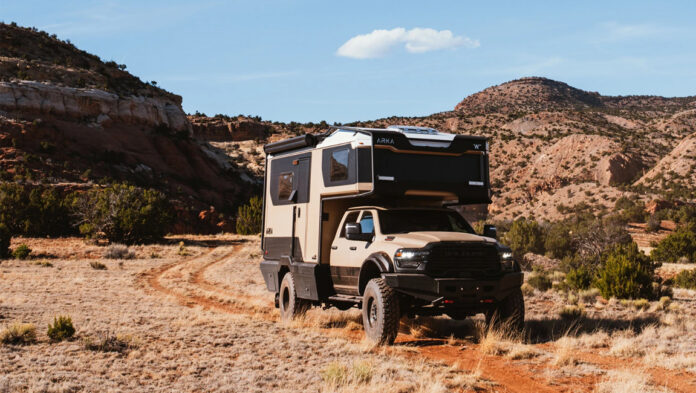
Winnebago Industries has unveiled the new ARKA adventure truck, and, at first glance, it looks less like a traditional RV and more like something designed for an expedition across Alaska or deep into the Mojave Desert.
The rugged-looking rig comes loaded with off-grid and off-road hardware. Winnebago says the ARKA can support up to two weeks away from hookups, with features including a large lithium battery system, hydronic heating, insulated tanks, aggressive tires, substantial ground clearance, and heavy-duty suspension components. The company is clearly leaning hard into the booming “overland” lifestyle image that has become increasingly popular across the RV and truck world.
But beyond the dramatic photos and marketing language, the new Winnebago ARKA overland RV also raises a practical question many experienced RVers may quietly ask: How many owners will actually use a rig like this anywhere close to its advertised limits?
That’s not necessarily criticism. It’s simply the reality of many adventure-focused RVers.
The overland fantasy versus RV reality
Scroll through social media, and overlanding can look like a nonstop series of dramatic mountain overlooks, remote deserts, river crossings, and isolated campsites accessible only by heavily modified vehicles.
In reality, many expensive off-road-capable RVs spend most of their lives on pavement, in established campgrounds, or on relatively tame forest roads that many ordinary pickups or SUVs could already handle.
That disconnect is not unique to Winnebago. It exists throughout the outdoor recreation industry. Lifted Jeeps often never leave suburban streets. Side-by-sides frequently stay on groomed trails. Heavy-duty diesel pickups capable of towing massive loads may never pull more than a utility trailer.
The ARKA simply takes that same dynamic into the luxury overland RV space.
And there’s a reason manufacturers keep building these rigs. Buyers are not always purchasing only capability. Often, they’re buying the feeling of capability.
“For many buyers, the dream of remote freedom may matter just as much or more as the destination itself.”
The idea of freedom matters
For many RVers, the appeal is not necessarily climbing boulder-strewn trails or navigating deep backcountry terrain.
Instead, it’s the comfort of knowing they could.
That sense of independence has become a powerful marketing tool in recent years, especially after the pandemic-era RV boom pushed many travelers toward remote camping and self-contained travel.
The ARKA appears designed around that mindset. Winnebago highlights extended off-grid capability, cold-weather protection, rugged construction, and the ability to reach remote destinations while carrying substantial gear and supplies.
To some buyers, that combination may feel reassuring even if the rig rarely leaves improved roads.
And, honestly, many RVers already understand this concept. Plenty of four-wheel-drive trucks spend most of their lives towing on highways, yet owners still value the security of extra traction during storms, muddy campsites, or rough secondary roads.
Complexity can become part of the story
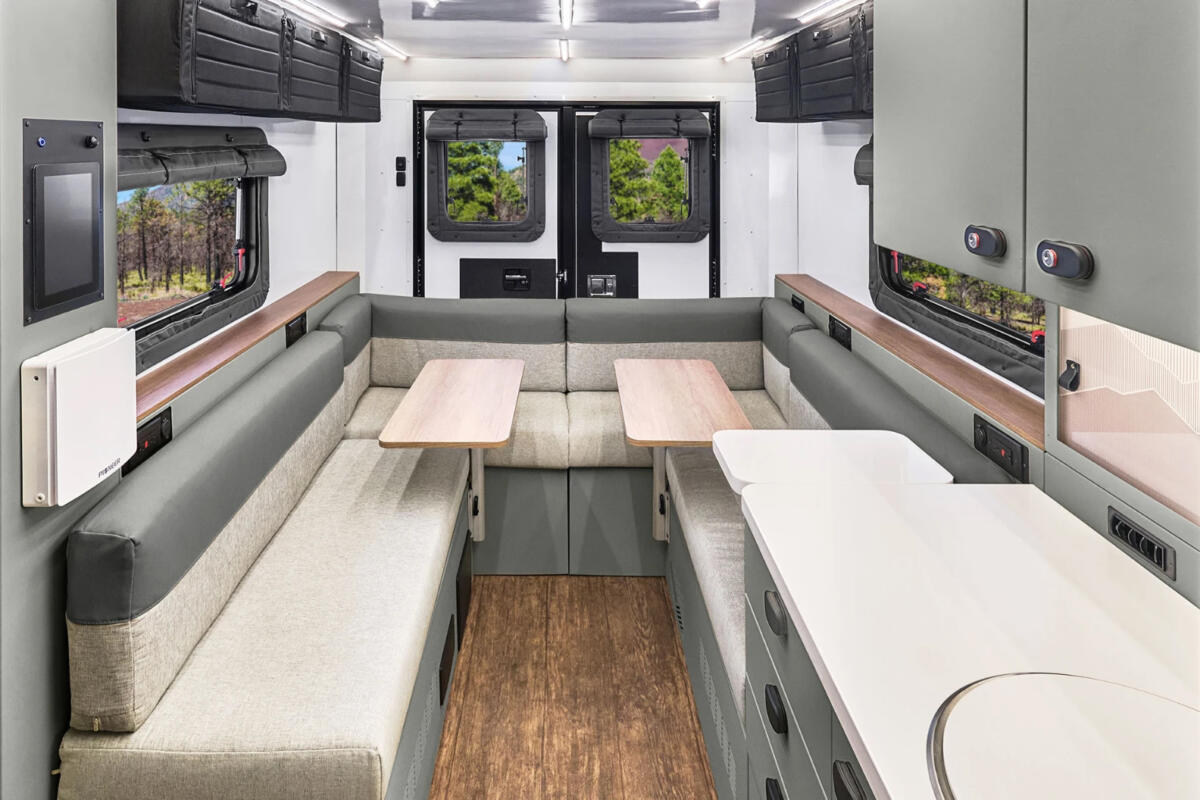
At the same time, rigs like the ARKA also introduce a level of complexity that can make some traditional RV owners uneasy.
The more advanced these overland RVs become, the more they rely on sophisticated electronics, large battery systems, specialized climate controls, integrated power management, and proprietary components.
That creates an interesting contradiction. Vehicles marketed for remote wilderness travel may also become highly dependent on systems that can be difficult or expensive to repair if something fails far from a service center.
Experienced RVers often understand this tradeoff well. Simpler systems are sometimes easier to troubleshoot in remote areas. More capability can also mean more maintenance, more weight, and potentially higher repair costs.
That doesn’t mean the ARKA is flawed. It simply means buyers may need to think carefully about how they truly plan to travel.
Not every campground is built for this
There’s also the practical reality of where a large expedition-style RV actually fits.
Many public campgrounds were not designed with oversized overland rigs in mind. Tight loops, low branches, narrow access roads, and older campsite layouts can quickly become stressful in larger specialty vehicles.
And while overlanding imagery often focuses on remote public land camping, access to dispersed camping areas has become more complicated in some regions due to crowding, seasonal closures, fire restrictions, and land-management concerns.
Ironically, the market for extreme off-road RVs is growing at the same time access to some remote public lands is becoming more limited.
The ARKA may say as much about the RV industry as it does about buyers
The bigger picture here may be what rigs like the ARKA reveal about the direction of the RV industry itself.
As traditional RV sales have cooled from pandemic highs, manufacturers increasingly appear to be chasing niche buyers willing to spend heavily on premium adventure-focused products.
That has led to a wave of ruggedized Class B vans, luxury Super C motorhomes, off-grid power systems, overland trailers, and high-end “expedition” builds.
The Winnebago ARKA overland RV fits squarely into that trend.
Whether most owners ever take one deep into the wilderness may almost be beside the point. For many buyers, the dream of remote freedom may matter just or more as much as the destination itself.
Sources:
Winnebago ARKA official page
RVBusiness coverage of the ARKA launch
RELATED
- Truck camper review: 2026 Northern Lite 10-2EX LE—a ‘right-sized’ option
- First look at the 2026 27North TR27 Trekker on Ram 5500
- Kingstar KRUZR truck campers: Where luxury meets utility
- The new 2026 nüCamp Cirrus 920—not your grandpa’s truck camper
- Tour two of the best truck campers: The 2025 and 2026 Bigfoot 10.4
- RV tech shares the pros and cons of truck campers
RVDT2902


I can’t find anything that says what kind of vehicle it is. I have my second ford F150 hybrid with nothing but recalls and problems and it’s not even a year old. My friend had a Ram HD with nothing but problems and had to get rid of it by the time it was a year old. Maybe we need a survey of people with new vehicles for their RV who have problems. Had a GMC with the only problem was the radio not playing music and a aftermarket brake controller installed by dealer. Radio on my F150 was the same stop playing sporadically.
There is a survey of new vehicles and their reliability issues in Consumer Reports and has been for decades.
Tell me you know nothing about going offroad or overlanding in one long, opinionated article! Yes, it’s not possible to drive from trail to trail without using paved roads, but that’s not the point of overlanding. The ability to leave the park princesses behind and get out into the wilderness is what sepparates the park princesses from the offroad/offgrid overland RVs. They can have their park pads, we’re going where they will never go!
This might be my favorite comment on this site – ‘park princesses’ is a bit harsh, but this is not “Expedition Portal” or one of those sites geared towards overlanding. This is RVtravel and skews heavily towards older travelers with larger more comfortable vehicles. One author on this site, sadly defined overloading as ‘camping without hook-ups’. That said, the great thing about exploring the outdoors is that you can do it in so many ways to accommodate different needs and abilities.
Many back-country RVers could go essentially the same places as the ARKA with a 10-year old, single rear wheel, Ram 3500 diesel, a used Lance 850 truck camper, a roof covered with inexpensive solar panels, a couple a LiFePO4 batteries, and a Honda 3kw generator. They could be just as comfortable, stay remote just as long, and enjoy the wilderness just as much and do it for 1/10 the cost!
I look at “overland” rigs like that and wonder how they’ll keep the eggs from breaking, milk from churning and canned goods in the cupboards. Lithiums and tanks don’t really like being bounced often so that has me a little curious as well. If it’s constructed with the default self-tapping Robertson screw that RV assemblers twist in until stripping starts, I wonder how long before stuff bolted to those lightweight luan walls will wind up on the floor. It looks cool for gravel roads but I’m really skeptical for Jeep trails.