

By Mark Polk, RV Education 101
I talk about the importance of checking inflation pressure in tow vehicle and RV tires all the time, but is your tire pressure gauge giving you accurate information?
When I was in charge of some large fleet maintenance operations, one of my responsibilities was the tool calibration program. Certain tools required regular calibration to ensure accuracy. A tool every RV owner uses is a tire pressure gauge. But did you know a tire gauge can lose accuracy if it gets banged around in your toolbox?
I’m getting ahead of myself. Let’s start at the beginning…

I always say you get what you pay for. Lots of inexpensive tire gauges at the auto parts store cannot be calibrated, and if the reading is inaccurate the gauge is worthless. This gauge is the tool you use to check tire inflation before leaving on a cross-country RV trip. This is why you should spend a little more money and get a quality inflation pressure gauge.
Now the question is, can you calibrate your tire pressure gauge? To do it professionally, you need some type of standard air pressure reference to measure it against. We all know that is not going to happen, so there are a couple of things you can do to check the tire pressure gauge for accuracy.
How to check the tire pressure gauge for accuracy
• You can check the air pressure in a tire with the gauge in question and then check the same tire with another quality tire pressure gauge. When there is a significant difference in the readings (3 or more psi) between the two gauges, one or both gauges might be inaccurate. If both gauges read within 1 to 2 psi of each other, they are fairly accurate.
• If you want a more precise method for checking the accuracy, you can purchase a master test gauge or take your gauge to a local tire dealer or fleet truck maintenance facility and ask them to check it using a master test gauge. A master gauge is certified as calibrated and accurate. But I caution you, there are lots of tire dealers who don’t have their own master test gauges checked or calibrated on a regular basis.
Tip: Don’t depend on gas station pressure gauges to be accurate. Gas station gauges are abused and neglected, raising concern over accuracy.
 Types of tire pressure gauges

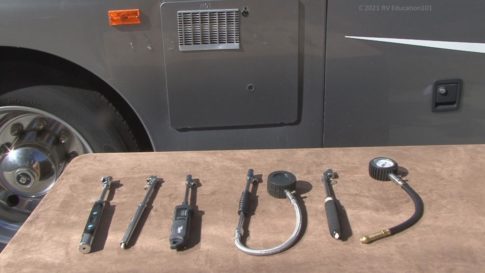
There are several different types of pressure gauges available on the market. When you buy a gauge, always look at how much pressure it is rated for. Most automobile tires are inflated from 32 to 35 psi, so a 0 to 60 psi gauge is sufficient, but motorhome tires can be 100 psi or more. It is important for accuracy and to prevent damage to the gauge that you get the right gauge for the job. A general rule is, find a gauge that reads double the inflation pressure. If this is not possible, try to find a gauge rated for higher pressure, like 160 psi.
The most common type of pressure gauge is the plunge or pencil-type gauge. As a general rule, a common plunge-type gauge you purchase will be accurate to + or – 3 percent when it is new.

Like everything else these days, tire pressure gauges are going from analog to digital. Analog tire pressure gauges were the standard for many years, and some people you talk to swear by analog gauges. But advancements in digital technology have improved on that standard. Analog dial gauges are about as accurate as quality pencil-type gauges. In numerous tests comparing analog to digital, the digital gauges were more accurate.
Regardless of the type of gauge you choose, there are high-quality and low-quality gauges available. Buying a cheap digital gauge would be the same as buying a cheap pencil-type gauge.
Here are a few things to keep in mind when it comes to tire pressure gauges
1) Spend a few more dollars and get a quality tire pressure gauge.
2) If a gauge is used to check dual tires on a motorhome, the chuck end of the gauge should have a dual foot design to make the job easier.
3) Always select a gauge rated higher than the inflation pressure of the tires you are checking. Caution: Do not apply more pressure than the gauge is rated for – it can damage the gauge and affect accuracy. If you over-pressure a gauge, have it tested for accuracy.
4) Try not to drop or jar the gauge. Store the gauge in some type of protective covering or case in an area where it won’t get hit or damaged.
5) Periodically test the gauge for accuracy. At a minimum, compare it to another quality gauge to see if both read the same or close to the same pressure.
6) After you purchase a quality pressure gauge, use it on a regular basis to check your tires.
Properly inflated tires are safer, extend the life of the tires, improve fuel efficiency and lessen the chance of unexpected and premature tire failure.
RELATED
- What is a good tire pressure monitoring system?
- Should you adjust tire pressure when temps get colder?
- RV Tire Safety: Is the tire pressure too high?
- Learn the basics of setting tire pressure and testing TPMS
RVDT2776
Digital???
I have never seen an air pressure gauge which could be calibrated. Would you list a brand or two for consideration.
Tire Pressure Gauges…sure would like to see a list of professional certified gauges and sources to buy from…thanks
I have three digital gauges. One small one I carry in the truck and two in the garage. One of these has the valve that allows me to fill the tires. All three are within 2psi.
When looking for a gauge, get one that has a deep connector that fits over the schrader valve, not just presses against it.
I have the typical long truck chrome tire gauge, a digital batt. powered gauge and 12v TPMS. I have checked them each against each other and they are each within 2 psi. I feel comfortable using any one of them or any combination if in doubt. The digital gauge hangs on the wall by the entry door of my Class A. The long truck gauge is located & mounted on broom holder clips on the floor behind the lounge chair at the entry door. Both handy and in full view for use. The TPMS is on the windshield center post.