

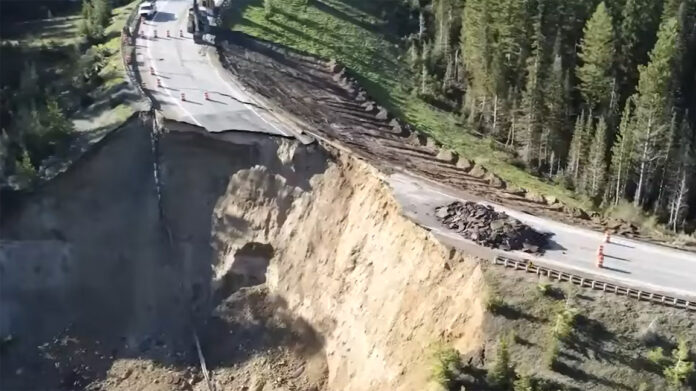
Last week’s catastrophic failure of a portion of Teton Pass (Wyoming Highway 22) has created a related catastrophe. The route is the main road into Jackson, Wyoming, and tourist dollars figure heavily into the need for reopening that route.
The State of Wyoming is handing over nearly a half-million dollars to a construction company to install a bypass quickly. However, some RVs might not be able to use the Teton Pass detour.
“Big Fill” landslide
Road damage at mile marker 12.8 has been dubbed the “Big Fill” landslide. And big it is! Images show tons of rock that supported the highway have just sloughed away. On Tuesday, the State approved a $430,000 emergency contract to “construct a temporary detour” around the Big Fill. While it will get traffic, tourists, and money flowing again, there are a couple of snags.

They call the proposed detour around the landslide a “shoo-fly,” to be built closer to the hill near the slide. Shoo-fly? It’s an old railroad term. If there were an accident or other problem blocking the tracks, a temporary shoo-fly would be built to route the tracks around the site. You may think “pie!” But this shoo-fly won’t be a piece of cake (or pie) for all RVers.
In a report published in local media, a state transportation official said of the shoo-fly: “The detour will have 10-foot or 11-foot lanes, no trucks with trailers should be allowed, [and] the maximum vehicle weight should be no more than 60,000 pounds.” So much for big truck traffic.
But here’s the RV snag: “And the sharp turn could cause a vehicle with a camper to hang up.” While no official restrictions have been published, it could easily be that “campers” such as fifth wheels and travel trailers could be turned away from the detour. We’ll keep you posted as information becomes available.
Four-inch drop in the pavement – a warning sign?
More details have come in on just how the mess on Teton Pass played out. And it does give rise to serious concerns. On Thursday morning, June 6, law enforcement was called to a motorcycle accident near mile marker 12.8. The cyclist was not badly injured, and while tending his needs, officers noticed a four-inch crack in the pavement. Perhaps that should have signaled a major issue was at hand, but the highway department response was to fill the crack and move on.
As we wrote earlier, the next day, Friday, not far down the highway, a mudslide slammed the highway at mile marker 15. It took all day to clear the muck, and engineers said spring run-off had saturated the earth, leading to the mudslide. Back at mile marker 12.8, engineers noticed that the pavement at the big crack had dropped four more inches.
Somewhere between three and four the next morning, the “Big Fill” landslide took out a huge section of the highway. Perhaps it was a good thing it happened when it did – limited traffic meant nobody was killed in the incident.
Some RVs might not be able to use the Teton Pass detour – which could be a good thing
Would finding a four-inch crack in the highway pavement make you wonder what was going on with the supporting ground? How about a four-inch drop in the pavement at the same spot, a day later?
Local politicians have their own concerns. On learning that the highway department intends to build the shoo-fly detour right at mile marker 12.8, the site of the original landslide, one of the state’s own highway commissioners asked, “Why put it there? It looks like it will happen again.” Another commissioner had similar fears and wanted the whole rebuilding process looked at more closely.
Reservations or not, the Highway Commission went ahead and awarded the contract. They claim the shoo-fly bypass will be “safe” and quick. One hopes that will prove true, and that no new “Big Fill” incidents will happen at the new Teton Pass bypass. While some RVs might not be able to use the Teton Pass detour, for those faint of heart, being blocked off might not be such a bad thing.
##RVT1161b

Maybe a one lane shoofly with traffic lights would work better?, letting larger rvs to use the total lane
WY 220 is not “the main road into Jackson”. Due to its steep grades, RVers have been warned about using it for years. The primary access roads into Jackson Hole and the town of Jackson are all US highways–US 26, US 191, US 89, and US 189.
Thank you, Russ and Tina! 🙂 Yes, a 4-inch vertical displacement is pretty significant, noteworthy even! 🤔😯 Thank you for the report and safe travels! 🙂
I would hope some engineering goes into the bypass
A lot of steel piling driven deep which i don’t see any evidence of now
the old saying
you can buy good and you can buy cheap but you can’t buy good AND cheap
Sounds like shades of the famous Devil’s Slide just outside San Francisco. After many slides and road closures, they finally closed it down to vehicular traffic for good and it is now a hiking, biking, and horse trail with parking lots on both ends. Wyoming, take note.
Well, that is not a bad thing that “some RVs might not be able to use the detour.” They have no business going over it in the first place. Check the Mountain West directory. We have been across that pass numerous times, minus RV, only in the pickup. Seen too many macho people halfway or at the bottom with overheated or burnt up brakes. Several years ago, we had to stop because only one lane was open as firefighters were putting the final ointment on a skeleton of what had been a Prevost.
We’ve crossed that pass—by car. Our AllStays app warns RVers to avoid it. What’s terrifying is that the road was open at all after the recent events. It’s a reminder to do your own due diligence when traveling. Last April, we were in a car on a mountain road in S California. It was raining, the ground saturated, and we saw mini-slides happening on banks we were passing. We turned around. Later, there was a slide on that road.
Leaving Jackson last Thursday we had to take US 89/26 westbound to get to Idaho Falls. The traffic going into Jackson eastbound was virtually bumper to bumper that morning.