

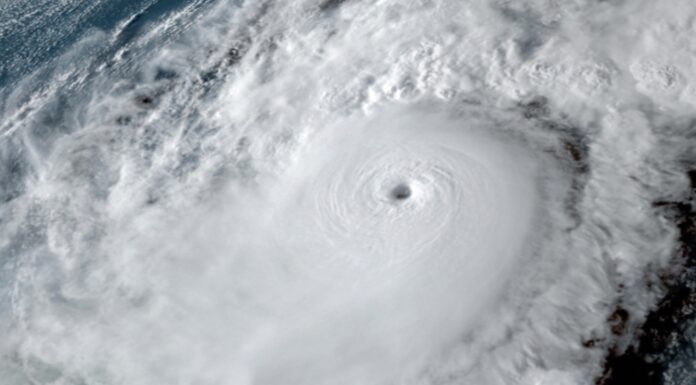
Colorado State University (CSU) researchers predict an above-average Atlantic hurricane season in 2025, driven by unusually warm sea surface temperatures in the subtropical Atlantic and Caribbean. These warmer waters weaken the subtropical high and trade winds, which leads to continued heat buildup and favorable hurricane conditions, including lower pressure and a more unstable atmosphere.
The team forecasts 17 named storms, nine hurricanes, and four major hurricanes (Category 3 or higher) from June 1 to Nov. 30. Their predictions use a statistical model and several global models based on 25–40 years of climate data.
Weak La Niña conditions in the Pacific are expected to shift to ENSO-neutral. [From climate.gov: El Niño and La Niña, the natural climate pattern collectively known as ENSO, the El Niño/Southern Oscillation.] The probability of El Niño, which suppresses Atlantic hurricanes by increasing wind shear, is just 13%, suggesting supportive conditions for storm development.
Hurricane activity is expected to be about 125% of the 1991–2020 average, slightly less than 2024’s 130%. Last year’s Hurricanes Helene and Milton caused more than 250 deaths and $120 billion in damage.
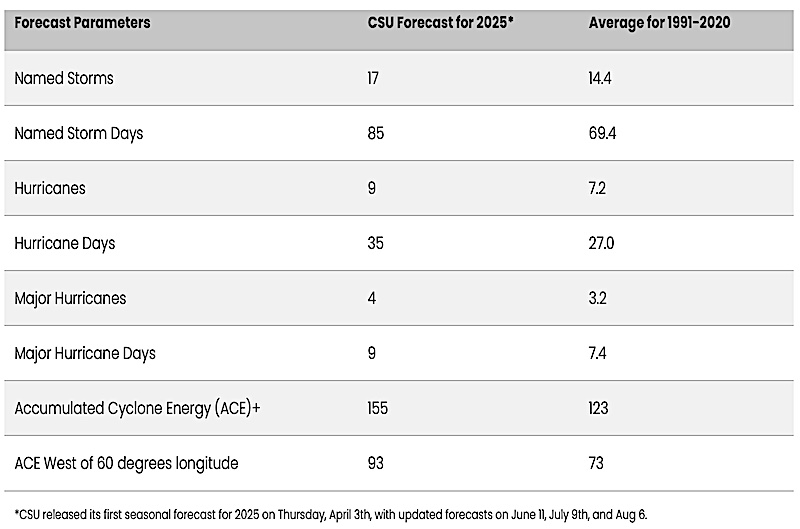
The forecast also uses a newer metric, Accumulated Cyclone Energy (ACE) west of 60°W, which correlates more closely with landfalling storms. ACE is projected to be high in 2025 due to the likely absence of El Niño.
This marks CSU’s 42nd annual forecast, started by the late Professor Bill Gray. The 2025 outlook was developed by Phil Klotzbach, Michael Bell, and Levi Silvers. Updates will be released June 11, July 9, and August 6.
Major Hurricane Landfall Probabilities for 2025:
U.S. coastline: 51% (average 43%)
U.S. East Coast: 26% (average 21%)
Gulf Coast: 33% (average 27%)
Caribbean: 56% (average 47%)
The forecast includes detailed storm probabilities for coastal regions in the U.S., Mexico, Canada, and the Caribbean. CSU emphasizes the need for preparedness: “It only takes one storm near you to make this an active season,” said Michael Bell.
RELATED
- The best weather apps for RVers
- When hurricanes hit the headlines, your RV hits the road (previous post but still relevant RVing info)
- RV Electricity – Just Ask Mike (J.A.M.): Be prepared for hurricanes (ditto)
RVT1209b


If this is as good as their regular predictions and forecasts, I wouldn’t put much credence in it.
Weatherman can’t predict the weather the next day. Yet for the season.
Thank you for the news, RV Travel! I find it mildly interesting that a school located in Fort Collins, Colorado has a formal group that studies hurricane spawning conditions. Perhaps it being a land-grant school is part of the reason. Have a great week and safe travels!
Same prediction as every year…… and every year those pot smoking Coloradans get it wrong but continue the unrelenting catastrophization from weather because it is good for business regardless the facts and that the science of man-caused climate change having been exposed as a hoax.