

By Chris Dougherty
Chris Dougherty is a certified RV technician. Here is an article he wrote while he was serving as RVtravel.com’s technical editor.
RVing in winter has its challenges as well as rewards. One major challenge is trying to keep liquids liquid, whether that be fresh water or waste.
Having been a full-timer in the Northeast for ten years, I became an expert at making RVs handle the frigid winters. I went through many sewer hoses, breaking them all. I wish I had this one from Camco back then.
Most RV sewer hoses are designed for warm-weather use only. Once the temperature falls below freezing, the plastics crack, and the hose is done.
In addition, most hoses use spring steel to form the ridges, which may work fine under occasional warm weather use, but once the use becomes more constant or extreme, the hoses will experience failure.
RhinoEXTREME to the rescue
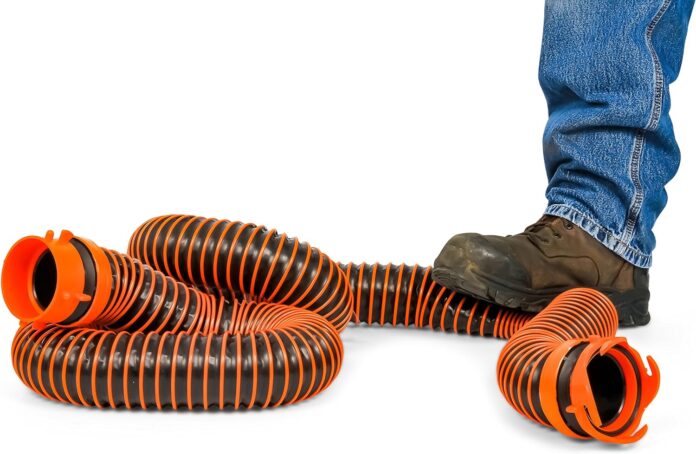
Camco has designed a hose, the RhinoEXTREME, that will survive to -44 degrees F, and won’t crush, rust, or crack. The hose is also abrasion-resistant and can even be driven over and return to its original shape. It can do this because of its triple-TPE vinyl layering and its polyolefin wire core, which won’t dent or rust, always returning to its original shape.
The hose kit comes complete with a 15-foot-long hose with pre-attached Rhino swivel connectors with four bayonet tabs instead of the usual two for more sound connections, a translucent elbow, reusable locking rings, storage caps and a universal campground sewer adapter.
At the time of this writing, the set retails for about $100 on Amazon. In addition, a 10-foot extension is available for just under $50.
It is important to note that no sewer hose, or rigid pipe for that matter, will prevent freezing and freeze-related damage.
Use this hose only while dumping—black water followed by grey water for a rinse out—and make sure no liquid remains in the hose when you’re done.
Have you used this hose during the winter? Do you have another product you’re using for wintertime RVing that other RVers should know about? Please let us know by leaving a comment.
RELATED
- How to easily pull an RV sewer hose out of bumper storage
- How to prevent sewer hose bumper plugs from falling off
- No mess, no hassle RV sewer hose storage tips
- The amazing disappearing sewer hose. Don’t let it happen to you!
- Evaluating RV sewer hoses and putting the best one to the test
RVT1234
While our stationary trailer now has a PVC hard line (routed under the trailer to reduce sun exposure), we previously used Rhino Extreme slinky and our very mobile little trailer still uses a Rhino Extreme slinky. They have outlasted standard slinkies by 4X so far.
The hardest part of using any flexible hose in freeze conditions is to make sure the hose drains completely after every use. No dips and certainly no ‘P’ traps! Waste frozen inside a hose can take days to thaw, and you cannot use the hose until it does thaw. Don’t ask how I know this.
I have found a heated sleeve/cover for the sewer hose. The hose sits in it and it wraps up with velcro closures and plugs in. Doesn’t take long to set it up. Found it on Amazon and it comes in 10′, 15′ or 20′ length. Works great. (Heated 15FT 20FT RV Heated Sewer Hose Cover Avoid Freezing at -20°F ) There are a couple different makers.
With all the bad things on Camping World I am the exception. I have not had a bad experience with the one located in Wichita, Ks. We bought our RV there (class c), and have had service completed there. I am not a push over person and have actually taken pics to ensure the work. So far so good, thankfully.