


After five straight days of declines earlier this week, the national average price of a gallon of gasoline was once again on its way back up as of Thursday, a couple cents lower than last week. With crude oil prices hovering in the $100/barrel range, pump prices remain elevated.
The graph below shows the national average at the same range as it was in 2022, the year gas prices hit record highs. Travelers are preparing to hit the road in record numbers next week, and drivers will be facing the highest Memorial Day gas prices in four years.

• Thursday’s national average: $4.534
• One week before: $4.558
• One month before: $4.118
• One year ago: $3.180
According to new data from the Energy Information Administration (EIA), gasoline demand decreased last week from 8.81 million b/d to 8.75 million. Total domestic gasoline supply decreased from 219.8 million barrels to 215.7 million. Gasoline production increased last week, averaging 9.8 million barrels per day.
Diesel price
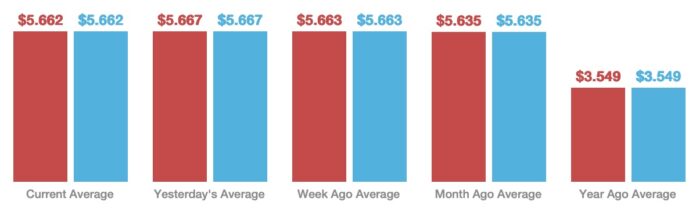 Oil market dynamics
At the close of Wednesday’s formal trading session, WTI (West Texas Intermediate) fell $1.16 to settle at $101.02 a barrel. The EIA reports crude oil inventories decreased by 4.3 million barrels from the previous week. At 452.9 million barrels, U.S. crude oil inventories are about 0.3% below the five-year average for this time of year.
EV charging
The national average per kilowatt hour of electricity at a public EV charging station remained the same this past week at 41 cents.
State stats
Gasoline
The nation’s top 10 most expensive gasoline markets are California ($6.14), Washington ($5.77), Hawaii ($5.64), Oregon ($5.34), Alaska ($5.26), Nevada ($5.23), Illinois ($5.08), Michigan ($4.89), Arizona ($4.84), and Pennsylvania ($4.65).
The nation’s top 10 least expensive gasoline markets are Mississippi ($3.99), Louisiana ($4.00), Texas ($4.00), Georgia ($4.01), Oklahoma ($4.02), Arkansas ($4.06), Alabama ($4.07), Kansas ($4.09), Tennessee ($4.13), and Nebraska ($4.13).
Electric
The nation’s top 10 most expensive states for public charging per kilowatt hour are West Virginia (53 cents), Hawaii (51 cents), Alaska (50 cents), Louisiana (46 cents), New Hampshire (46 cents), California (46 cents), New Jersey (45 cents), Arkansas (44 cents), Illinois (44 cents), and South Carolina (44 cents).
The nation’s top 10 least expensive states for public charging per kilowatt hour are Kansas (29 cents), Missouri (32 cents), Utah (33 cents), Maryland (33 cents), Iowa (34 cents), Nebraska (34 cents), South Dakota (34 cents), Vermont (35 cents), Delaware (37 cents), and New Mexico (37 cents).
RELATED
- Gas prices rise again, up 25 cents a gallon on average
- U.S.–Iran ceasefire talk hasn’t lowered fuel prices much. Here’s why
- Gas prices jump nearly 30 cents in a week
- Rising war tensions drive fuel prices higher
- Gas prices start their seasonal climb as spring travel nears
- State fuel taxes inch higher in 2026
- RVers hit harder as diesel climbs past gasoline again. What you can do
RVT1261b

We can forget about gas prices dropping for quite a while.
Even IF and When this war is over, big oil will keep prices high as long as they can.
I don’t see any end soon to a war we should never had started.
The Law of Supply and Demand is in effect. Tight oil supplies, refinery problems, create high prices. When the conflict ends there will be a flood of oil hitting the market, driving fuel prices down again.
It’s only been since early March that oil made a run up. Our ancestors survived 1942-45 fuel rationing. This is not going to last much longer because blockaded Iran can’t export, has no revenue to pay their troops, and we haven’t even played all our cards.
Meanwhile pray for the safety and success of our brave troops.