

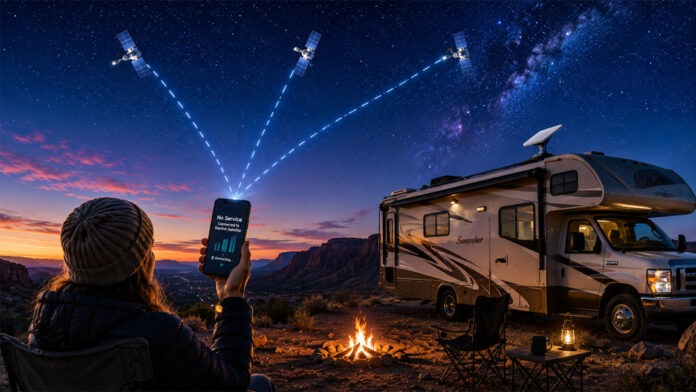
For years, RVers have faced a familiar dilemma. Once you leave the interstate or head deep into a national forest, Starlink mobile service and other satellite-based communications could eventually help fill one of the biggest frustrations of RV travel: losing all connection when cell towers disappear.
According to a Financial Times report cited by Reuters, SpaceX has discussed launching a Starlink mobile service for U.S. consumers, although the company has not publicly announced such plans. If it happens, it could eventually change how travelers stay connected far from traditional cell towers.
For RVers, though, the bigger story isn’t whether Starlink becomes another Verizon or AT&T. It’s that satellite connectivity is steadily becoming part of everyday cellphone service.
A shift already underway
Most RVers know Starlink as the company behind the satellite internet dishes increasingly seen on RV roofs.
But another Starlink service has quietly been taking shape.
Until recently, satellite communications meant carrying a separate satellite phone or installing a dedicated Starlink antenna on your RV. Direct-to-cell technology changes that equation by allowing compatible smartphones to communicate with satellites using the phone already in your pocket whenever no terrestrial cellular signal is available. The goal isn’t to replace cell towers. It’s to fill in the gaps where towers don’t exist.
T-Mobile has already begun offering Starlink-powered satellite connectivity for compatible phones when customers are outside normal cellular coverage. The service currently focuses on messaging and emergency communications, with additional data capabilities expected to expand over time.
That means the transition has already begun—even before any standalone Starlink mobile service exists.
“The bigger story isn’t whether Starlink becomes another cellphone company. It’s that satellites are steadily becoming part of the cellular network.”
What SpaceX is reportedly considering
According to the Financial Times, SpaceX executives told prospective investors the company is considering launching its own retail mobile service, while also exploring the possibility of building terrestrial wireless infrastructure in the United States. That would represent a significant shift from today’s model, where Starlink primarily works through wireless partners instead of selling phone service directly to consumers.
Whether those plans become reality remains uncertain.
Launching a nationwide mobile carrier would require regulatory approvals, additional wireless spectrum, major infrastructure investments and agreements with device manufacturers. Those hurdles are substantial, even for a company with SpaceX’s resources.
What this could mean for RVers
The biggest benefit wouldn’t necessarily be faster internet.
Instead, expanding satellite-to-phone service could mean fewer situations where a dead cellphone leaves you completely disconnected.
Imagine being able to:
- Send a text after breaking down on a remote highway.
- Contact roadside assistance from a Forest Service campground.
- Let family know you’ve arrived safely after losing cellular coverage.
- Exchange messages during an emergency when no cell towers are nearby.
- Stay in touch while exploring well beyond normal cellular range.
Those are situations many RVers encounter every year.
Don’t expect to stream movies
This technology is very different from using a Starlink dish.
Today’s direct-to-cell systems are designed primarily for texting, emergency communications and limited data—not the kind of high-speed internet people receive from a Starlink antenna mounted on an RV.
For many RVers, that may be enough.
Being able to text, receive weather information or summon help can be far more valuable than watching a movie from the middle of nowhere.
The real story
Whether SpaceX ultimately launches its own cellphone company almost misses the point.
The larger trend is that satellites are becoming another layer of the wireless network.
A few years ago, losing cellular service meant losing communication altogether. In the coming years, it may increasingly mean your phone quietly switches from a nearby cell tower to a satellite hundreds of miles overhead.
For RVers who already own Starlink Roam equipment, none of this replaces satellite internet. If anything, it complements it. A roof-mounted Starlink terminal remains the better choice for high-speed internet, while direct-to-cell service is designed to keep ordinary smartphones connected when no towers are available.
For RVers who regularly travel beyond the edge of traditional coverage, that could become one of the biggest connectivity changes in decades.
Would satellite-to-phone service change the way you travel, or do you already rely on Starlink, ham radio, a satellite messenger or another backup communications system when you’re off the grid? Tell us in the comments below.
Sources
Reuters (reporting on Financial Times story)
T-Mobile: Satellite (T-Satellite) service information
MORE ON STARLINK
- Thinking about Starlink? New pricing changes could affect your decision
- Starlink Mini may be getting a built-in battery. Why RVers would care
- Starlink just raised prices again. Some RVers will feel it
- Starlink’s growing pains could matter to RVers more than anyone
- New Starlink hybrid plan not as cheap as it looks
- New Starlink hybrid plan promises simpler internet for RVers
- That ‘pause’ on Starlink could cost you hundreds—or more
- The $299 Starlink Mini deal is back—and RVers may want to look again
- New Starlink Mini RV charger powers Starlink Mini and other devices at once
RVT1270b

I use Wi-Fi calling via Starlink Roam often when RVing in remote places like I am now; Stoner, Colorado. I’m streaming movies, texting, reading emails, and talking. Service is great!