

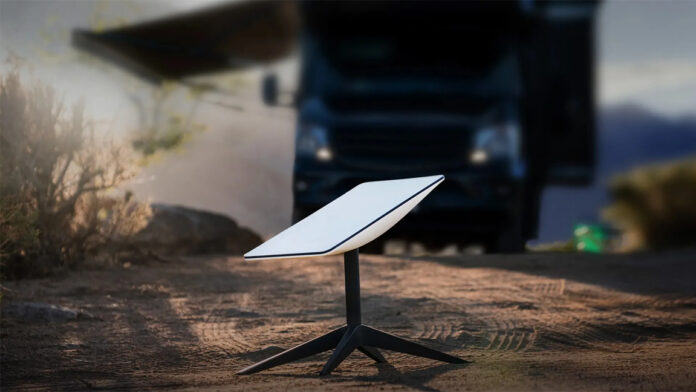
Starlink RV internet has transformed life on the road, making it possible for RVers to work, stream, and stay connected from almost anywhere. With more than 10,000 satellites in orbit, Starlink delivers speeds similar to many home broadband connections, keeping video calls and online work smooth even in remote locations.
And now, Amazon Leo (formerly Project Kuiper) promises more options in the future. It offers RVers the potential for even faster, more flexible satellite internet as competition heats up.
How Starlink works—and why it’s better than old satellite internet
Before Starlink, staying online on the road was a gamble. Traditional satellite internet relied on satellites far above the Earth, which meant slower speeds and noticeable lag. Starlink uses satellites much closer to Earth—about 350 miles up—which makes the connection faster and more reliable.
The system automatically links to the best satellite overhead, so whether you’re video calling, streaming, or working online, the connection usually stays strong.
RVers test Starlink and find freedom on the road
Early RVers testing Starlink were impressed. One reviewer, trying the RV version from a camper van in Western Europe, called it “fast and reliable compared to the 4G/5G data networks in the remote locations I like to travel.” That kind of performance is enough to convince someone to trade a traditional home for a van or fifth wheel, and embrace a mobile lifestyle.
Work, play, and stay connected anywhere
For full-time or part-time RVers, Starlink opens up new possibilities. You can work from a desert campsite, a mountaintop, or a quiet beach shack without worrying if the Wi-Fi will fail. Some RVers spend months on the road, hopping from one spot to another, and still handle video calls, file uploads, and all the digital stuff that keeps life moving. Starlink has made that level of freedom realistic.
Limitations, and what’s coming next
That said, it’s not perfect. Costs have gone up, and some convenient features—like pausing service—are harder to use than before. Heavy cloud use or crowded networks can slow things down, and being tied to a single provider makes some RVers nervous. The Verge notes, “Starlink currently dominates the market, but Amazon Leo is expected to offer competition in the years ahead.”
RVers look forward to more options
The prospect of competition has RVers dreaming of more. Some hope for features like better pricing options, flexible service pauses, or improved hardware designed specifically for mobile use. Others anticipate faster speeds, even lower latency, or coverage in areas Starlink hasn’t fully reached yet.
For those who live on the road full-time, the thought of a true alternative from Amazon Leo could ease concerns about relying on a single provider—and perhaps unlock even more freedom and peace of mind.
Freedom on the road—for now, and the future
Still, for many RVers today, Starlink RV internet is worth it. It’s freedom, connection, and convenience rolled into one. You can truly work, play, and live anywhere—even if it comes with a few trade-offs along the way. And as Amazon Leo and other competitors begin to roll out, the dream of even better, more flexible satellite internet for RV life is closer than ever.
Sources include The Verge, Amazon, Data Centre Dynamics
RELATED
- Starlink still leads, but Project Kuiper’s rapid expansion is closing the gap
- New Starlink Mini RV charger powers Starlink Mini and other devices at once
- Starlink to bring 5G cell service to RVers anywhere
- Amazon’s internet satellites just got a lift…from Starlink?
- Building a global internet service from space isn’t cheap—just ask Starlink
- T-Mobile and Starlink team up for cell service anywhere
- Ways to connect to the internet while traveling, and the pros and cons of each option
- Got Starlink? Scam alert for unsuspecting customers
RVT1239b

I finally sprung for a Mini for my travels in my Winnebago. Last year I missed the $300. deal by a day or two. Eh, not something I really needed..
This year when it went down to $200. from Home Depot with a Veteran’s discount and free next day home delivery…Bang! Went for it.
Now I need spring to show up and hit the back-roads.
That price also made it easy to get the12 volt cigar lighter cord with battery level and a short connector to join the 10′ to the 40′ cord in case of trees.
I have plenty of batteries and solar if out in the sticks, where I usually enjoy the peace and quiet.
There is also a site where other Starlinker’s can share information.
We will never go back to relying on cellular. There’s just too many gaps, saturated towers poor reliability these days. I don’t care where I am, if I can see the sky, I can stream data. With the Mini running DC direct, it’s even better. Maybe competition will help with the Roam rates though. While the unwavering connectivity is of value, $165 a month is a pretty stiff hit.
I would love to read an article praising what Elon Musk has accomplished. It may be helpful for owners who constantly complain about the cost to be given facts about how much it has cost to field the Starlink capability verses just dissing the system. With the $5 per month standby mode recently implemented hopefully will help owners and reduce the complaints. Merry Christmas everyone…..people expecting something dramatic from the LEO beta system will be disappointed. But it will eventually match the Starlink capabilities.
Got my $5 bill just this week. This was our first season with Starlink and I do not have a single complaint, I just wish it would go public so I could buy some.
✌️😎
Hum, after Starlink gets all their satellites up and then Amazon, I wonder if we will be able to see the stars??? I read Starlink is starting to affect the Hubbell telescope and will eventually make it worthless.
Where did you read this? As far as I know, Hubble is at a higher altitude than Starlink, so it should not be affected. Hubble is also near end of life, and a much better telescope (James Webb) is much farther away from Earth.
A simple search will find you several articles on it. I am sure you can do it! Oh, and Hubbell isn’t the only one. All the earth based telescopes will be having the same issue. Sure, there will be the James Webb telescope. Apparently you think one is enough! LOL!!!
FYI – the one I was reading was from Fake New MSN and NPR, so who know if it is really true.
I notice you have zero actual information about what Leo will offer. Yes, competition is always good, but your blurb implied that it had some better capabilities. How soon will Leo be usable? And by then, what capabilities will Starlink have?
Thanks for the Starlink commercial! Maybe next week you can do a LEO commercial?