

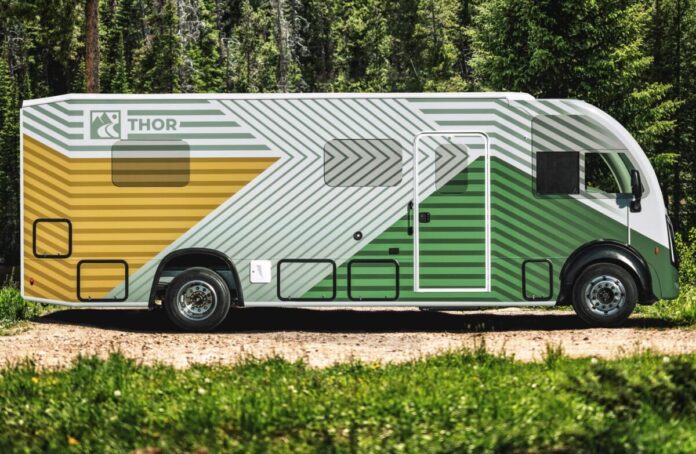
THOR Industries, the parent company of Airstream, has introduced a plug-in-hybrid Class A motorhome, taking a major step forward in the electrification of the RV industry.
Developed in partnership with electric vehicle manufacturer Harbinger, the prototype combines a 140-kWh battery with a compact internal combustion generator, delivering an impressive total range of approximately 500 miles. The innovative design balances sustainability with practicality, addressing concerns about the limited range of all-electric RVs.
As the global push for electrification continues, RV manufacturers are exploring hybrid and fully electric solutions to stay competitive and meet the growing demand for eco-friendly travel options. THOR’s new prototype could serve as a benchmark for future RV engineering, with its series-hybrid powertrain and steer-by-wire functionality offering both efficiency and advanced handling capabilities.
The THOR hybrid Class A motorhome Test Vehicle features an 800-volt system with DC fast charging, enabling up to 150 miles of travel on battery power alone. The internal combustion range extender, which powers the electric motor rather than driving the wheels directly, significantly extends this range. THOR also claims the motorhome delivers “twice the torque of a diesel engine,” though exact powertrain specifications have yet to be disclosed.
For campground operators and RV park owners, the expansion of hybrid RVs could present new opportunities, as extended-range electric models become more viable for long-distance travel. Dealerships and rental businesses may also see a shift in consumer interest as hybrid options gain traction in the market.
THOR Industries plans to release RVs based on this prototype’s platform in 2025, though pricing details remain under wraps. With hybrid technology addressing key challenges in electric RV travel, this development could mark a turning point for the industry’s shift toward sustainability.
RELATED
- Lightship RV’s quarter-million all-electric RV offers innovation but lacks important features
- Truma Combi G moves RVs one step closer to all-electric models
More articles you might really like
• RV review: 2025 Forest River Wildwood Grand Lodge 44VIEW
• Lessons learned from the theft of our RV in storage
• 30,435 Grand Design RVs recalled again for same gas leak danger
• Is it time to quit RVing? Our readers respond
• RV electricity: How to install a 30-amp RV outlet at home
• BLM closes popular boondocking area in Arizona
##RVT1194b
WOW..150 miles of travel on battery power…and then start up a generator with an ICE powered motor to recharge your battery to continue on your journey ?? Still need to fill up some type of fuel tank?
No thanks.😐
100 mi of electric motor based range … with remaining 400 mi of stated range being based on fossil fuel fed generator.
Now that’s a sales pitch!
And what’s more, the generator creates less battery charge than required to travel, so at 500 miles the thing is dead-in-the-water anyway!
P.S. Did Tony design the paint job! I know how much he loves those kinds of exteriors!!! 🤭🤣
Completely agree with you, and it sounds like the new terminology is to appease the greenies because they can say it doesn’t have a generator, it has a “mileage extender”…Lol
Thank you, RV Travel! Thor?!? 150 miles?!? No, sorry, no sale; thanks anyway. Have a great weekend and safe travels!
Creative naming notwithstanding, it still relies on fossil fuels. Something that only manufacturers in their quest for new customers could refer to as “All electric”.
Wonder if the current trend with e-vehicle sales will lower fuel prices?
While I’m for Hybrid (HEV) vehicles, I’m not for plug in hybrid electric (PHEV). vehicles. PHEV may raise the price of campsites or make campground owners start charging for electric.
That is one ugly motorhome!
Fuggly !
😂
Ask anyone that works at an auto dealership. They’ll tell you they can’t give away the electric cars – nobody wants them. Like it or not, that’s reality, not fantasy.
Very practical approach to bridge the gap to pure EV – hybrid. Great job Thor
I wonder if the campground and rv park owners would really be that excited about having to upgrade their electric system to accommodate these vehicles.
Good point! The “upfront” is always different than the “aftermath”
It might be more interesting if this hybrid were built by any company but Thor. Despite owning Airstream and DRV, “quality” RVs have not been exactly a Thor trademark. Maybe if this were built by REV, Newmar, etc., it would be a viable “concept RV”.
But the production-line version, fahggetaboudit!
The idea of all electric in RVs and semi trucks suffers from an irrefutable problem as of now: physics. Scaling batteries up to meet the demands of these massive vehicles is not possible, at least for now. Plug in hybrid is dubious as it will undoubtedly require more robust pedestals and increased costs for the RVer. It would seem more practical to develop a normal hybrid for everyone involved.
Tesla has already delivered these to Pepsi. Nikola and Freightlimer also have developed the,.
I have driven this and it’s a solid effort. Harbinger already is making these chassis just as Ford makes their chassis for delivery trucks and such.
This makes so much more sense than a motorhome with a large commercial diesel that gets driven few miles. The gasser on board acts as a generator when needed in tandem with solar and battery reserves, you get the torque of electric power and battery reserves to operate both the house and the driveline. I see fewer downsides than with a diesel pusher.
Plus you can optimize the gas engine for a single use rather than the variety of use cases of a normal IC. My one concern is the placement of the gasser.
If that’s the only paint job that motor home comes with, good luck on sales! According to the article, it’s drive system has a lot more torque that diesel motorhomes, that alone will anger I.C.E. motorhome owners at the stop light Gran Prix.
If you look at any vehicle prototype they paint them in a pattern that throws off the camera so that photos don’t show the actual appearance of the vehicle. Look at “spy” photos of any pre-production vehicle and they’re not dissimilar to this type of appearance.
The shell, to me, looks very much like a Thor ACE or AXIS which makes sense as that may be a direct drop-on fit for the Harbinger chassis.
But if they didn’t do something this distracting people would say, “oh, it’s only a Thor ACE.”
Innovation, particularly in the face of a changing business climate (and in this case environmental climate, despite he ostriches) is the lifeblood of successful businesses and their long-term viability. Innovation mean less than perfect prototypes, some failures and learnings along the way to finally offering breakout products. Kudos to Thor for being proactive in this regard. Hopefully others, particularly those who are more quality focused will follow.
“despite he ostriches” I love auto correct! hahaha
Unless my math is betraying me, 140kWh at 800VDC is only 174Ah of battery reserve. If my numbers aren’t failing me, that kinda leaves me feeling this PHEV attempt to be more show than go.
I know ya gotta start somewhere but imagine giving up roughly 1,400 pounds worth of payload, amenities and build material quality to accommodate just the weight of the batteries alone to avoid exceeding GVRW. Trade the weight difference of the traditional powertrain to the hybrid propulsion and that explains why they’re attempting this in the higher GVRW of the Class A versus a Class B or Class C. Ouch!
What does Airstream have to do with this article (First sentence in article)?
I didn’t get that either Gary, and Thor is parent company to a heck of a lot more than Airstream!
I would counter the claim of EV RVs creating new opportunities for campground owners with more headaches for CG owners with EV folks plugging into their already overtaxed electrical grid. And, to add and install EV charging stations, what would the expense be vs the return on a major investment? Would said campgrounds have to raise their rates for all campers to provide amenities to the few EV campers by percentage? As a side note, virtually Every EV manufacturer making EVs besides Tesla (which makes its money on carbon credits, not EV sales) is losing huge amounts of cash with perhaps Ford being the major name in deep financial straights from EV productions forced on them by the Feds.
Well stated.
Since it is a hybrid, an important cypher in the equation is actual fuel mileage. Hybrids should have enough of a better fuel mileage to offset the higher purchase cost after a given number of miles that must also crank in the great variables of fuel costs around the country and from the vagaries of changing fuel costs. That won’t be easy but must be done to justify a potential purchase. I would think that the on-board engine would almost always have to take care of keeping the battery topped off as campground charging will not be allowed by any of them until it becomes a cash cow for them.
Good start Thor!
I’ll probably be in the NFS campgrounds in the other worlds when these become available. Sounds like a great thing, especially with an onboard gennie to supply power when needed other than a plug-in outlet on the nearest tree.
Sure hope it comes about unless a better power source is found.