

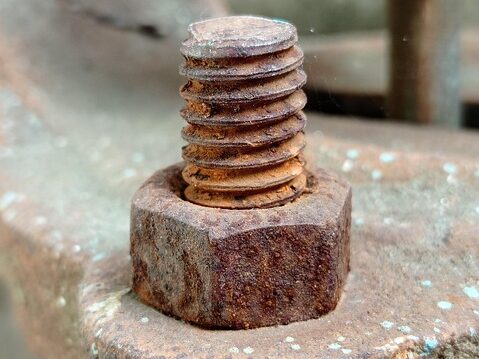
A routine RV exterior check revealed several rusty bolts on our rig. Rusty bolts can show up in all the places where your RV meets the weather.
You might discover them in undercarriage suspension and frame hardware, slide-out rails, awning brackets, roof mounts, jacks, and more.
Why worry?
Rusty bolts are a bigger deal on RVs than on a lot of other vehicles because they can affect safety, reliability, and repair costs all at once. Here are several reasons why rusty bolts should be addressed.
First, rust weakens the bolt itself. Corrosion eats away at the metal, reducing its strength and making it more likely to snap under load. On an RV, bolts often secure critical components like suspension parts, stabilizer jacks, slide mechanisms, hitch hardware, and awnings. If a corroded bolt fails while driving or during setup, it can lead to component damage or even a safety hazard.
Second, rust can lock parts together. When corrosion forms between the threads of a bolt and the nut or frame, the bolt can seize in place. That turns simple maintenance jobs—like adjusting slide-out components—into time-consuming repairs. Seized bolts often break when you try to remove them, which means drilling, cutting, or extracting what’s left, adding labor and cost.
Third, RVs live in harsher conditions than most cars. They sit for long periods, get exposed to rain, snow, road salt, coastal air, and campground moisture, and then vibrate constantly when traveling. That combination accelerates corrosion. Because RV frames and mounts often use thinner metal than heavy trucks, a broken or rusted bolt can damage the surrounding material, not just the fastener.
Why does it rust?
Salt air, road spray, trapped moisture, and contact between dissimilar metals speed corrosion. The constant vibration of travel can let a bit of surface rust lock metal together over time. These are common trouble spots for RVers because water + metal + time = seized fasteners.
Avoid this!
If you reach for a breaker bar or an oversized wrench without preparation, you risk snapping the bolt or rounding or stripping the head. What’s more, you may damage the surrounding area (thin RV skin, fiberglass, or a threaded mount).
Once a bolt breaks or the head is ruined, you’re a lot closer to cutting, drilling, or rebuilding. All of these are harder and costlier than a patient removal. Many pros and how-to guides warn that slow, controlled methods prevent turning a simple job into a big one.
The patient method
Start with cleaning and inspection. Brush loose rust and grit away so treatments can reach metal-to-metal contact.
Spray a quality penetrating oil at the bolt/nut interface and let it soak. Long soak times can really help. (This can be minutes to overnight.) The soak time is important because the fluid needs to wick into the joint.
Try gentle mechanical persuasion next. Use the correctly sized socket or wrench and apply steady torque. Use controlled leverage rather than sudden jerks. If the bolt still won’t budge, an impact driver or an impact wrench can break the corrosion by applying short, percussive force while turning. That vibration is what often frees stuck fasteners.
For bolts with rounded heads, bolt-grip extractors or tapered extractor sockets grab onto the metal and let you turn them without destroying the surrounding area.
If the bolt head is gone or the shank is seized, try soaking with the penetrating oil once more. Then gently tap the bolt. Sometimes that gentle tap can dislodge problematic bits of rust. Still stuck? You can cut off the head and remove the remaining stud. Or carefully drill and use an extractor.
When to change tactics
If the torque is rounding the head, stop and switch to an extractor or cutting method. More force will often break the bolt and multiply your work.
If you’re near fiberglass, wiring, or gas lines, or if you’re unsure about cutting into a structural area, step back and consider hiring a professional shop to handle the problem.
Guides and pros recommend escalation: soak, tap/vibrate, apply steady torque, use impact, use extractors/cutting, then drill/extract. Don’t skip safety or start off with the most destructive option.
Quick tips
Always wear eye protection and gloves. Use the correct socket size. (A loose fit rounds heads.) Support nearby components so heat or leverage doesn’t bend or break mounts. Keep a spare bolt, nut, and a matching replacement on hand so you can finish the repair cleanly when you’ve removed the old hardware.
Preventing rusted bolts
When you reassemble, do what you can to stop future corrosion. Swap in stainless or hot-dip galvanized fasteners where strength and thread fit allow. Or use a high-quality anti-seize compound on threads before tightening to prevent metal bonding.
Seal joints and fastener heads with sealant or a bead of marine-grade silicone around roof penetrations and exposed hardware. Keep drainage paths clear so water doesn’t pool, and inspect vulnerable areas often. A quick clean and a dab of anti-seize or corrosion inhibitor will save time later.
Can you add to these tips? Please do. Use the comments below to weigh in.
RELATED
- RV rust can destroy your rig: How to fix and prevent RV rust
- Rusty wheel bearing grease? What it means and why RVers should care
- How to prevent rust from damaging your RV
- How to get rid of rust spots on a stainless steel sink
- My RV’s undercarriage is covered in rust. Should I sandblast and undercoat it?
RVT1251


Another method is to soak the bolt in penetrating oil then try turning the bolt in the clockwise direction if it moves a little the reverse direction moving a small amount and repeat. This is very much like threading at Tap when making treads. The small turns in opposite direction allow the debris to clear.
If the bolt is stubborn, soak the bolt multiple times in a 24 hour period.
Do not use an impact wrench. The high torque will probably snap the bolt. Using a drill with adjustable torque settings is a better option.
Using a 6-point vs. a 12-point socket really makes a difference.
After over a half a century of arguing with rusty nuts, bolts, and screws I have found that the best penetrating fluid is a home brew of 50% acetone and 50% automatic transmission fluid. If you insist on buying a product, Kroil is the next best penetrating fluid that I have found. Apply it to the fastener, let it soak and then use the tighten/loosen technique to free the fastener. As has been mentioned in other comments, you may have to do this multiple times over a couple of days to get it to loosen but I rarely break bolts since using this method.
“the best penetrating fluid is a home brew of 50% acetone and 50% automatic transmission fluid.” Yep, the old farmer’s best friend.
The best penetrating oil I’ve found is PB Blaster. You just have to get past the evil odor. (Can’t they make that stuff smell a little better?) But, it works.
If penetrating oil doesn’t work on stuck nuts, then try using a little heat. A small propane torch is fine, just heat the nut (not the bolt), then before the nut cools, try turning it off. Obvious caveats about not using a flame around things that could ignite.
An aerosol can of PB Blaster catalyst and a short wait will make removing rusty bolts with ease.
“What’s more, you may damage the surrounding area (…thin RV skin, …).” Too often I have damaged the RVers thin skin.
Nope,. every year or sooner wherever you live or park. squirt what works for you before it is rusted and ornery. Busted or broken is no fun ever. It may cost $$ if you don’t have heat and are not at home.
Thank you for the suggestions and information, Gail. Have a great day and safe travels!