

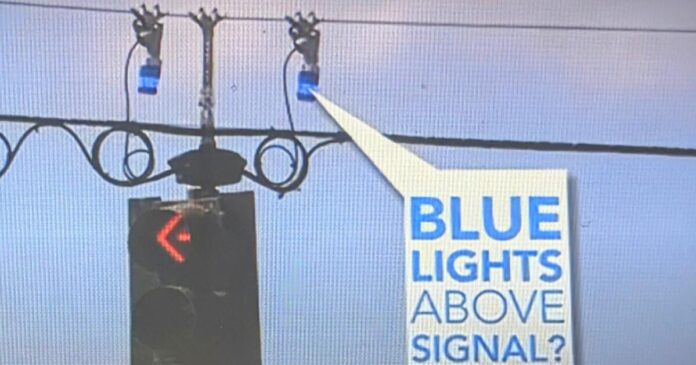
Red means stop. Yellow means caution. Green means go. Blue means… Blue?! Yep, now there are blue lights at traffic signals.
Why have blue lights joined the more familiar red, yellow, and green? Read on to find out.
Where we saw them
Driving through Gainesville, Fort Myers, and Orlando, we noticed Florida’s blue lights. These aren’t decorative accents or turtle-friendly lighting. They’re part of a growing effort to crack down on red-light runners and keep intersections safer for everyone on the road.
What are these blue lights?
Known as confirmation lights (sometimes “blue beacons” or “reverse-side red indicators”), these blue LEDs are wired directly to the red traffic signal phase.
Whenever the main signal turns red, the blue light above it switches on simultaneously. Because it’s mounted on the arm or the back of the signal head, it’s visible from nearly any angle. This gives law enforcement a clear, unambiguous confirmation that the light was red when a vehicle entered the intersection.
According to Collier County Transportation Management Services, if an officer sees the blue light illuminated and a car proceeding through the intersection, they have the legal basis to cite the driver for running a red light.
NOT SUBSCRIBED TO RVTRAVEL.COM’S NEWSLETTERS? You should be! Since 2001, we’ve been publishing North America’s favorite newsletter written by RV experts, for RVers. To learn more, click here. (No spam! Ever! We hate spam!)
Blue lights help officers
Traditionally, catching a red-light runner often required two officers. One stationed with a direct view of the signal and another positioned down the road to pull the driver over.
The blue lights enable just one officer to do the same thing. Any deputy parked safely off the intersection can simply watch for that blue glow and know exactly when to stop the violator. This not only frees up manpower but also reduces the risk for officers who no longer have to weave through traffic to verify signal status before making a stop.
Impact on safety
Early adopters of confirmation lights have seen measurable results. A Minnesota Department of Transportation study (later summarized by the Federal Highway Administration) found that intersections equipped with confirmation lights experienced up to a 33% reduction in right-angle (T-bone) crashes. These are the most severe type of signaled intersection collisions.
Similar positive findings have been reported in cities across Colorado, South Dakota, and Kansas. as the technology spreads beyond Florida’s borders.
RVers should take note
For RVers, big rigs, and towing setups alike, stopping safely and legally at every red light is crucial. Not only will it avoid tickets, but it also prevents dangerous intersection wrecks.
The blue lights can be harder to spot than the standard red, yellow, and green lenses, so always watch for the traditional signal rather than relying on the beacon. Give yourself extra braking distance when approaching unfamiliar intersections and treat every yellow light as a cue to slow down, not speed up.
DID YOU KNOW that RVtravel.com includes more than 700 articles about RV electricity? Wow! Check out the long list of topics.
RELATED
- Is it legal to run a yellow light in an RV? Maybe, maybe not
- Traffic lights: How they work, how they waste your time
- Illuminating the fascinating history of the traffic light
- From the archives: Random observations from the road in 1988 America
- How to determine if oncoming traffic has an advanced green light
RVT1222

I don’t understand how the blue light can reduce red light running, only how it can help police catch more runners. 33% reduction seems like a lot…
Hopefully, when drivers understand the blue light’s function (enabling police to more easily ticket red light runners) they will stop running the lights.
Again, integrity by Police is paramount to Blue Light monitoring
Seems like you understand it quite well actually.
The blue light is meant to be seen by officers that are in a position that they cannot see the red light for the lane it is controlling. Usually they are stopped on a side street or behind the light in an oncoming lane. The light means nothing to the motorist. Its possible that they are connected to the system that changes the lights when triggered by Opticom, but in my state, they are attached to the back of the signal, not hanging like shown in the image.
blue lights sends face recognition video and picture of a suspect through the attached camera.
Actually they are for emergency service vehicles that use sirens and lights to show that traffic signal has activated and changed to all stop in all directions. This insures that it is safe to enter the intersection.
In Japan they also have blue traffic lights !!!!
Thank you for the information, Gail! Have not seen any of these in or around where we live. Will be curious to see if they make it to us or not. Have a great day and safe travels!
So, if a vehicle is in the middle of an intersection when the light turns red, and now blue too, does that person get a ticket? This would be wrong because the legal way to wait to make a left-hand turn when traffic is constant is to sit in the middle of the intersection until the coast is clear. Often this won’t happen until the light turns red, stopping the oncoming traffic.
Hi, Lonewolf. In Washington state it is illegal to pull into an intersection to wait to make a left turn. Per RCW 46.61.202: “No driver shall enter an intersection or a marked crosswalk or drive onto any railroad grade crossing unless there is sufficient space on the other side of the intersection, crosswalk, or railroad grade crossing to accommodate the vehicle he or she is operating without obstructing the passage of other vehicles, pedestrians, or railroad trains notwithstanding any traffic control signal indications to proceed.” Per Doug Dahl, the previous director of communications for the Washington Traffic Safety Commission, the Department of Licensing interprets that law in the Driver Guide: “Drivers must not enter an intersection unless they can get through it without having to stop.” In other words, according to Dahl, a person who enters the intersection and then has to wait for an opportunity to complete a turn in a safe manner has violated Washington state law. Have a great day, and don’t stop in an intersection in Washington state.🙄 😀 –Diane at RVtravel.com
But that’s not true in every State.
Hi, Gene. You’re correct, and that’s why I said it was for Washington state. I had to look it up to make sure I was remembering correctly, from when I learned to drive 64 years ago(!), or if the rules here had changed since then. Have a great day and a terrific 2026! 😀 –Diane
so, if i’m stopped in the intersection waiting to make a left turn and the light turns red and the blue light also turns on am i running a red light?
Hurry to your nearest K-Mart for a special offer?