

By Cheri Sicard
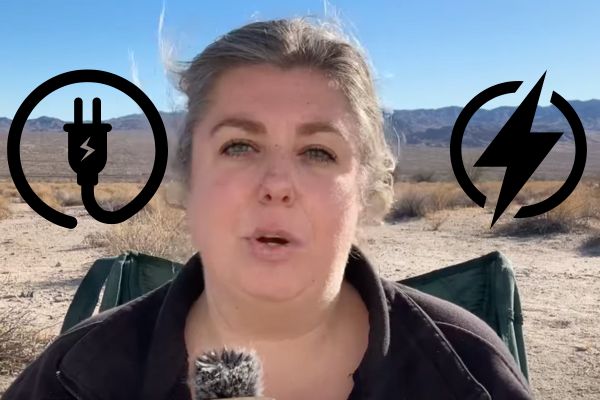
In the video below, we join Brooke of Brooke and Pippa for tips on how to save power when boondocking. Brooke and Pippa (her dog) live off the grid in an ambulance RV conversion.
Learning to use, balance, and conserve power represents one of the biggest learning curves for new boondockers. I find that with time, you will get into a natural rhythm with it that fits your lifestyle; but in the meantime, Brooke’s tips can help.
Even if you are carrying generators and/or plenty of solar power, conserving your power when boondocking always makes sense. It will save you money from overrunning a generator, and you never know when wind or rain might interfere with solar.
How to save power when boondocking
#1 Switch to lower-wattage appliances: Run appliances on lower settings or switch them out for similar appliances with lower-wattage draws. With so many people boondocking and car camping these days, there is no end to small appliances that don’t take much power. Here are some favorites for cooking, for instance.
#2 Replace appliances with no power alternatives: For instance, a French press or Moka pot to make coffee takes no power, and a regular coffee maker can draw 1000 watts. Find no-power coffee maker alternatives here.
#3 Ditch the TV: Watch on your phone or tablet instead, as these recharge at much lower power wattage rates.
#4 Upgrade your lighting: Use LED or rechargeable lights that don’t pull much power.
#5 Use a propane stove: Anything that heats usually draws a lot of electrical power, so a propane stove is a better alternative.
#6 Change up your fans: Regular fans that run through the night can use a lot of power. Rechargeable or USB-powered fans are a more economical alternative.
#7 Use high-draw items during the day: Using these when solar power is strongest can help keep you charged up for later when it is not.
#8 Charge big items during the day: This goes hand in hand with #7, but get your recharging done while the recharging is good.
#9 Unplug everything when not in use: Even if you are not using an electrical appliance, it still draws a little power when plugged in, so always unplug it until needed. Sometimes the draw is significant. For instance, Brooke found that having her induction cooktop plugged in when not in use was drawing 8 watts of parasitic power!
#10 Turn off power station ports when not in use: Like appliances that draw power, leaving your portable power station ports on, even though nothing might be plugged into them, still draws some power. Turn off the power station when not in use and only power the ports needed to run what you need at that moment.
#11 Check the weather in advance. This way, you can plan for cloudy, windy, or rainy days and charge accordingly. Beyond that, and regardless of upcoming weather, I always operate from the ABC (Always Be Charging) philosophy, meaning if conditions allow you to charge something, do it.
#12 Save fridge power by adding ice: Frozen foods or water bottles can help your RV fridge stay cold and use less power.
#13 Have a backup battery bank: Brooke talks about her system at point 10:20 in the video. I would recommend just having enough of a battery bank and keeping it charged as much as possible.
For instance, I have two 100-watt lithium batteries that I can charge with a portable solar panel. Even when boondocking for extended periods, I charge them back to 100% almost every day, and I always have plenty of power. I also have two portable power stations that give me plenty of power to keep running Starlink and allow me to work online uninterrupted. You should choose your backups and batteries according to your needs.
#14 Insulate, insulate, insulate: Brooke says insulating everything as much as possible makes a huge difference, whether it insulates from heat or cold.
Do you have other ways to save power when boondocking? Be sure to leave your tips in the comments below.
RELATED
- Using the powerful and versatile OUPES Mega 2 power station and solar panels
- RV inverters 101: Portable and large inverters for off-grid power
- No power? No hookups? You’d better be prepared!
- How to choose the best portable power station for your needs
- Ugreen PowerRoam 1200 portable power station review – my favorite?
##RVT1193
Thank you, Cheri, for forwarding the power-saving tips. These are especially helpful because we have AGM batteries, which cannot be safely depleted very far. Have a great week and safe travels!