

By Cheri Sicard
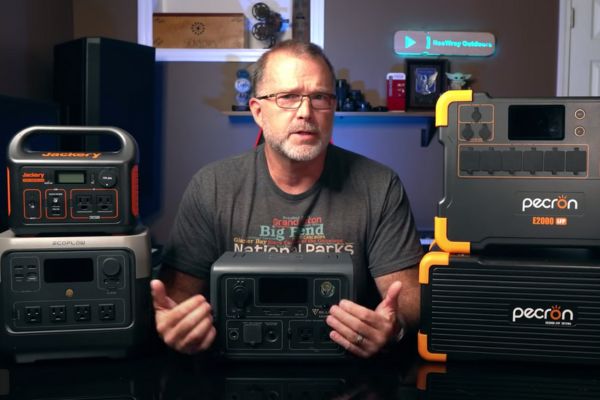
In the video below, Ray from ReeWray Outdoors helps you learn how to choose the best portable power station for your needs.
Personally, I LOVE my portable power stations, with Ugreen’s PowerRoam 1200 being my favorite. They have completely transformed the way I RV.
But I know that the vast amount of different models, power levels, and brands can overwhelm would-be consumers trying to decide which portable power station will best meet their needs. Ray’s video can help. At this point, he has tested and reviewed over 30 different portable power stations!
Ray says it gets confusing because, while different power stations can clearly be “better” than others in one or more ways, which one is “best” for you is going to boil down to how you intend to use it, as well as your budget. So, he rightly says there is no one-size-fits-all answer to what is the best portable power station.
What to consider when shopping for a portable power station
What Ray does in this invaluable video is give you the most important considerations you should take into account when shopping for a portable power station. Portable power stations can be significant financial investments. Evaluating products from the point of view of your personal priorities and needs, not marketing hype, will enable you to make a savvy consumer choice that should serve you well for years to come.
Ray cites his own experience when he bought his first power station, a Jackery 1000, as motivation for this video. While it’s a decent product, it was not the best product for his needs. I feel similarly about my Jackery 1500 purchase, made in the same way. It works, I use it, but if I had it to do over again, I would have chosen the aforementioned Ugreen PowerRoam 1200, or possibly one of the higher-wattage models now on the market.
Ray begins the video by breaking down some of the ridiculous marketing campaigns put out there by portable power station companies. (And, for clarification, some people know these gadgets as solar generators—same thing.) These campaigns show the portable power stations being used in unlikely ways and scenarios.
The goal of this video is to cut through the hype. Besides the questions you should ask, Ray intersperses a whole lot of good general knowledge about portable power stations that anyone shopping for one will benefit from.
How to choose the best portable power station? Ask yourself these questions:
#1 What do you need to run and how long do you need to run it?
What do you want the portable power station to power? How much electricity does it consume? How long do you need to power this device or devices? Watch the video as Ray will show you how to estimate how much power you will need to run your devices using an inexpensive watt meter. He says the watt meter costs less than $20; however, here’s one on Amazon for less than $10.
He also prepared a spreadsheet you can download that already covers many commonly used items, so check this first—you might not even need the watt meter.
But man (or woman) does not live by one appliance alone. In the video, Ray shows you how to calculate the total consumption of all the appliances and devices you will want your portable power station to power.
Answering this question will significantly narrow down the portable power station choices you have. And that’s a good thing.
#2 Evaluate the battery chemistry
Portable power stations are essentially just lithium batteries with electrical outlets and charging stations built into them. As with all lithium batteries, battery chemistry matters.
While there are other types of lithium battery chemistries, the two most common are Lithium NMC (Nickel Manganese Cobalt aka Ternary Lithium) and Lithium Iron Phosphate (aka LFP or LiFePO4). Ray says there are pros and cons to both. However, the pros column for LiFePO4 batteries far surpasses that for Lithium NMC. He explains why in the video as he goes through the positives and negatives of each.
Also note that if a sales description simply describes a product as “lithium,” it is almost always Lithium NMC.
#3 What is the power station’s maximum solar input?
If you don’t ever intend to charge your power station with solar panels you can ignore this one. However, most boondockers are going to want to pay attention here. In the video, Ray shows you how to calculate how long it will take the portable power station you are thinking of buying to charge in good sunlight conditions.
#4 Warranty considerations
Ray says the average warranty period for portable power stations is about two years, but there are some brands that are now offering a five-year warranty. So if the warranty is important to you, shop around.
Be aware you will have to register the product with the company in order to get that warranty, and brands with this warranty tend to be more expensive, so it will depend on how important warranties are to you.
#5 Miscellaneous features
Watch the video as Ray covers a lot of features typically offered on portable power stations. These may or may not be important to you, but it is always good to know your options before buying.
#6 Battery expansion capabilities
Not all portable power stations have battery expansion capabilities and this feature may or may not be important to you. But if you ever want to use the power station for emergency home backup power, Ray says you will want to choose one with battery expansion capabilities.
He also notes that not all battery expansion capabilities are created equally and therefore goes into the details of what you should look for when evaluating this feature.
Take these six points into account before buying and you should end up with a great portable power station that will serve you well for years.
##RVDT2315

Thank you, Cheri! I’m not in the market for a portable power station right now, but I will save the video in case that changes. Thanks again and safe travels! 🙂
Thanks Cheri- May I add one simple but important formula? Watts (power) = Volts (electric pressure) X Amps (electric volume). If you don’t have a watt meter, and the device label instead lists input voltage and amperage (input is far more important than output for this exercise), simply multiply the two for wattage.
And remember, watts is an instantaneous value. You need to also consider time – how long will you be sucking those watts off a battery? That is where the battery’s watt-hour (Wh) capacity comes into play.
Excellent video, thanks