

By Cheri Sicard
Most camping frustration doesn’t come from one big disaster. It comes from tiny, annoying stuff that keeps popping up, like wind blowing out a stove, or gear sliding around in transit.
The team from Playing with Sticks asked fellow campers to share small DIY fixes that quietly remove those stress points. In the video at the end of this post, they share the results.
Simple surfaces and safer storage in a small camper
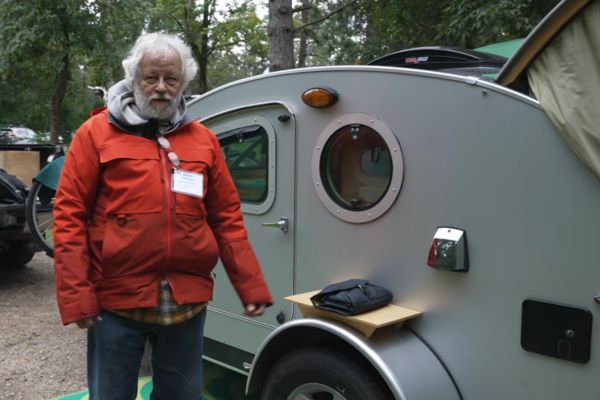
• Dean’s flip-out fender shelf solves a problem most people ignore: There’s rarely a spot to set something down when hands are full. He uses it for a morning toothbrush kit, but it works for anything from a phone to a first aid pouch. He found the fender angle through trial and error, then used a CNC router for clean legs and joinery. Without a CNC, the same idea still works with simpler cuts and fasteners.
• He also built a trailer-matching knife holder, using the same birch-style look as the interior. The point is simple: Knives stop bouncing around in drawers, stay sharp longer, and sit in one visible place while cooking.
• Organization shows up again in the “activity bin” idea. Instead of digging through mixed storage, one box holds charcoal tools together, including a chimney starter and homemade fire starters made from wax plus sawdust or wood chips. (Some campers use dryer lint and wax.) A foldable chimney starter fits the same role without taking up much space.
Wind, rain, and weak spots that ruin a trip
• Wind protection doesn’t need to be fancy. One camper made a simple stove collar from aluminum flashing, with a cutout for the handle, held together with pop rivets. It blocks shifting gusts so the trailer doesn’t need to be re-parked every time the wind changes. A basic pop rivet kit makes this kind of fix quick.
• Another small win is the galley hatch pull-down. A bungee strap wrapped around the hatch handle becomes a built-in grab loop, and it hangs there even when the hatch is closed. A purpose-built option like The Perfect Bungee works the same way.
• Side-entry shelters can tear at stress points in hard wind, so some campers add corner protectors made from a pool noodle section, cut and bent to 90 degrees, then taped. A basic pool noodle is cheap padding where fabric usually loses.
• For clam-style shelters, a painter’s pole can brace the roof by pushing its tip into the hub. With that support in place, wind and heavy rain are less likely to force the hub to fold. A simple painter’s pole is all it takes.
Comfort, pests, and the small gear that earns its space
• Airflow fixes show up in two ways. A fan vent cover bought for Alaska’s constant daylight now does double-duty in cold weather by redirecting air away from sleepers’ faces while still letting the fan run for condensation control. A fan vent blackout cover handles both jobs.
• For cooking, a rechargeable 24-volt Kobalt fan hangs from the galley door, pushes air into the workspace, and helps keep flies off food. Since it shares batteries with other tools, it’s easier to justify bringing along.
• Rodents get handled with layers, especially in early spring when mice look for nesting spots. The approach: Seal gaps, run an LED rope light around the camper perimeter, keep food out, then add an ultrasonic deterrent inside as a last line.
• On the convenience side, one Vistabule owner built a shoe box at sitting height so shoes slide in and out without bending over. It also works as a small table. Another easy add is a trash setup using a suction cup meant for auto glass, which holds almost any bag. A similar heavy-duty suction cup handle matches that idea.
• Inside the galley, vertical space matters. A hinged silverware shelf got replaced with a real drawer so items can sit on a permanent shelf without being cleared every time. A small spin-out drawer picked up the overflow, keeping extra tools close to the stove.
Hard ground tent stakes that don’t bend
• Standard stakes fail fast in gravel or packed dirt, so one camper switched to lag bolts driven with an electric drill. The setup used 5/16- by 6-inch lag bolts, washers, and modified S-hooks, with a short piece of fuel line to keep parts in place. The S-hook makes guyline attachment easier, and reversing the drill backs the stake out clean. Parts like 6-inch lag bolts with washers make the idea easy to copy.
Conclusion
None of these mods are flashy, but they change how a trip feels and functions. A place to set things down, a way to stop wind from ruining coffee, and storage that matches real habits all add up fast. The best part is how personal the fixes are, because most trailers start out 80 to 90 percent right, then owners close the gap. Small tweaks beat small frustrations, and camping gets simpler because of it.
MORE RECENT GADGET ARTICLES YOU MAY ENJOY:
- Small gadgets for RVers with big wins
- Duraflex Gator sewer hose kits product review
- Why you need a label maker in your RV
- DIY ‘chuck box’—The ultimate off-grid cooking kit
- New smart toilet uses video and audio to analyze your health while you use it
RVDT2845

Lights and electronic deterrents don’t actually repel mice. Check out the Mousetrap Monday test videos on YouTube and see for yourself.