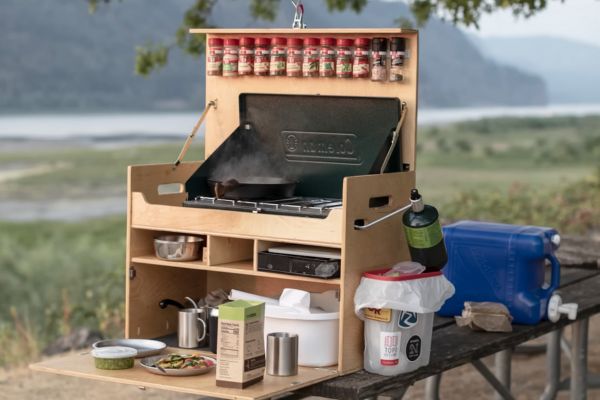
From morning coffee to toasted burritos, Jon Moore’s favorite camp upgrade isn’t a new pan or a fancy stove; it’s a portable camping kitchen that keeps everything in one place. He calls it a chuck box, a nod to old chuck wagons, and the idea is simple: a place for everything, and everything in its place.
For anyone tired of digging through bins at camp, this kind of setup makes cooking feel normal again, even on the road.
In the video at the end of this post, Jon shows how you can make your own chuck box.
What makes this chuck box work so well
Jon built this wooden chuck box as his second version after learning what didn’t work on the first. Gen 1 was bigger and heavier—still useful, just less friendly when space and weight matter.
Gen 2 is built to be easier to live with:
- Smaller overall size
- Lighter carry and load
- More polished layout for full-time road cooking
Materials, size, and the basic build
The camping kitchen box is made from a single sheet of 1/2-inch plywood. It’s sanded, shellacked, glued, and screwed, which keeps it simple and sturdy. Jon says it takes a little woodworking know-how, but it’s not a fussy build.
Gen 2 measures 16 1/2 inches tall, 22 1/2 inches wide, and 14 inches deep. Loaded up, it lands around 35 pounds. For readers who want to build their own, Jon mentions a cut list shared below the video on YouTube.
Flip-down counter, seven compartments, and a “grab it and cook” layout
A flip-down countertop turns the front of the box into a quick prep space, which is a big deal when cooking outside. Inside, seven compartments keep the kit tight and quiet, with smart touches to cut rattles on rough roads.
One compartment holds two stainless steel plates and two camp bowls, with a dish rag tucked behind them to stop clanking. Another compartment keeps the utensil count low on purpose: an egg spatula and a Supoon, which handles both scooping and scraping. A cutting board sits next to a silverware drawer stocked with hand sanitizer, a coffee scoop, a large lighter, fork, spork, long-handled spoon, and knife, plus coal tongs, a can opener, a knife sharpener, trash bags, and rubber bands.
Coffee, fuel, cast iron, and the hidden spice stash
For coffee, Jon packs a kettle, two mugs, and a pour-over brewer—his go-to method. Fuel storage includes two Coleman fuel canisters, separated by coffee filters and a small olive oil container.
The star is the Lodge 2-quart cast iron Dutch oven. He uses the bottom like a general pot for stew or ground meat, and the lid as a frying pan for eggs or toasted burritos. A pair of leather gloves works like oven mitts. Behind the Dutch oven is a spice compartment with chili powder, red pepper flakes, paprika, garlic powder, cilantro, cumin, bay leaves, cinnamon, plus salt and pepper.
Stove fit, plus the trash bin that always comes along
The stove bay is sized to fit a Coleman two-burner stove. Jon also calls out a simple trash setup that follows the chuck box everywhere, a cereal container lined with a bag, inspired by the Bound for Nowhere channel.
Conclusion
Jon’s chuck box shows how a few smart constraints can make camp cooking easier, not harder. By practicing at home and building around what he actually cooks, he ended up with a kit that can handle the same meals he’d make off the road. Anyone curious about building one can start with the cut list and adjust from there.
RELATED
- 6 kitchen gadgets for your RV
- Simple, no-build minivan camper with shower, toilet, and kitchen
- 22 tips and gadgets for a small RV kitchen
- 16 helpful tips and tricks for your RV kitchen
RVT1248