The Runaway Roses had one clear goal with this flatbed build: Get a 2023 Ford F-350 cab chassis ready for a Lance 1172 truck camper without giving up the extra storage a flatbed can offer.
Carla and Todd had owned flatbed trucks before, so the job was less about guessing and more about adapting a setup that had worked well. The truck still needed a full round of changes before the camper could go on.
Before this truck, the channel had used a Ram 4500 cab chassis and a Ford F-450, both with skirted beds and built-in boxes. This time, the platform is a 2023 Ford F-350 cab chassis with a 9’4″ CM Steel Truck® bed. A deeper look at why they chose the F-350 over a Class 4 or 5 truck is coming later, but the early signs were good. On a 700-mile towing trip, the truck rode smoothly. Even in XL trim, it came with aluminum wheels, an unused gooseneck ball, a spare tire, and an 85-gallon auxiliary tank with a rear storage box.
Clearing the bed and cleaning things up
That rear tank had to go before the camper could move in. First, the wiring came off, then the spare tire, and then the four mounting bolts. After that, the tank slid off the back of the bed on ramps into the shed.
The hard part was the weight. There was still diesel in the bottom, and that extra fuel made the tank much heavier than expected. Once it was gone, the bed got a quick wash to clear away the dirt that had built up underneath.
Building the front stop and test-fitting the camper space
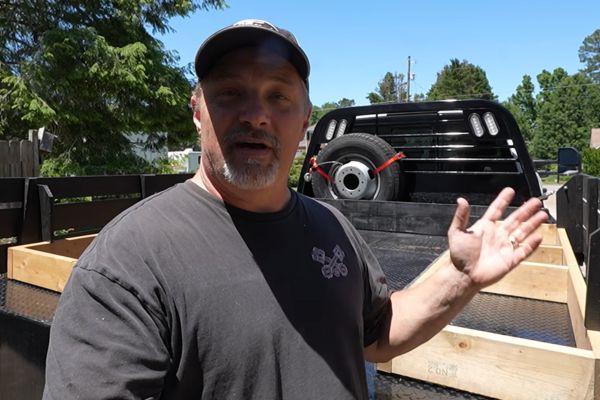
Next came the front bump stop, a reused piece built from a 2×10, angled ends, and 6×6 blocks. It fit against the headache rack and was bolted down, with a board placed behind the rack to protect the cab. One bolt had to move to clear a fill point. With the stop in place, the usable bed length measured 8’3″, which fits the Lance 1172 well and still leaves about 11″ of storage ahead of it.
The spare tire also fit in that front pocket. It sat at a slight angle against the headache rack and was secured with ratchet straps and a lock.
Side rails, storage boxes, and the last tweaks
The old side rails also came back into service. Because this truck uses the same brand of bed as the last one, the CM stake pockets lined up, and the rails dropped right in. Turnbuckles and eye loops held them upright. Then the side boxes went in to add storage and keep the camper centered so it could not slide left or right.
At first, the gap between those boxes was only 45 inches. The camper needed 48. So the boards were notched about 1 3/4 inches, which opened the space to a little over 48 inches. A front 7-pin plug, camper tie-down mounts, a detachable box mount, and shortened Torklift FastGuns are still on the list.
Final thoughts
This setup shows how much function a flatbed can add to a truck camper build. It also shows that even reused parts usually need a little rework, and those small measurements are what make the whole rig trip-ready.
The side rails and boxes are not required, but they make storage and fitment much easier. For anyone building a flatbed camper rig, that kind of simple, practical thinking goes a long way.
RELATED
- 2026 Aliner Switchback—an attention-grabbing, folding truck camper
- RV tech shares the pros and cons of truck campers
- Truck campers not welcome at some RV parks
RVDT2933