


Dear Dave,
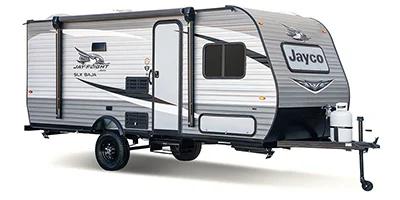
What is the best jack to use for changing a tire? —Charles, 2020 Jayco Jay Flight SLX 184BS
Dear Charles,
There are several factors to consider when looking for a jack that is best suited for your application. These include the weight of the rig, construction or underbelly support, how high it needs to go, and how much storage capacity it has.
According to JD Power’s website, your rig weighs 3,240 lbs. dry from the factory and has a carrying capacity of 960 lbs. That means the Gross Vehicle Weight Rating (GVWR) should not exceed 4,200 lbs. Since you won’t be lifting the entire rig to change a tire, we can say the jack should be able to safely handle 2,100 lbs.
More factors to consider
The next factor is the construction and what type of framework there is underneath for a lifting point. It is not recommended to lift the unit up with the jack placed on the axle, leaf springs, or shackles as it could bend and damage components. Some owner’s manuals specify where to place a jack, which is typically on the frame underneath at the perimeter. This could mean a very small frame piece, so you will need to inspect the area that the jack will make contact with.
Since the frame of this unit looks to be a little high off the ground, a small bottle jack might not lift the rig high enough to get the wheel off the ground. In this case you would need to add blocks of wood. I would suggest getting a jack that has the appropriate height instead.
And, finally, how much storage do you have. These compact units typically only have one or two storage compartments and they are not very large or tall.
I am not a fan of the bottle jacks as they don’t provide enough of a stable “footprint” on the ground, in my opinion. However, they don’t take up much room in a storage compartment. Same for the scissor jacks that have the threaded rod in the middle and lift up and down by turning the nut on one side.
Floor jack for changing tire
I have used a small floor jack for the past 30+ years for both my RV and my personal truck. This Big Red model is my favorite, and you can find it on Amazon here.
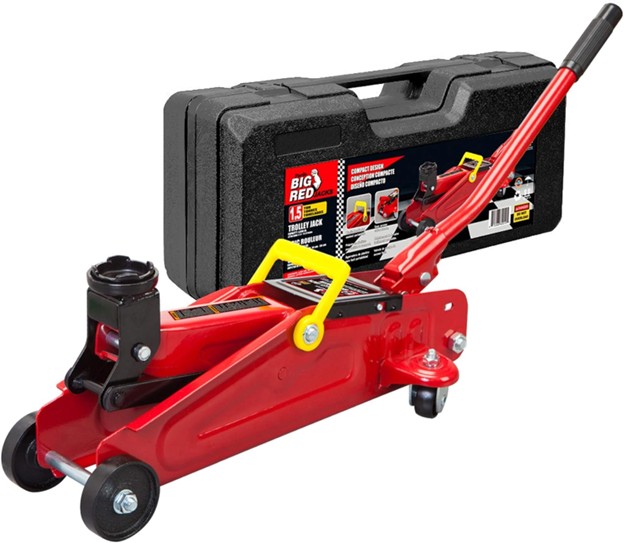
It has a nice weather-resistant carrying case that makes it easy to store in a compartment or in the back of a truck bed, like I do. The rollers make it easy to slide it under the rig. The handle twists into a slot and locks in place. It is rated to 3,000 lbs., and is an easy and quick up and down.
The problem with this jack as well as most others is it only goes to 13” fully extended. My truck and most trailers that I have worked on are at 18” to the bottom of the frame rail, so this needs some type of spacer.
Floor jacks with extension
There are some floor jacks that have a post-type extension for the pad. However, they are a little expensive in my opinion. I have to admit I have used several blocks of wood over the years to get the jack to reach.
However, this past summer while shooting content for the RV Lifestyle & Repair Club, I had the challenge to lift the trailer with the jack that was too short. This was just after shooting content of the Tire Block product, and it all came together.
Leveling blocks
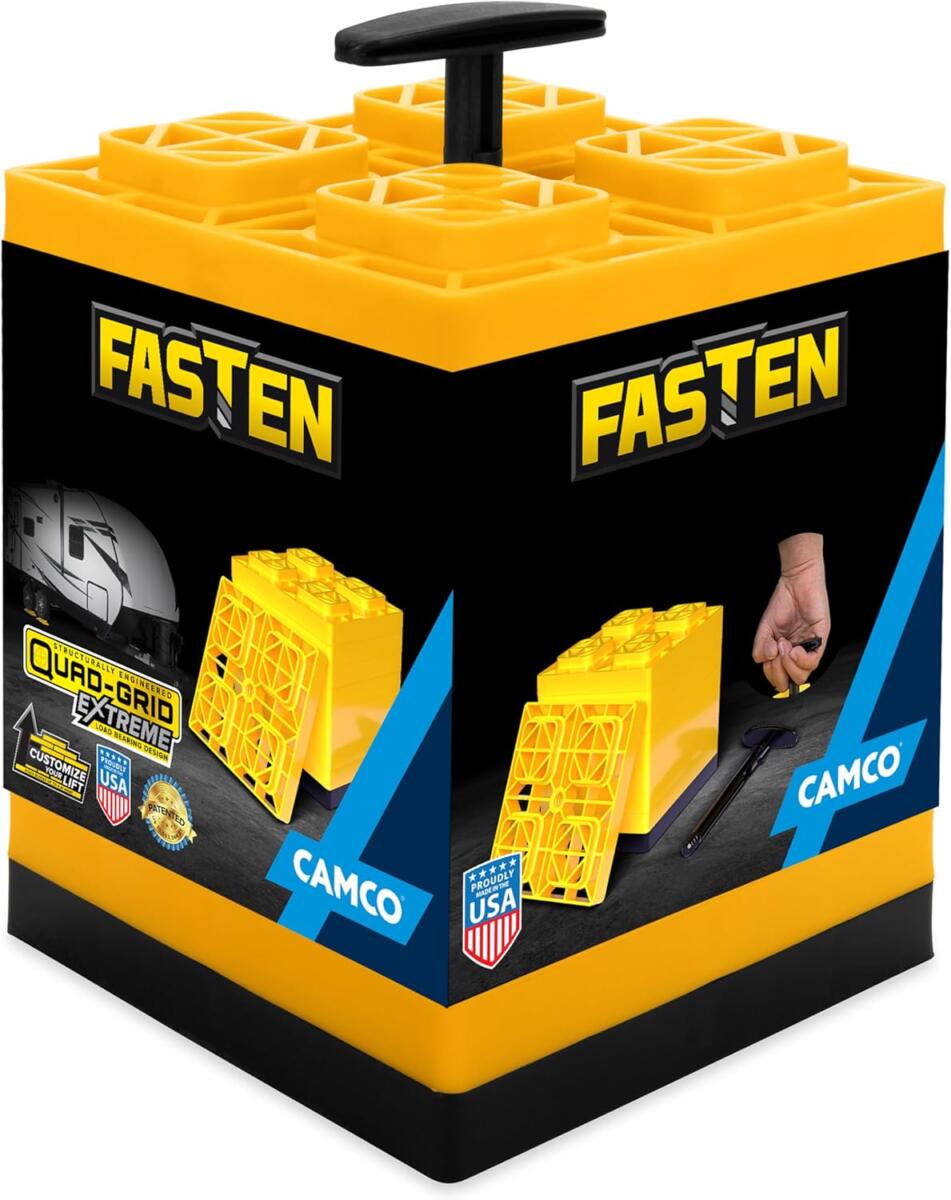
I already had a set of the Camco leveling blocks, so I used the appropriate number of blocks to get the right height. You can find them on Amazon here.
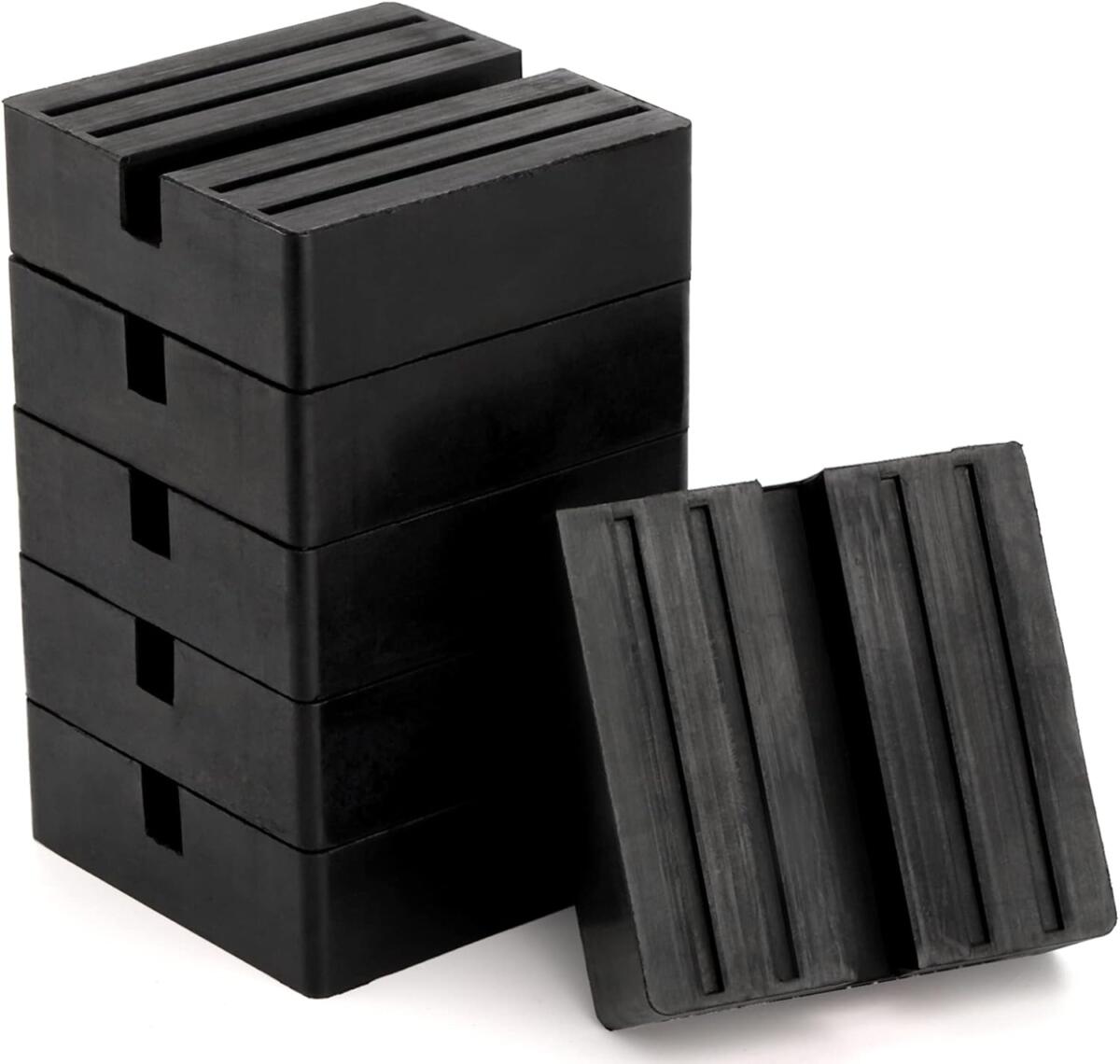
I also found these rubber blocks on Amazon that look like they would also work. I ordered a set and will try them out next spring when we shoot again.
Jack stands
And, as always, I support the rig with a set of jack stands for added safety. They are very inexpensive on Amazon here.

Of course, all this depends on the amount of storage room you have. I typically only bring one jack stand as I just need to support the edge, not lift the entire front end.
You might also enjoy these posts from Dave
- Should RV leveling jacks be retracted during winter storage?
- Can I use a small battery jumper to extend and retract RV jacks?
- My RV’s auto-level system doesn’t work. How do I recalibrate it?
- Are SnapPads on the RV’s jacks a good idea?
- Why aren’t the leveling jacks working?
- What is the best jack to change a trailer tire, and where do you place it?
DAVE HAS ANSWERED MORE THAN 1,000 readers’ maintenance and repair questions. Read a directory here. There is so much to learn!
Dave Solberg is a leading expert in the RV industry and the author of the “RV Handbook.”
RVDT2803

Don’t tow my single axle TT with a truck and very little storage space. I use a double-ram bottle jack with a frame cradle for safety. Because you can’t lift on the spring or axle (watch out for mechanics who will do so anyhow), you have to lift higher to get a tire on the hub. I also carry a pair of stacking screw jacks for safety as they are very stable, hold a lot of weight and take little space.
I think this is much better bottle jack), with jack cradle!
Discovered that the jack that came with my Silverado has a high lift and adequate capacity. Don’t need an extra jack for the trailer
I just bought the Tallboy as shown in RV Travel on Dec. 18. If it works as advertised then I can eliminate my other bottle jack and portable floor jack. It will be delivered today…a Christmas present to myself.
https://www.rvtravel.com/rv-gear-power-mountain-tallboy-jack-2800/
https://www.etrailer.com/Automotive-Tools/Power-Mountain/PM34FR.html
You are actually lifting ‘more’ than half of the total trailer weight. The pivot point is the opposite wheel. It’s probably closer to 3/4, or more, the weight since you will be shifting most of the weight to the other wheel.
It’s not like using the tongue jack. The wheels (pivot point) is closer to the center of the trailer.
And you can also place the jack under the spring mounting plate. It only take a few inches of lift to raise the tire.
I carry a bottle jack and a flat board to set it on in case of soft dirt. Jack stands a must! And don’t unhitch if you’re towing.
I bought something that looks like a quarter moon. It’s made out of aluminum. If you have a dual axle trailer, you drive one tire onto the device and it will lift that side of the trailer up so you can change the tire without a jack. Ez-peasey.
I bought the Camco Trailer Aid. Same principle. With any type of jack, you also need a jack stand for safety.
With the wheel type lift, the other wheel supports the load.
Thank you for the discussion, Dave! Very helpful information! Have a great day and safe travels!