

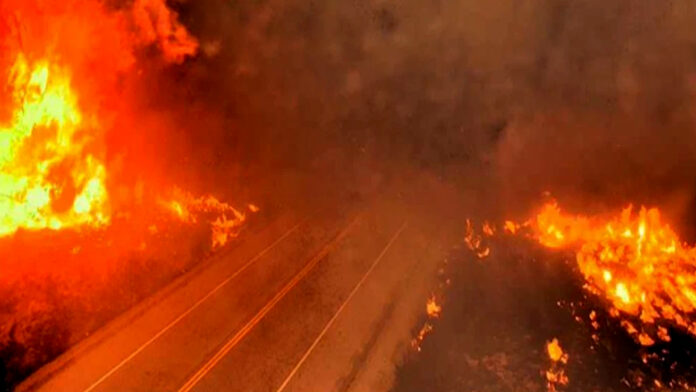
If your summer RV plans include the mountains, deserts or national parks of the West, wildfire safety for RVers should be part of your departure checklist. Large fires are burning across several Western states, and they can disrupt a trip long before you ever see flames. Smoke, road closures, campground closures and sudden evacuations often affect travelers well outside the immediate fire zone.
The National Interagency Fire Center reports 52 large active wildfires nationwide, burning more than 465,000 acres across nine states. Fire managers say hot temperatures, critically dry vegetation, gusty winds and low humidity continue to create dangerous conditions across much of the Southwest and Great Basin. Those conditions can change rapidly, making it important to check wildfire updates before every travel day—not just when you book your campsite.
“Smoke, road closures and campground evacuations often reach RVers long before flames do.”
You don’t have to be near a wildfire to be affected
Many travelers assume that if a wildfire is 50 or even 100 miles away, it won’t affect their trip.
Unfortunately, that’s often not the case.
Smoke can drift hundreds of miles, reducing visibility and creating unhealthy air long before flames threaten your campground. A campsite may remain open, yet outdoor activities become unpleasant—or unsafe—because of heavy smoke. Older adults and people with asthma, COPD or heart disease are especially vulnerable.
For many RVers, smoke becomes the first sign that something has changed. Next may come reduced visibility, road restrictions, campground closures or evacuation notices. Flames are often the last thing travelers actually see.
Fires are affecting travel across much of the West
Utah has drawn the most attention, but large fires are also burning in Nevada, Arizona, Colorado, New Mexico and several other Western states.
One example is Canyonlands National Park in southeastern Utah, where the rapidly growing Babylon Fire forced the closure of the park’s Needles District—a popular destination for RV campers, hikers and backcountry travelers. Campgrounds, trails, scenic drives and backcountry permits were all affected.
Elsewhere, the Cottonwood Fire in central Utah has grown to more than 93,000 acres, making it the nation’s largest active wildfire. Other significant fires are burning near Grand Junction, Colorado; north of Sedona, Arizona; and in parts of eastern Nevada frequented by RVers traveling between southern Nevada and Utah.
The situation changes daily. A route that’s open in the morning may close by afternoon if fire activity intensifies or smoke reduces visibility.
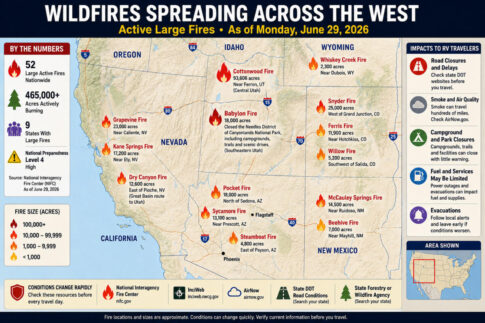
One of the most important parts of wildfire safety for RVers is checking conditions before every travel day
One of the biggest mistakes travelers make is assuming conditions haven’t changed since they made their reservation.
Instead, spend a few minutes each morning checking:
- Wildfire activity
- Highway closures
- Campground status
- Air quality
- Weather forecasts, especially Red Flag Warnings
A Red Flag Warning doesn’t necessarily mean a wildfire is burning nearby. Instead, it means weather conditions—typically strong winds, low humidity and dry vegetation—are ideal for fires to start and spread rapidly. If one is in effect where you’re headed, it’s worth paying extra attention.
Know when it’s time to leave
Mandatory evacuation orders rarely come without warning.
Often there are clues that conditions are deteriorating.
Ash begins falling around camp. Smoke grows noticeably thicker. Helicopters and air tankers become more frequent overhead. Fire engines begin arriving in the area. Rangers start visiting campsites to brief campers.
Don’t confuse “not under mandatory evacuation” with “everything is fine.”
If conditions are obviously worsening, leaving early may save hours of traffic—or keep you from driving through smoke after dark.
Keep your campsite ready to pack up
One of the pleasures of RV camping is settling in. The awning goes out. Chairs come out. Rugs are spread across the site. Bikes come off the rack. Grills and tables appear.
During periods of elevated fire danger, consider keeping your setup a little simpler.
If you’re asked to leave with only a few minutes’ notice, every extra item has to be packed before you can pull away.
Likewise, keep medications, important documents, pet supplies and chargers in places where you can grab them quickly.
Communications matter, too
Wildfires can disrupt power and cell service, especially in remote areas. Download offline maps before you leave, and carry a paper road atlas as a backup in case you lose cellular service and can’t access online navigation.
Help prevent the next wildfire
Many wildfires are caused by people—not intentionally, but accidentally.
RVers can help reduce the risk by making sure trailer safety chains don’t drag on pavement, never parking over dry grass where a hot catalytic converter could ignite vegetation, completely extinguishing campfires, following local fire restrictions and properly disposing of cigarettes.
Even portable generators should only be operated where they’re permitted and well away from dry vegetation.
A few minutes of caution can help protect public lands—and fellow campers.
Five websites every RVer should bookmark
These resources are among the best tools for wildfire safety for RVers and are worth bookmarking before every Western RV trip.
- National Interagency Fire Center (national wildfire activity)
- InciWeb (major fire information)
- AirNow (smoke and air quality)
- Your state’s Department of Transportation (road conditions)
- Your state’s forestry or wildfire agency
One of the great advantages of RV travel is flexibility. During wildfire season, that flexibility becomes one of your best safety tools.
If smoke fills a valley, a campground closes or your planned route becomes unsafe, changing plans isn’t a failure—it’s smart travel. Spending a few minutes checking conditions before each travel day may save hours of delays and help keep your next adventure headed in the right direction.
Sources
National Interagency Fire Center – National Fire News
National Interagency Fire Center – Incident Management Situation Report (pdf)
NBC News – Wildfires rage across the Southwest
SFGATE – Babylon Fire closes the Needles District of Canyonlands National Park
RELATED
RVT1268b
