


Dear Dave,
You’ve been very gracious in the past to reply to my questions, so I thought I’d reach out again.
We have a 2019 Grand Design 337RLS which we’ve been living in full-time since October 2020. This is our second straight winter in NE Pennsylvania, so the “four season” RV structure has definitely been put to the test. I’ve been told by Grand Design that the roof is a TPO Alpha Systems material.
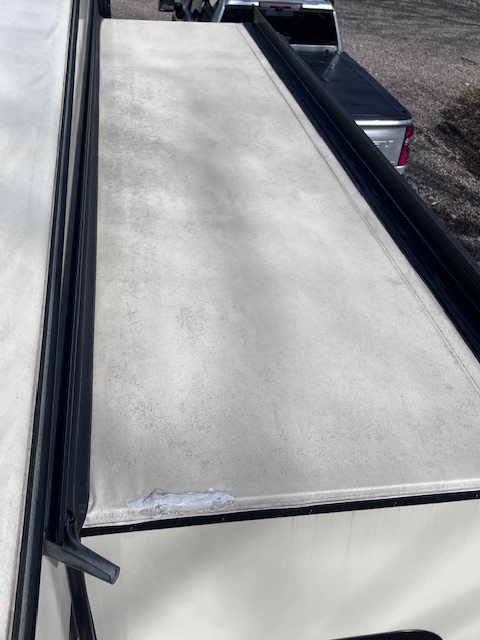
I have taken your roof maintenance advice to heart and used Murphy Oil or Dawn for washing/cleaning the roof at least once every 3 months, typically more when it’s not winter. I also spend time inspecting the roof itself, sealant in all areas (cleaning and resealing with Alpha Systems caulk) and inspecting all ledger screws on the roof/slide out perimeter where it is secured to the sidewall. In one of my photos, you’ll see a roof patch I made and have been keeping tabs on following a branch/slide out encounter.
Dark spots on RV roof
That all said, I have a dark-colored speckling that appears in a few spots on the main roof but is more prominent on the slide outs. I’m hopeful the pictures pick it up. I don’t know if this is a discoloring process that happens over time, or a breakdown of the TPO material. There is no evidence of the roof leaking that I can see or feel. Thoughts, suggestions?
I’ve also been considering doing a DIY roof recoating. I was at the Harrisburg RV Show and trust it was a solid experience for you. I did speak to the roof recoating vendor there. He threw Grand Design and their TPO roof install quality way under the bus—followed up by a $7,500 quote to make it right.
That further led me to want to reach out to you for your seasoned experience as to what you see in the real world as to TPO Alpha Systems roofing quality/durability. Any maintenance suggestions? Recoating product recommendations?
I’m cautious, but I am a willing DIYer. I made it a focus to learn as much as possible to repair and maintain our RV. Frankly, it’s been very rewarding to do so.
I greatly appreciate your time and any feedback you can provide. All the best. —Jeff, 2019 Grand Design 337RLS

Dear Jeff,
Thanks for attending the Harrisburg RV Show. Yes, it was a “solid experience,” as attendance was up 35% from the previous year and my seminars were mostly packed! I think I met you and we discussed the roofing guy; however, the whole weekend seems like a blur now.
I believe what you are experiencing is a mold growth, especially in a low area—which is the darker line in the middle. If you place a level side to side on your slide room roof, I think you would find a gap in the middle and water/moisture is settling along that low line. Any moisture and condensation would flow to the low spot and bring dirt with it, as well.
Mold grows on wet surfaces and actually grows on dust, dirt, and grime—not the actual roof material. Typically, Dawn Dish Soap has been beneficial in removing the dirt along with the mold. However, in your case, it might need a little boost with a fungicide product.
RVRoofMagic
I have recently had several conversations with the technical department at RVRoofMagic. You can find more information on their products here. There are dozens of roof conditioning companies and products coming out of the woodwork since the RV market has exploded. For years, Dicor has been the “go-to” roof conditioning product. However, there have been several discussions regarding that it does not hold up in heavy sunlight conditions.
According to the RVRoofMagic technician, their product is a solvent/catalyst-based roof product rather than an elastomeric version. It is superior in durability and longevity, chemical resistance and, most important, temperature stability. It does not expand and contract with temperature changes as much as some other products, which reduces cracking, fatigue, and thermal stress.
The RVRoofMagic technician also suggested using their cleaner, as it will emulsify the dirt and mold, which will bring it to the top of the material and can be rinsed off.
Mold will not grow without moisture. Looking at your photos, the room must have had water pooling in the streak area and just enough dirt to promote growth. From what I have seen on roofs and the samples I got from Alpha Systems, the material is much smoother than EPDM or TPO and should be easier to clean and dry. I would suggest trying some of the RVRoofMagic Cleaner or another fungicide to treat the dark areas and dry it off extremely well.
The Alpha Systems material is a solid color, not a black rubber that is “treated” with a color like EPDM is, so there should be no deterioration that causes a darker bleed-through. I don’t know that you would need a roof reconditioning. However, looking at the photo I do see several wrinkles in the upper left-hand portion that is on the actual roof. Whatever roof conditioning you are considering, those would need to be addressed before applying any coating.
If you showed the photos to the roof vendor, this might be why he quoted $7,500 for the process, as the current roof material would need to be pulled up and new adhesion applied. I doubt the entire roof membrane would need to be taken off—just pull up the corner where the ripples are and get them to lay down flat. We have had several posts on this recently—and several were Grand Design.
Check out RVRoofMagic Cleaner here and on Amazon here.
Also check out our own Cheri Sicard’s excellent article on her DIY roof reconditioning project.
You might also enjoy this from Dave
My RV needs a new roof. What are the pros and cons of PVC vs. TPO?
Dear Dave,
I have to get a new roof on my RV, scheduled for September. The RVgeeks recently did an article on TPO (what I have) and EPDM roofing, describing the pros and cons. My guy wants to use PVC. What are the pros and cons for this roofing material? —Jim, 1999 Fleetwood Discovery 36T
Dave Solberg is a leading expert in the RV industry and the author of the “RV Handbook.”
Read more from Dave here.
HAVE A QUESTION FOR DAVE?
Send your inquiries to him using the form below.
##RVDT2328

Jeff,
The black spots on your roof is organic growth (mold/moss), and is more common in cooler, higher humidity areas of the country. Unfortunately it is unavoidable. Left ignored for multiple years it will become a serious issue as it grows and spreads, hindering proper runoff, and retaining moisture. Fortunately with proper care and maintenance (which you have been doing), it is primarily a cosmetic issue.
As for a DYI project; if you are comfortable cleaning your roof, you can reseal it (proper cleaning and prep is the hard part). As for resealing products, make sure it is compatible with your roofing material, and follow all manufacture instructions.
YOU CAN DO IT!
Just a few additional notes: unless you are replacing the membrane (a project NOT recommended for the inexperienced, or faint of heart), do NOT remove the original caulking around the perimeter, vents, and roofing fixtures. Unless of course it is loose or pealing, only then carefully remove the loose pieces. Avoid any vigorous mechanical scraping and sanding, as it will cause delamination of the membrane from the roof underlayment.
Use self-leveling caulk where needed to avoid unnecessary buildup, and water ponding. Use a QUALITY roof coating. I have had excellent results with Duck Coat liquid thermoplastic rubber roof coating. duckcoat.com/duck-coat-roof-coating.
Continued…
A 5 gallon pail is enough for the recommended two coats on RVs up to 40′. And again! follow ALL product manufacture instructions. Use compatible cleaning products, and adhesive primer, and work in a cool shaded area. These products can be purchased on-line, or at most home improvement retailers. Total material costs will be around $500. That means the RV Service Center quoted you $7000 in labor! I can clean, caulk, prime, and reseal most RV roofs in under 30 hours (I’m old, slow, and meticulous). I’m sure a young roof jockey could slap on a recoat in half the time. I’ll let you do the math on their hourly service rate.
But if you don’t have the abilities, You’ll have to pay the man!
Thank you, Dave! Very interesting. Thanks and safe travels! 🙂
I made the mistake of buying a new GD fifth wheel in 2017…never again as I had so many problems with it , it was a constant nightmare. Especially the roof which had so many wrinkles it like corrugate tin. I sent numerous pictures to GD and was told by their “engineers” just to keep any eye on it,keep in mind it was under warranty. After fixing all the other problems on the trailer,due to lack of quality control and dealer inspection, I sold the trailer. Buyer beware on anything now days.