

As we have discussed a few times, the RV Industry Association (RVIA) relies on codes and standards set by the National Fire Prevention Association (NFPA), the American National Standards Institute (ANSI), and the National Electrical Code (NEC).
In an earlier post, we discussed the smoke alarm codes and the types used, and from that, I got an interesting question from a reader regarding the carbon monoxide detectors used in RVs. Here was the question/comment:
You should put something in about carbon monoxide detectors, and if the units being installed in all types of RVs are adequate to save a life, and will detect at what level. This is very important! Detectors should be calibrated to detect lower than 70, and should detect not only CO but also LP.
What standards do RV carbon monoxide detectors follow?
The code for residential application is a combination of NFPA 720 and Section 915 of the International Residential Code. It states:
Carbon monoxide detectors are typically required in dwellings with fuel-burning appliances or attached garages, and require UL 2034-listed alarms.
However, according to the listing on the Kidde site here, Texas and Missouri do not have a state-wide mandate, but rather allow codes to be adopted at the local level.
The location of the detectors/alarms seems to vary by state, as well. Some require units within 10 feet of every sleeping room and others at 15 feet.
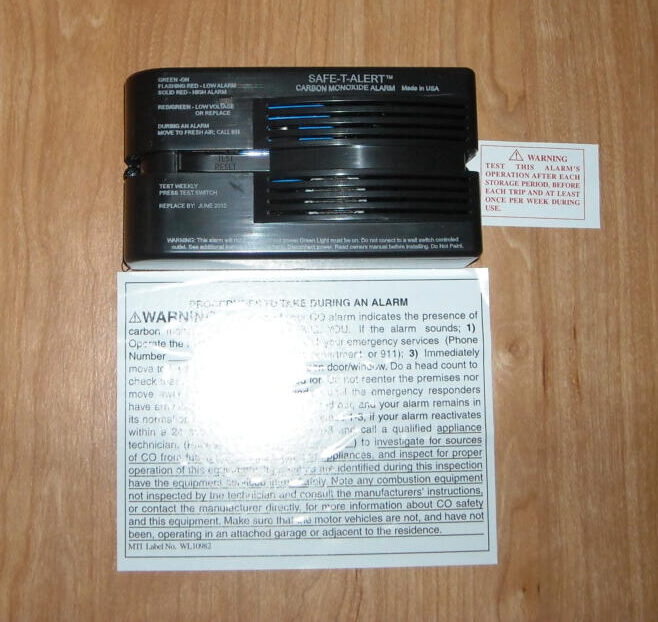
I contacted my “go to” code guy, who is Thor’s VP of Vehicle Safety & Regulatory Compliance and sits on several committees for RVIA. He stated that the CO detector must meet UL 2034. Combination alarms that detect CO and smoke detectors must have sensors that meet UL 2034 for CO and UL 217 for smoke detection.
Since smoke and CO disperse evenly throughout a room, the recommended placement is near any bedroom, as stated earlier, and at least five feet high on a wall or on the ceiling.
Are RV CO detectors sensitive enough?
According to the Underwriters Laboratory (UL) website:
Listed CO alarms must pass several tests to establish they work well in different occupancies, locations and conditions. This means the alarms must respond within set times when exposed to different levels of CO. The higher the concentration of CO, the quicker an alarm must respond. The levels are 400 PPM within 15 minutes or 100 PPM within 90 minutes, and no alarm under 30 PPM.
Where should carbon monoxide and LP detectors be installed?
Since smoke and CO disperse evenly throughout a room, the recommended placement is near any bedroom, as stated earlier, and at least five feet high on a wall or on the ceiling.
Units are also tested to help ensure they don’t trigger alarms for low CO levels, such as those from traffic or normal use of a fuel-burning appliance. They also cannot alarm when exposed to other vapors that may be present in a residence, such as methane and ammonia.
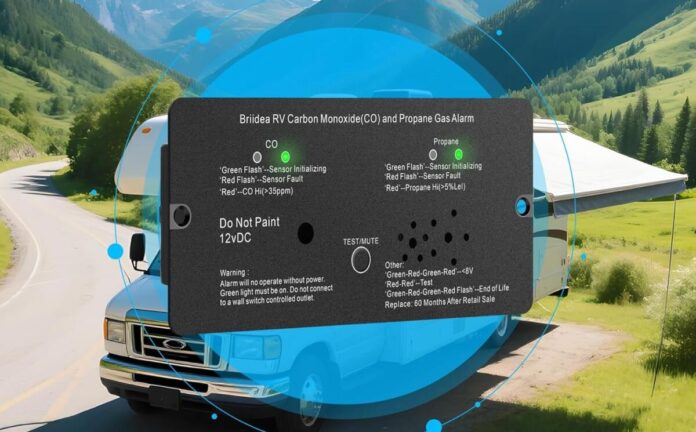
Since LP is heavier than air, it is recommended to place them closer to the floor or on the steps leading up to a bedroom in a 5th wheel. You can also find combination LP and CO detectors, as CO detectors can be placed just about anywhere since it disperses evenly. You can also find combination CO and smoke detectors, but not smoke and LP combinations.
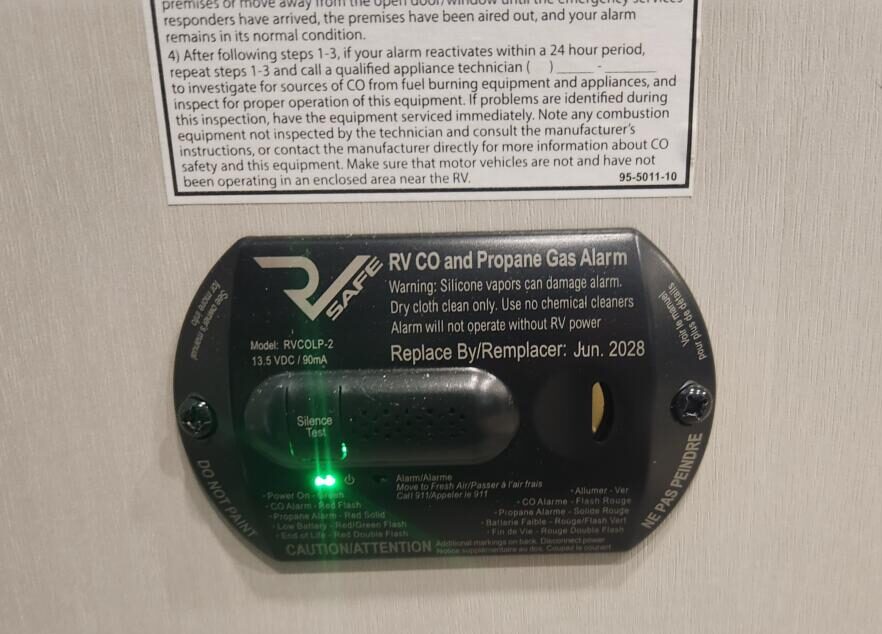
All detectors should be tested, with some recommending every month. Plus, batteries should be replaced every year, and look for an end-of-life date or alarm sound.
To professionally test a CO detector, you can purchase a can of CO test gas from Safe-T-Alert here.
Make sure you have a working carbon monoxide detector. If not, you can buy one here.
RELATED
- Your smoke alarm: Meet new code? Maintained properly? Critical info
- Does flame from RV stovetop create carbon monoxide inside the rig?
- Don’t be a carbon monoxide victim
DAVE HAS ANSWERED MORE THAN 1,000 readers’ maintenance and repair questions. Read a directory here. There is so much to learn!
Dave Solberg is a leading expert in the RV industry and the author of the “RV Handbook.”
HAVE A QUESTION FOR DAVE?
Send your inquiries to him using the form below.
RVT1260


When in your RV, especially with the slide in, be careful walking past your gas stove. You can brush against the gas turn on knobs and turn the gas on without lighting the stove. Luckily I caught it twice when the gas alarm went off.
I have witnessed this at shows as well! Someone leans back and pushed the stove top knob in and all of a sudden there is a horrible smell of propane. Even though there is not supposed to be any propane in a tank or cylinder inside a show! Most fire marshals don’t allow the DOT Cylinders on the tongue of travel trailers so I typically only seen it on a few motorhomes. The tanks are supposed to be empty; however, removing one wire makes the monitor panel not light up so they think it is empty.
Where should carbon monoxide and LP detectors be installed?
In our 2017 and in most RV’s the CO detector is installed near the floor, wouldn’t you agree?
Excerpts from AI: “Yes, a CO detector mounted near the floor is generally effective because carbon monoxide (\(CO\)) has nearly the same density as air and distributes evenly throughout a room.
Plug-in Units: Plug-in \(CO\) detectors near the floor are effective and often include, or can be, combo propane/natural gas detectors. Propane is heavier than air and must be detected low.”
I don’t recall if ours detects LP but if LP was detected at 5′ you’d really be in trouble in my opinion.
According to what I found on NFPA and several of the CO Detector manufacturers sites, it stated they should be mounted at 5′ or higher. However, most of these codes or recommendations pertain to a residential setting with cold air returns, ceiling fans, and other methods of having a good airflow in the house. In an RV, it’s a very confined space with typically only one cold air return and several areas that I call HVAC “pockets” where air is not circulated and just sits. Since most RV heaters have the vents on the floor, it seems wise to have the CO Detector mounted lower in my opinion. Even with some of the LP burning appliances such as a stove top or oven that might emit CO, those are typically only used for a short period of time unlike a furnace/heater and should never be used during the night for a heat source.
Dave, Have you ever researched the difference between CO detector rated for home use and those rated for RV use? Be curious as to what is actually different.