

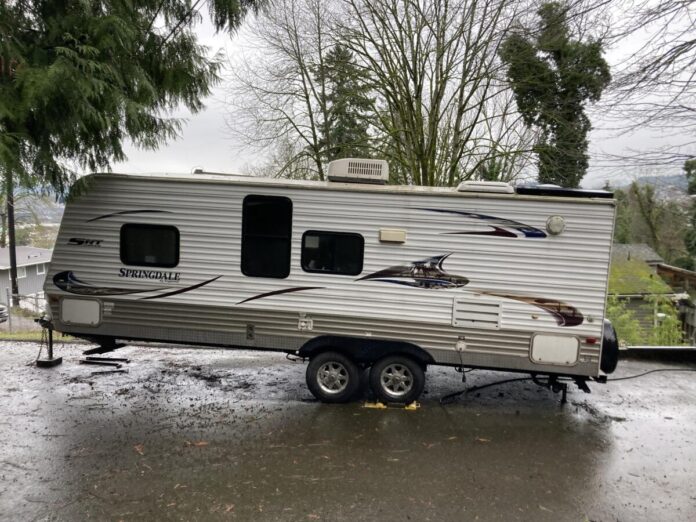
Detecting and correcting RV rain leaks is a must for preserving the life of your RV. Water intrusion can result in extensive damage to an RV if left unchecked. As someone who has been around RVs all his life and worked in and owned RV dealerships, checking RVs for rain leaks was one of my top priorities when the rainy season arrived—which, in Western Washington, is most of the year.
One thing I learned over all those years of finding and fixing RV rain leaks is that rainwater will always follow the path of least resistance.
I also learned to put that knowledge to work when I discovered one of the stock inventory units with an RV rain leak and no immediate way to get it under cover or into one of the service bays for repair.
By raising or lowering the nose of travel trailers or fifth wheels as far as possible, I could alter the path of the rainwater. By doing so, the path of least resistance for the rainwater began running off the RV roof onto the ground, rather than through the roof at the leak point into the interior of the RV.
While this didn’t work 100% of the time, it did work enough of the time to avoid rearranging the sales lot to get access to the one leaking unit. It also gave the sales staff a heads up if they spotted a unit with the nose all the way up or down: It had an RV rain leak and it was probably best to avoid showing it to a customer.
This tip may also work with motorhomes
This method could also be applied to motorhomes with leveling systems or enough room to drive up on ramps. In the case of units with leveling systems, you would want to raise the front up as high as possible, as it is never safe to raise the rear wheels off the ground.
Note: Always lift evenly, as twisting the chassis can cause doors or slide-outs to bind, Class A windshields to pop out, or worse.
Remember, check your RV frequently for RV rain leaks in the rainy season. If you discover a leak and are unable to immediately get it under cover or into a service bay at your local RV dealership, raise or lower the nose of the RV as much as possible to hopefully encourage the rainwater to run somewhere other than the interior of your RV.
Here is some good information on rubber RV roof sealant when you get a dry day to fix the leak.
RELATED
- How to perform an exterior RV body reseal to protect RV from water damage
- RV inspector shares how to catch RV water damage early
- Preventing major water damage to your RV slide-out roof
- Your RV takes on water damage through more than rain. Protect those sealants!
RVT1249

Great tip to raise or lower the nose. It saved the day for some friends of ours who discovered a leak over their bed one night. Tnx.
I dunno. Tossing a tarp thus eliminating the water touching the roof works pretty good.
That only works if you know you have a leak. My trailer is stored over the winter and we only check on it a few times during the storage period.
Never use a tarp as a long term cover.
Absent a leak, there’s not much reason to slope your rig either my friend… 😉
Helps to keep black streaks off the sides. Most of the water will run towards the rear during a harder rain. The tiny gutters can’t handle a lot of water flow.
I always raise the front. Also helps to prevent black streaks down the sides.
I use a 6×6 block under the tongue jack so I don’t have to overextend the jack.
We were in a very off-level campsite during some heavy rain with the MH tilted to the passenger side. The leveling system was unable to fully compensate. Water started leaking out of a ceiling AC vent near the front of the MH. When we arrived home, I climbed up on the roof to find that the front AC shroud was missing. Since replacing the shroud, that’s not happened again, but it’s not clear if the missing shroud caused the leak or, more likely, there’s an issue with the AC roof gasket.