

In the first installment of this series, we collected battery consumption data (battery shunt current displayed in Amps) from the actual usage of our RV for each item connected to the house battery. In the second installment, we measured the amount of current you consumed with the shunt while using the RV in the same way we would expect when no shore power is available.
(Make sure you read both parts one and two before continuing on.)
This time, we’ll see how to determine the amount of stored energy necessary to operate your RV the way you expect to use it when disconnected from shore power for some amount of time.
Collect your data in a spreadsheet/table
A spreadsheet or table can be used to calculate the 12-volt energy you need to operate for some period (24 hours in this example) without access to shore power. Fill in the number of amps shown on the shunt display for each item and the number of hours you expect to use the item.
| Item name | Amps@12VDC | Watts = A*12 | Hours per day | Watt-Hrs / day |
| Baseload | 2 | 24 | 24 | 576 |
| Refrigerator LP | 0.9 | 10.8 | 24 | 259 |
| LP furnace/fan | 6 | 72 | 1 | 72 |
| Lights | 2 | 24 | 4 | 96 |
| LP water heater | 0.8 | 9.6 | 24 | 230 |
| TOTAL Energy: | 1234 |
The table above is an example of a spreadsheet you could make. You can copy this spreadsheet or make a manual table and fill in your own shunt current measurements and the number of hours you expect to use each item in the list.
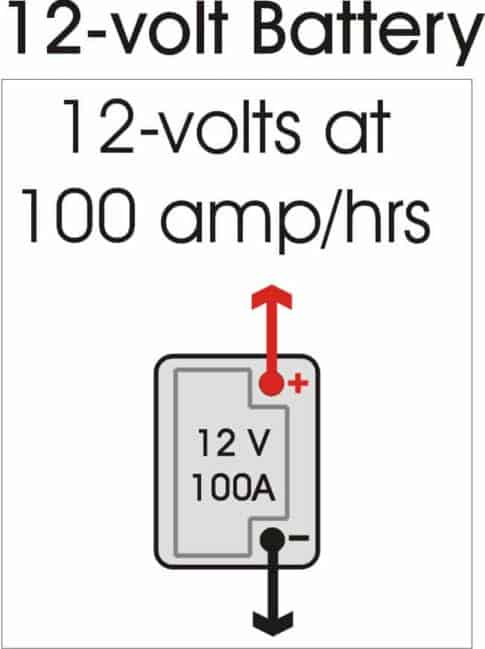
The total energy used in this example is 1234 Watt-hours, which is roughly the capacity of a typical 12V, 100 100-amp-hour lithium battery: 12V*100Ah = 1200 Watt-hours. One Lithium Iron Phosphate (LFP or LiFePO4) battery of this type is probably the bare minimum for such a scenario, with no margin for errors in the estimate.
Compare estimates of energy usage
Compare the estimate above to the current measured in Amp-hours of battery energy used in the second part of this article series, where you used your unplugged RV. Multiply the number of Amp-hours from the shunt by 12V and divide by the number of hours in your test run to see how many Watt-hours you actually used during the test period.
If your unplugged RV test took 5 hours and your shunt indicated that you used 20 Amp-hours from your house battery, then the rate you used energy during each hour of your test is 20 Ah/5 hours or 4Ah per hour. If you use power at that same rate for a 24-hour period, then the total would be 4Ah*24 = 96 Ah total.
How much battery capacity do you need?
Since both estimates are close to 100Ah, that is a reasonable estimate of the size of the MINIMUM usable house battery bank you need for your rig. That’s equivalent to one 100Ah 12V lithium battery or two 12V 100Ah lead-acid batteries, since they should only be discharged to 50% of capacity. A better choice would be two lithium batteries providing 50% reserve capacity, and operating for about two days before depleting the battery.
The cost of a decent 12V 100Ah lithium battery is currently in the $200 range, and they are superior to lead acid in most respects. Lithium batteries are probably the best choice if you plan to upgrade or purchase a replacement battery, anyway.
There are other things (compatibility with your converter/battery charger) you should consider if you plan to switch from lead-acid to lithium batteries, but that is a topic for another article.
Once you know how much energy you need to store in your house batteries, you need to consider how to charge them. You can choose from many options, including solar panels, vehicle engine alternators, or generators to charge your batteries, topics to be covered in future articles.
RELATED:
- All about solar: Types of panels, buying tips, and more
- What can I power with one solar panel and one battery?
- Do solar panels inside windshields work?
RVT1217

Clear, concise info Ken! Looking forward to the next installment 🙂
Thanks for the feedback – it’s kind of dry boring stuff, but unless price is no object, knowing what you really need is key whether you buy or DIY.
-K
Thank you for organizing the decision process, Ken. It is much easier to get to the correct answer or end point if one follows a logical path, never putting a cart before a horse. Have a great week and safe travels!
Thanks – that’s what engineering economics is all about! -K
Why use watt-hours when batteries are rated in amp-hours? Amps are the same whether you are using 12v DC or 120v AC. It just adds an extra calculation when your goal is to see how many amps your batteries have remaining.
Yes, using Ah (Amps*hours) is more intuitive while dealing with a 12VDC system in an RV. This is especially true with batteries since they are rated in Ah. However not all RV house batteries used for storage of solar energy are 12V – some systems are 24V, 36V, or 48V to reduce the size, cost, and wire heating losses in a power system. Specifying a device that uses 120W is a more generic way to represent power, since Watts (power) =volts*amps. For a 12V system a 120W load is 10A, for a 24V system it’s 5A, and for a 120Vac it’s 1A. Also power is dependent on voltage, which can vary depending on the state of charge of the battery, and how much it’s loaded especially for lead-acid batteries.