

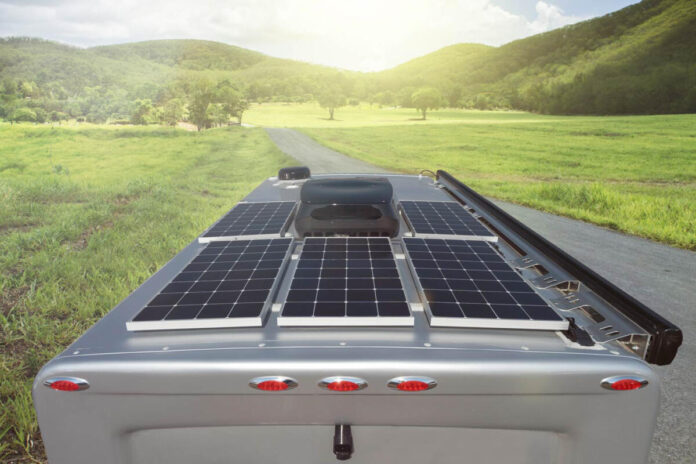
Part 1: Understanding RV solar system sizing is crucial for optimizing energy efficiency in your setup. This introductory part will guide you through the essentials.
By Ken Arnold, The Electron Plumber
You’ve probably seen this happen to others if it hasn’t happened to you: A slick salesperson convinces a homeowner to buy or lease a solar system and then, after it’s installed, the homeowner finds that the system is not what they want or need. Solar installers make more money by selling more and bigger systems, not necessarily what meets their customers’ needs. Unless you don’t care how much it costs, you’ll want to aim for “good enough,” not the biggest commission for the salesperson.
It can also be a significant investment for an RV upgrade, much like a vehicle purchase. You wouldn’t want to get stuck with (and pay for!) a big gas guzzler if what you really need is an economical, high mpg sedan for your daily commute.
Why proper RV solar system sizing starts with data
Part one of this article will cover the best way to size an upgrade to the 12-volt DC electrical power system in your RV to enable you to make an informed decision based on your actual power and energy usage. Only one relatively simple device is needed to gather the data, and you will only use simple arithmetic to calculate how much power and energy you need.
Calculating what is truly reasonable for you implies you have good data to start with, and that depends on many different things that are unique to your rig and how you use it.
Home vs. RV solar: Why the approach is different
There are excellent tools to estimate the size of a fixed home solar system based on your electric utility billing history, but not for RVs. And it also depends on how you want to use your RV. If you usually have an electrical hookup and only need limited power while on the road, you may not need to do anything. But if you want to use your rig without an electrical hookup, you will likely need something more than what is in a basic RV.
The one tool every RVer should have
Spreadsheets and other tools you can use to calculate rough estimates are available, but they are a hassle to set up and not very accurate. If you want to know what you need to upgrade in your RV’s 12-volt DC electrical system in the form of solar panels, chargers, or batteries for your rig, the very first thing you should get is a battery monitor. A monitor will help you keep your existing 12V battery healthy and tell you how much 12-volt power you use when you’re in your rig and don’t have a shore power connection.
Choosing a battery monitor that works for you
The built-in battery capacity LED displays shipped in most RVs are nearly useless for this. You need a good battery “fuel gauge” to monitor the charge (energy) stored in your house battery. A battery current monitor (called a shunt) is a good way to find out how much current everything in your rig uses. That way you can figure out how much battery capacity (energy storage) and how many solar panels (power) you will need when you aren’t connected to shore power.
There is a wide variety of options, but this is one of those things that makes a higher-quality shunt worth the additional cost. A good one will play well with other electrical systems and likely last a lot longer than budget versions. Most people prefer a unit that will connect to a phone using Bluetooth, but if there’s a display, you can collect the numbers manually.
Most house batteries provided by RV manufacturers are 12V flooded lead-acid or AGM types, but newer RVs may have different battery voltages and types. The shunt goes between your 12-volt house battery’s negative terminal and everything that’s currently connected to the battery’s negative terminal in your rig. The instructions are reasonably clear, but if you have any doubts about it, your dealer should be willing to help walk you through it. A mobile RV service tech should be able to install it in well under an hour.
Before you buy: Measure your real power needs
Don’t buy anything else until you have the shunt installed and have a chance to measure your actual 12V energy usage. Later, you can use the data you collect to determine how much power and energy you need.
After the shunt is installed, you can begin to measure how much energy your rig uses when it’s in use. The display or Bluetooth app for your phone should display the % remaining energy in your battery, how much current is going in or out of the battery, and how long it will last if nothing changes.
Start in a place with a shore power connection. After your house battery capacity is at 100% capacity (fully charged), turn off all the lights and other devices in your rig that can be switched off and disconnect the AC shore power cord on your rig. Determine how much power is used when everything is turned off.
Usually, there will be some amount of power drained even when everything is powered down. Some devices, such as smoke and propane detectors, cannot be turned off in some rigs.
Next, turn on all the 12-volt electrical devices one at a time, noting how much current each item takes to operate.
How long will your battery last?
You can also find out how long you will be able to last on battery power only. You can also use the shunt’s display or phone app to see how much energy is left in your existing battery. Lead-acid batteries that come with most RVs should not be discharged below 50% of their rated capacity or their service life will be impaired and need early replacement.
Preparing for the next step: RV solar and battery sizing
Once you have that info, it will be easy to figure out how many solar panels, what kind of battery, and how much battery capacity you will need for your DC 12V system. The next part will address the calculations you need to perform to determine how much 12V DC power you need. Later parts will discuss the AC (120-volt) power system in your RV to help you decide what, if anything, you want to use when you aren’t connected to shore power.
Quick definitions: Power vs. energy
Electrical Power (P) is measured in Watts, an instantaneous measure. Power can also be measured in different units, like horsepower (1 HP = 760 Watts). It’s the product of instantaneous Voltage (V=volts) and current (I=Amps) and P=V*I. So a 12V device like a lamp uses 1 Amp and consumes 12*1 = 12 Watts when it’s on.
Energy is Power times the amount of time that power is applied. At home you pay for the total energy used, which is the average power over a time interval, usually an hour. Using the 12V lamp above for one hour would use 12 W*1 hour or 12 Wh of energy in one hour of operation.
Energy = P*time, usually stated as Watt-Hours (Wh) or thousands of Watt-Hours (kWh). At home, your energy usage is shown as kWh on your electric bill.
Ken Arnold, The Electron Plumber
Ken is a long-time RVer, electrical engineer, author, and recovering academic who believes you have to get old, but you don’t have to grow up. Now he has fun playing with big toys like his RV, e-bike, and plug-in hybrid car.
RELATED
- All about solar: Types of panels, buying tips, and more
- What can I power with one solar panel and one battery?
- Do solar panels inside windshields work?
RVT1214

Thanks for sharing. Look forward to your future articles.
You’re welcome – the next one should be in the Sunday newsletter. – Ken Arnold
Very good guidelines, well done.
Thank you Les – feel free to suggest other ideas on solar and post questions on RV electrical topics here in the comments. – Ken Arnold
I prefer amp-hours to watt-hours in measuring power consumption in my RVs. There is no difference between amp-hours consumed by my 12v systems directly from my Li batteries and the 120vac systems powered by my inverter from the Li batteries. With watt-hrs, the voltage is just an extra, unneeded calculation (W = A x V). My batteries have an A-hr maximum rating, not a W-hr maximum rating.
Yes, you’re correct — current in A and Ah makes more sense for 12V batteries, but power in Watts and energy in Watt-hours are more useful when comparing other elements that are rated in Watts, such as solar panels, AC appliances, inverters, and similar devices. If you know the power used in Watts you can divide by the voltage to determine the 12Vdc and 120Vac load currents in Amps. That’s useful when determining how much battery and shore current is used, since they are typically limited by a circuit breaker or fuse from either source. Then you can convert the 120VAC or 12VDC load current by multiplying and dividing by 10. For example, a 120W load draws 1A@120V and 10A @12V. – Ken Arnold
Never buy Solar. The expense will never repay. You could go to the finest RV parks across America for less than the cost of solar and enjoy all the amenities, including electricity!
Sorry you had a negative experience with solar systems, Brian. Unfortunately that is far too common for systems that are sized bigger than they should be by businesses just to maximize their profits. The point of this article is to say that everyone should determine their own needs for solar power and pick something within their budget that makes economic sense for their situation. Everyone has a different situation. In my own case, I sized the solar systems for both our home and boondocking in our RV, and they both reached economic break-even in less than 3 years without tax incentives because of our individual usage and needs, so now our electric power is virtually free. – Ken Arnold
What if you want to spend your time in a peace and quiet open space, not a Rv park? Thats where solar has the advantage over shore power. I don’t really care for Rv parks and the cramped spaces, and sometimes rude folks that are loud….
ROI on A RV usually doesn’t pencil out anyway, but you enjoy your RV park, and I will enjoy my solitude without the genny running 😃
Thank you for the discussion, Ken! I appreciate you taking the time and making the effort to share your expertise. Have a great day and safe travels!
You’re welcome! Feel free to post any questions you have in the comments and I’ll do my best to answer them. – Ken Arnold