

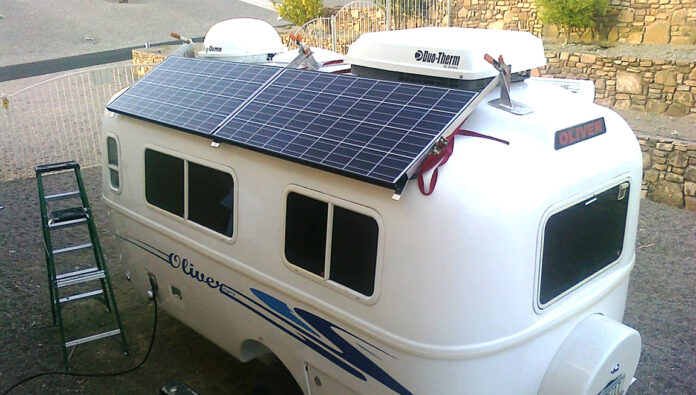
This is the second in a series of articles on RV solar system sizing. Before you continue, make sure you read part one to discover just how much power and energy you need.
Why solar needs vary, and what to know before you buy
The right answer to the question of how much power and energy you need is “it depends.” How much solar (and battery) capacity you need in an RV varies widely depending on how and where you use your rig, which is very difficult to estimate accurately, but relatively easy to measure with a current shunt. Depending on how and where you use your rig, you may not need to install any solar panels or add any other gear. If you want to use your rig for extended periods off-grid, you’ll need to know how much and what kind of electrical upgrades to make.
You should find out how much power and energy you will need, regardless of whether you will hire someone else to install your solar system or you plan to install some or all of it yourself. Otherwise, you may end up paying a lot more than you need to, or not have enough power or energy when you use your rig off-grid. Accurate RV solar system sizing prevents these costly mistakes.
Using a current shunt to measure power
The first article covered collecting actual usage data to determine how much 12-volt DC power and energy you will need from your house batteries to run the various items in your RV. This is achieved by adding a device called a current shunt to your house battery and measuring how much power each item requires. This is done by turning on all the 12-volt electrical loads (12DC-powered devices) one at a time and noting how much power each item takes to operate.
You will also need to determine how much energy capacity your existing house batteries can hold, usually specified in Ampere-hours (Ah), usually at 12 volts DC. Many RVs come from the factory with a single 100Ah 12V lead-acid battery (or two 6V batteries connected in series to provide 12V).
Understanding battery capacity and energy
The energy capacity is the product of the voltage and Ah capacity: Watt-hours=12*Ah. So a 12V battery rated at 100Ah will store a maximum of 12*100 = 1200 Wh or 1.2kWh. If it’s a lead-acid battery, you only want to use half that, or 600Wh. Over a 24-hour period, that’s only 600Wh/24 hours = 25 Watts average—not much power. That may be about what your rig uses when most everything is turned off!
Testing battery usage without shore power
The next step in RV solar system sizing is to go to a place where you have 120VAC shore power available (120 volts alternating current).
First, plug into the power pedestal or other source and ensure your house batteries are fully charged. Then turn off the circuit breaker and unplug your RV, and make a note of the time. Then use your rig as you normally would when using it in a location where you don’t have shore power, keeping track of the amount of power and charge in your house batteries.
If you have traditional lead-acid batteries, don’t let the batteries discharge below 50% to avoid degrading their long-term life and capacity. Those are either liquid sulfuric acid batteries that need to be refilled with distilled water occasionally or AGM (Absorbed Glass Mat, no maintenance) batteries.
If you have lithium batteries, also called LFP, or LiFePO4 (Lithium Iron Phosphate), you can let them drain down to 10-20% of full capacity or lower with no adverse effects over a roughly 10-year service life.
There are some very different scenarios for using your electrical devices when disconnected from shore power. It might only be for brief stops on a travel day between parks with full hookups. Or you might be leaving your RV parked unoccupied for a while, or boondocking for a night along the way. Or it might be an all-out, off-the-grid stay for multiple days on public lands.
Track energy use over time
Once you have recorded the amount of energy used over a typical usage period in each case, you can plug in your shore power cord and turn on the corresponding circuit breaker to restore the charge to your house batteries.
Estimate your runtime and battery limits
You will also find out how long you will be able to last on battery power only using the shunt’s display or phone app to see how much energy is left in your existing battery. Lead-acid batteries that come with most RVs should not be discharged below 50% of their rated capacity or their service life (typically 3-5 years) will be impaired and require early replacement.
Planning the right-sized solar system
Once you have that info, it will be easy to figure out how many solar panels, what kind of battery, and how much battery capacity you will need for your DC 12V system.
The next part will address the calculations you need to perform to determine how much 12V DC power you need. Later parts will discuss the AC (120-volt) power system in your RV to help you decide what, if anything, you want to use when you aren’t connected to shore power.
What’s coming next?
In the next installment, we’ll determine the size (and cost) of the components required to meet your needs for the way you use your RV.
Terms defined:
Battery capacity is rated in Ampere-hours (Ah), usually how many hours the battery will last at a very low current such as 1 Amp.
Battery energy capacity in Watt-hours (Wh) is the product of Ah*Voltage. A typical 100Ah 12V house battery stores 1200Wh = 1.2kWh, at most.

Thank you for this helpful information, Ken! Have a great day and safe travels!