

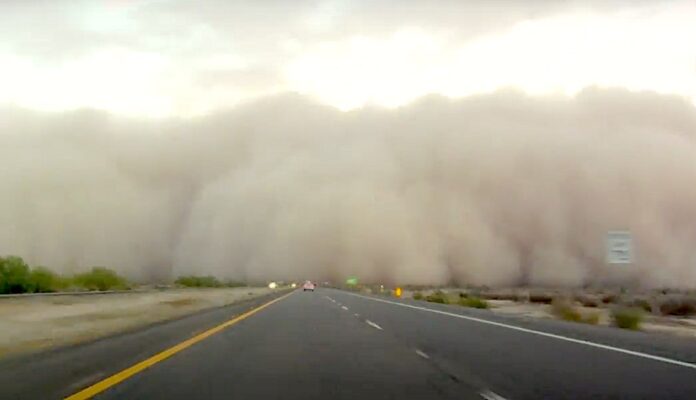
Monsoon season is back to the Southwest. While the exact moment of when the first massive wall of dust will rise up from the desert floor isn’t known, we do know this: It’s coming and could stay around through September. Arizona and New Mexico are ground zero for the storms.
With June 8-14 officially proclaimed Monsoon Awareness Week in Arizona, now is the perfect time to brush up on the actions drivers can take to stay safest when confronted with blowing dust.
Monsoon thunderstorms can produce strong downdrafts of precipitation-cooled air, resulting in microbursts—wind gusts that can exceed 100 miles per hour, and thunderstorm outflow winds capable of generating areas of dense blowing dust.
The No. 1 thing motorists can do to stay out of harm’s way? Do. Not. Drive. Into. A. Dust. Storm.
That’s a really bad idea. Visibility can drop to zero and turn pitch black, meaning you’re driving blind and so is anyone else on the road with you. But maybe you’re curious and wonder, “Just how dark and dangerous could it be?” Well, we’ve got the answers.
The video below shows how quickly visibility is reduced to nearly zero after driving into a dust storm.
What to do?
OK, so now you’re convinced to not make the decision to drive into the towering wall of dust. But what if a dust channel whips across the highway in front of you, engulfing your vehicle in a swirling sandstorm? Remember these words: Pull Aside, Stay Alive.
The Arizona Department of Transportation (ADOT) has developed the following “Pull Aside, Stay Alive” dust storm safety driving tips, which can help motorists survive a blowing dust event:
- If you encounter a dust storm, immediately check traffic around your vehicle (front, back and to the side) and begin slowing down.
- Do not wait until poor visibility makes it difficult to safely pull off the roadway—do it as soon as possible. Completely exit the highway if you can.
- Do not stop in a travel lane or in the emergency lane. Look for a safe place to pull completely off the paved portion of the roadway.
- Turn off all vehicle lights. You do not want other vehicles, approaching from behind, to use your lights as a guide and possibly crash into your parked vehicle.
- Set your emergency brake and take your foot off the brake.
- Stay in the vehicle with your seat belt buckled and wait for the storm to pass.
- Drivers of high-profile vehicles should be especially aware of changing weather conditions and travel at reduced speeds.
More information on dust storm safety can be found at PullAsideStayAlive.org and safety tips for driving in rainstorms can be found at azdot.gov/monsoon.
MORE ON SAFE DRIVING
• Blowing in the wind: Truckers’ tips for safe driving
• Watch a tow truck winch up an RV blown over by wind
• Favorite wind apps and tips from our readers
• Tips for safe RV driving on snow or ice
• Driving safety: What we’ve learned from highway mishaps
RVT1213b

Thanks for the guidelines RV Travel.
I always thought monsoon season was torrential rain.
“Monsoon thunderstorms can produce strong downdrafts of precipitation-cooled air, resulting in microbursts—wind gusts that can exceed 100 miles per hour, and thunderstorm outflow winds capable of generating areas of dense blowing dust.”
Thank you for the warning, RV Travel! My, that is horrific. I may do well to stick to the dangerous natural events we have in the Southeast. All y’all out west be careful, real careful. Have a great weekend and safe travels!