


By Dave Solberg
Dear Dave,
My question is regarding axle ratings versus GVWR. My trailer has two 6,000 lb. axles and a GVWR of 14,343. How much cargo can go in this trailer without overloading it? The manufacturer says it can haul 4,171 lbs. worth of cargo. Hitch weight is 2,343 lbs. Dry weight is 10,172. Are these axles correct? —Brett, 2023 Cedar Creek Experience 2925RL
Dear Brett,
Even though I have spent a great deal of time researching weight ratings and feel fairly comfortable when it comes to general questions, yours is a lot more complicated and complex than usual. Therefore, I went to the expert, Trey Selman at RV Safety & Education Foundation (RVSEF).
Here is Trey’s response.
How much cargo can go in this trailer without overloading it?
Trailers can be overloaded in multiple ways. Exceeding the GVWR (gross vehicle weight rating) is one way. The GVWR is set by the manufacturer and is the maximum allowable loaded weight of the vehicle. The GVWR is on the Federal certification label on the front driver’s side of the trailer.
The manufacturer also helps the owner understand this by providing another sticker with the Cargo Carrying Capacity (CCC) label, which is found in two places. First, another label near the Federal certification label, and the second location is a yellow label on the forwardmost passenger side door.

The CCC is the difference between the unloaded vehicle weight (UVW) with all the specific vehicle’s optional equipment installed at the factory with full propane tanks. In America, the CCC calculation does not include the weight of water in the holding tanks. The CCC identifies how much cargo can go on the trailer without exceeding the GVWR, which is the same thing as overloading the vehicle.
Overloading the axles
Another way the vehicle can be overloaded is by overloading the axles. The manufacturer also includes GAWR (gross axle weight rating) for each axle on the vehicle. This is also on the Federal certification label and is the maximum allowable loaded weight for the axle assembly. Exceeding the GAWR is another way the vehicle can be overloaded. Axles can also be overloaded if one end of the axle exceeds more than half of the GAWR.
The pin box also has a rating that could be exceeded, and the hitch has two ratings that could be exceeded. Tires also have weight ratings which may also be exceeded.
Solutions to overloading
The solutions to overloading vary depending on what is overloaded. If the GVWR is exceeded, then the only option is to remove items from the vehicle to get the weight under the GVWR. If axles or axle ends are overloaded, then weight may need to be moved to another location on the vehicle.

Are these axles correct?
If the Federal certification label states that the GVWR is 14,343 lbs., then two 6,000-lb. axles are more than sufficient for the trailer.
RV trailers are semi-trailers, which means that all of the weight of the trailer is carried on the frame of the trailer, but not all of the weight of the trailer is carried by the trailer axles. Most of the weight of the trailer is carried by the axles, but a portion of the weight of the trailer is loaded on the tow vehicle.

The part of the weight of the trailer that is loaded on the tow vehicle is called pin or tongue weight. Sometimes this is also called hitch weight. This part of the weight of the trailer is cargo weight that is loaded on the tow vehicle, just like the weight of any other cargo item that is placed on the truck.
Pin weights for RV trailers are designed to be between 15-25% of the weight of the loaded trailer. Therefore, if one loaded this trailer to the GVWR of 14,343 lbs., then the pin weight could be somewhere between 2,152 lbs. and 3,586 lbs.
Dry (unloaded) trailer weights and dry (unloaded) pin/tongue weights that are found on websites are not very useful. Once the trailer is loaded these numbers will change.
Tow vehicles also subject to overloading
What has not been discussed in the answer to these two questions is that tow vehicles are also subject to overloading in more ways than RV trailers.
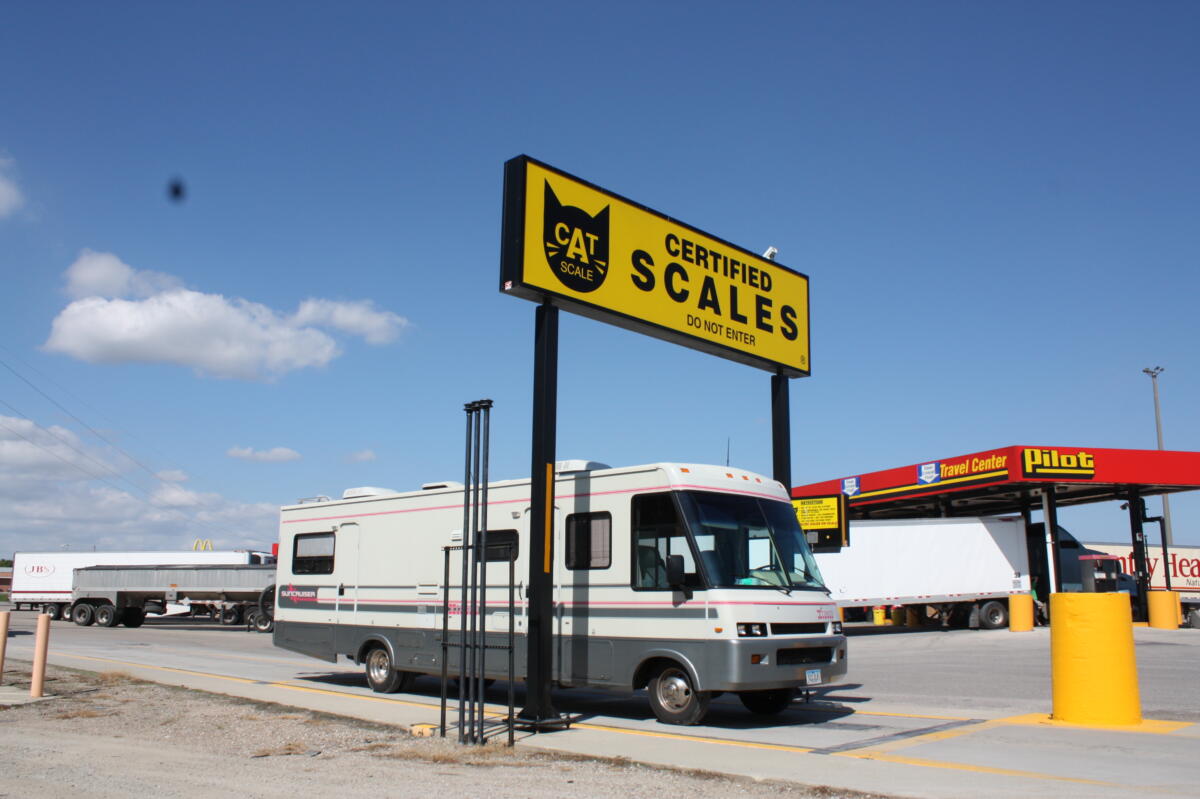
Due to all the ways that overloading might occur, the loaded vehicle weight should be measured on a vehicle scale. Overall weights can be done at truck stop CAT scales across the country.
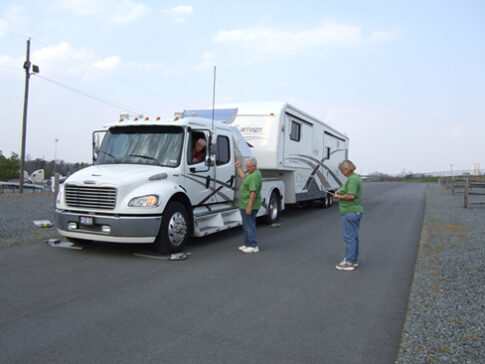
Wheel position weights are more detailed axle end measurements that are very useful for RVs and can be done by RV Safety Education Foundation’s weighing program that is done at events and locations throughout the year.
More of these weight details are discussed in courses on RV Safety Education Foundation’s training site.
Back to Dave
And that, folks, is why I go to the experts, as there are so many variables and unknowns that there is no generic or stock answer that covers every scenario. And, if the dealership, website, or any other “influencer” does not ask the questions to get the right information, it could lead to severe issues.
As I’ve said many times, never say never and never say always when it comes to RVs.
Thanks, Trey!
You might also enjoy this from Dave
How do you determine proper truck towing capacity? Part 1
GCWR, payload, GAWR—so many terms and so much confusion. There has been an enormous amount of discussion and debate on what a truck can actually tow. For years there were publications such as the Trailer Life Guide to Towing and Ford’s and Chevrolet’s own towing guides published every year regarding truck towing capacity.
It seemed pretty easy: Just find the make, model, cab configuration, and rear end ratio and the towing capacity was right there.
The math has changed!
DAVE HAS ANSWERED MORE THAN 1,000 readers’ maintenance and repair questions. Read a directory here. There is so much to learn!
Dave Solberg is a leading expert in the RV industry and the author of the “RV Handbook.”
RVDT2786

Thank you for sharing the question and answer, Dave! It seems that too little attention is given to the possibility of overloading. This seems especially so, given Roger Marble’s observations and admonitions over the years concerning tire inflation. Have a great day and safe travels!