


Dear Dave,
I have three AGM batteries under the step. Do I have to remove them for the winter? I never had to winterize it before. —Joseph, 2014 Winnebago Adventurer 37F
Dear Joseph,
According to the Winnebago website, your Adventurer originally came with two flooded lead acid (FLA) batteries and most likely were NAPA Auto Parts brand. A third battery would also have been standard that was the engine start battery measured in cold cranking amps (CCA).
Wiring diagram
Here is the wiring diagram for your unit that is available on Winnebago’s Owner’s Resource pages.
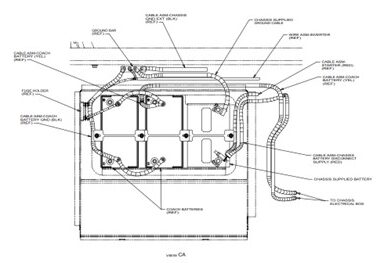
This diagram shows two deep cycle house batteries connected in parallel and one CCA engine battery in the same compartment under the entrance step.
What is a little confusing is you stated that there are three absorbed glass mat (AGM) batteries in this compartment now. Since the unit is more than 10 years old, it is most likely the house batteries would have been changed at least once. Your AGM batteries might even be a third generation replacement. However, the engine or start battery on the right should be a CCA-rated start battery and not a deep cycle type.
Most engine or start batteries that are “maintenance free” batteries are actually AGM and have no fill caps on the top. Therefore, it might look like all three batteries are the same. Hopefully, they are not. Even though the engine battery is AGM, it should be one designed for a higher CCA to start the engine.
How to winterize batteries
The reason I asked about the batteries is there are different issues and procedures for storing batteries for either winter or extended storage. All batteries will discharge when left dormant even if there is nothing connected or a parasitic drain. A fully charged FLA battery will only freeze if the temperature gets below -75 degrees; however, a fully discharged FLA battery will freeze at 20 degrees.
AGM batteries also have a liquid electrolyte which is absorbed in separators and electrodes but can still freeze. According to Lifeline, one of the premiere battery manufacturers, AGM batteries should be stored in a cool, dry place at temperatures between 32°F and 80°F (0°C and 27°C). They should be given a maintenance charge every 6–12 months if not in use. Storing a battery in a discharged state can lead to sulfation and permanent capacity loss.
Use a battery maintainer
Not everyone has the ability to store their RV and subsequently the house batteries in a temperature controlled environment that does not dip below 32 degrees. In that case, it is recommended to initially charge the batteries to 100% State Of Charge (SOC), disconnect the negative cable so there is no parasitic drain, and use a battery maintainer throughout the storage period. This is one of the best I have found over the years, which you can get on Amazon here.

If you do not have access to a 120-volt power source, you can use a small solar maintainer. However, I would recommend removing the batteries and store them in a climate controlled environment with the NOCO maintainer. Leaving them stored in below-freezing weather conditions without a maintainer is asking for trouble.
Third battery may also need to be maintained
Keep in mind, if the third battery is an engine or start battery, it would also need to be maintained. Removing it from the system will cause the engine CPU to default due to lack of power. This typically requires a restart sequence of running the engine at a certain RPM for several minutes and then driving at a certain RPM or speed for another sequence.
My father stored his RV every winter without a maintainer and every spring the engine battery was dead. It was on a Workhorse chassis with a Chevy Vortec engine. We had to go through this sequence every spring!
You might also enjoy these posts from Dave
- Follow-up to 12-volt roof air and refrigerator question. What are the best batteries?
- My RV’s “larger” batteries are dead. Can I replace them with lithium?
- Can different type and age RV batteries be mixed? Can I add a lithium battery?
- Will RV’s house batteries ‘play nice together’ if I replace chassis battery with lithium?
- Will my RV’s charger be sufficient for new lithium batteries?
DAVE HAS ANSWERED MORE THAN 1,000 readers’ maintenance and repair questions. Read a directory here. There is so much to learn!
Dave Solberg is a leading expert in the RV industry and the author of the “RV Handbook.”
RVDT2743

I store a car with an AGM starter battery and a maintainer for 6-months in an unheated garage in Michigan’s Upper Peninsula. I do not disconnect the battery from the vehicle. The battery is about 6 years old and in under a month will start the 7th winter. By leaving the battery connected, all the various car settings are also maintained.
I store a small camper for most of the same 6 months in Texas Hill Country. It does get a few days below freezing. I have a battery disconnect and use this solar charger. The deep cycle AGM battery is about 5 years old.
If the RV is accessible, another good option is to drive it periodically over the winter. It’s not only good for the batteries, but also the engine, transmission, wheel bearings, tires, etc. Make sure you drive far enough to get everything warmed up. Run your generator, too.
Although it doesn’t pertain to the original question, I’d like to point out that a switch to lithium batteries eliminates winter storage issues. They’re fine at any storage temperature and only self-discharge at 1-2% per month. Just follow the manufacturer’s recommendation for the charge level before storage, which is typically 50-80%.