


Dear Dave,
Our Redwood is a fifth wheel. We are considering downsizing to a travel trailer. I can’t wrap my head around how a load-leveling hitch system on a travel trailer works. I understand the importance of insuring that the trailer is loaded in such a way that the weight is properly distributed. To my thinking, no matter what you have on the trailer, it all comes down to the single hitch on the back of the truck. The weight of the trailer is not placed anywhere else on the truck. —Gary, 2013 Redwood
Dear Gary,
This has been a very hot topic not only here at RV Travel but at my seminars and this past year at the Ford Towing Bootcamp. I believe what you are referring to is a weight distribution hitch.
What a weight distribution hitch does
I have had the same struggle trying to figure out the dynamics of what it actually does. However, one of the best descriptions I got was from a CURT technician, who explained that it acts like placing an I-beam underneath the truck receiver hitch back to the trailer tongue. That makes everything level and relieves excess weight on the connection point, which is the ball.
I know it’s more technical than that, and I’ve gotten many comments in past posts. So, to be more clear, I’ve included some information from the Lippert/CURT website.
Lippert/CURT
CURT has been, in my opinion, one of the leading experts on everything towing for many years. It is part of the Lippert (LCI) family. It has an impressive lineup of weight distribution hitches. One of my favorites is the TruTrack™ WD Hitch with integrated sway control. Here is their description:
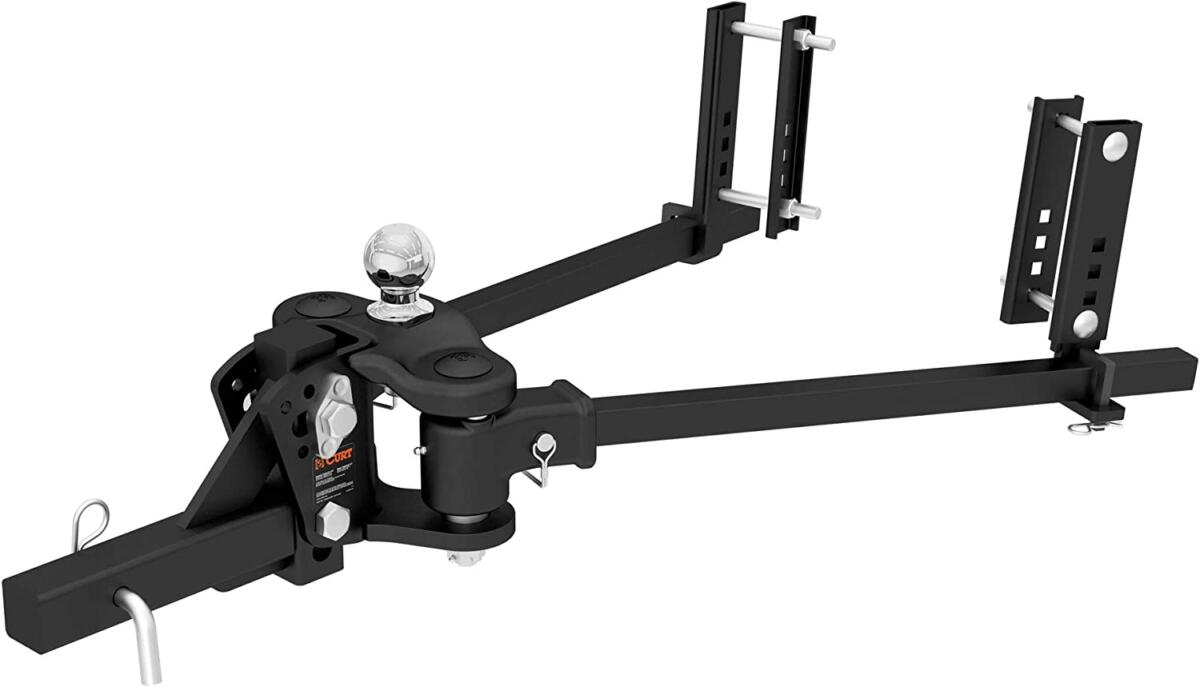
What is a weight distribution hitch?
A weight distribution hitch (aka “WD hitch”) is a type of trailer hitch designed to evenly distribute the tongue weight of a trailer between the tow vehicle and the trailer itself. This is particularly useful when towing heavy loads like RVs, which can otherwise cause the tow vehicle to become unbalanced.
The weight distribution hitch works by altering the transfer point of the trailer’s load onto the vehicle. Instead of concentrating the tongue weight solely at the connection point, the hitch disperses it across the axles of both the trailer and the vehicle. This is achieved through the use of spring bars, which are attached to the hitch on either side of the trailer’s A-frame. These bars help to minimize the vertical pivoting at the hitch ball, ensuring that the tongue weight remains within a safe range of 10-15% of the overall load. This balance is crucial in preventing excessive swaying of the trailer, which could lead to loss of control, or excessive diving, which could cause the driver to lose control.
What does a weight distribution hitch do?
A weight distribution hitch evenly spreads trailer tongue weight across all axles, restoring balance to the tow vehicle and trailer to improve steering, braking, and overall towing control.
What exactly is a weight distribution trailer hitch? It’s pretty much exactly what it sounds like: a hitch that helps distribute weight better and more evenly.
In more technical terms, a weight distribution hitch (also called a load-equalizing hitch or load leveler hitch) distributes the tongue weight of a trailer across all four wheels of the tow vehicle. Any time a trailer is hooked up to your vehicle, it puts a certain amount of weight on the rear axle, which is called the tongue weight. The job of a weight distribution hitch is to even out that weight over the entire vehicle so that both the trailer and vehicle ride more levelly. This gives you more control on the road and makes the job of towing easier on your vehicle.
Do you need a weight distribution hitch?
When I was younger, I didn’t know what I didn’t know. Isn’t that a country song? Full of piss and vinegar, as my grandpa would say. Now I see on Facebook, or whatever they call it, you can mix that with gelatin and lose weight! My wife often asks, “Do you always have to be funny?” I say, “Yes, but looks aren’t everything!”
As I have aged like a fine wine, I now realize what I don’t know. WD hitches fall into that category. All I know is that they work. Most truck manufacturers, Ford included, recommend them for anything more than 5,000 lbs. being towed.
Why I use a WD hitch
I have a 2016 SOB (Some Other Brand) truck, and it has a very soft/weak rear suspension. Therefore, I use the WD hitch for anything over 3,500 lbs. Even though all my specific weight ratings such as GVWR, GAWR, GCWR, hitch weight, and payload are good, the truck still “squats” and I get highway hop or porpoising.
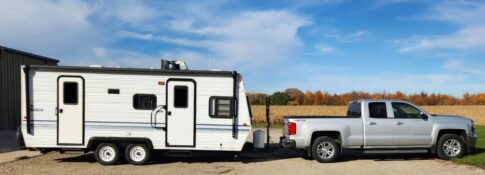
Here is my truck with a lightweight trailer before the WD hitch.
Plus, driving/towing in the state of Iowa is a challenge with the frost heaves on the highways and the constant wind from EVERY direction!
Keep in mind, a weight distribution hitch/sway control device does not increase towing capacity or weight carrying capacity at the hitch or rear axle. Also, it will add almost 100 extra pounds to the hitch or connection point.
You might also enjoy these posts from Dave
- What is the ’60/40 rule’ for towing a trailer? Should I use it? How?
- How much cargo can go in this trailer? All about RV weight ratings
- Can my truck tow my trailer based on this weight data?
- Should a hitch ball be greased or not?
- Warning: Welded hitch broke loose and “toad” took off! Preventable?
- Can weight distribution hitch bars get weak?
DAVE HAS ANSWERED MORE THAN 1,000 readers’ maintenance and repair questions. Read a directory here. There is so much to learn!
Dave Solberg is a leading expert in the RV industry and the author of the “RV Handbook.”
HAVE A QUESTION FOR DAVE?
Send your inquiries to him using the form below.
RVDT2894

Read your tow vehicle owner’s manual in the section on towing!
In the manual for our 2020 Subaru Ascent, it is rated for 5,000 pounds towing and 500 pounds hitch weight. And it very explicitly tells the owner to not use a weight distributing hitch. Many WD hitches also use anti-sway technology and our Subaru automatically handles trailer sway within its AWD system. The mechanical and computer systems will fight each other. Car magazines have tested this and point blank have told readers to believe their owner’s manual.
If your owner’s manual isn’t explicit, contact the manufacturer before you spend the money.
Jim, I have a 2020 Jeep Grand Cherokee (7,200 lbs towing capacity), and the owner’s manual says, “If the gross trailer weight is 5,000 lbs or more, it is recommended to use a weight-distributing hitch to ensure stable handling of your vehicle.”
The Jeep also has a TOW mode with trailer sway control (TSC). I don’t know how the Subaru works, but the Jeep TSC is an “electronic system that recognizes a swaying trailer and automatically applies individual wheel brakes and/or reduces engine power to attempt to eliminate the trailer sway.” Nothing about not using a sway control hitch.
I believe the advice you are getting from car magazines is ridiculous and dangerous.
Jim didn’t say he got his Subaru Ascent towing info from magazines; he said the Owner’s Manual. There are a few SUV AWD vehicles that the manufacturer says to not use a WDH. I would wonder if the suspension can actually level-out the trailer and the TV, though. Even the Jeep GC, with its load-leveling, tells the owner to disable the auto-level when setting-up the WDH. I had the dealer install the WDH, and it didn’t do its job when the trailer was loaded. It took some time, but it was a noticeable difference when I towed, after setup with the Auto-level disabled. Much better.
According to the Ford Engineer that was at the first 5 Ford Towing Bootcamps you can use the “squiggly lines behind the truck” button even with a WDH and towing a trailer. It pulses the rear wheels slightly on the truck but does not activate brakes on the trailer. Even the ones like airstream that have that feature on their trailer brakes. It pulses a slight ABS type braking to straighten it out.
Jim’s point is always good no matter the topic. ALWAYS read your Owner Manuals.
That said, if there is not a restriction on a weight distributing anti sway hitch, spend the money! This is especially true with lightweight trucks and SUVs. I see 1/2 tons bobbing up and down on the road with trailer in tow all the time. A good hitch setup will take care of that.
I don’t think Dave completely answered the question. I have a WD hitch with sway control, and when I first got it, I had to figure out how it worked (being an engineer). Basically, the WD hitch applies a moment at the hitch to transfer load from the rear tires to the front tires of the tow vehicle. With a normal hitch, there is no moment, just a point load. The sway control applies a frictional resistance to damp lateral (yaw) oscillations.