


Dear Dave,
I have come across several posts, articles, and graphics that recommend using the 60/40 rule for weight distribution of a towed trailer. Should I use this, and how do I determine the weights? —Paul
Dear Paul,
The general rule of thumb used in most trailer training programs such as U-Haul and others is the 60/40% rule. That means 60% of the loaded trailer weight is in front of the trailer axle or axles, and 40% of the weight is behind. While this may be good for a flat bed or cargo trailer where the weight can easily be shifted, it can be confusing for RV owners.
An RV trailer has most of the dry weight permanently mounted, such as furniture and appliances. Owners can typically only add weight in predetermined compartments. This can make it difficult to calculate.
Weight specialists such as the RV Safety & Education Foundation (RVSEF) recommend using a much easier concept of tongue weight. They recommend a minimum of 10% and typically not more than 15% tongue weight. This can be calculated easily at a weigh scale such as CAT Scales.

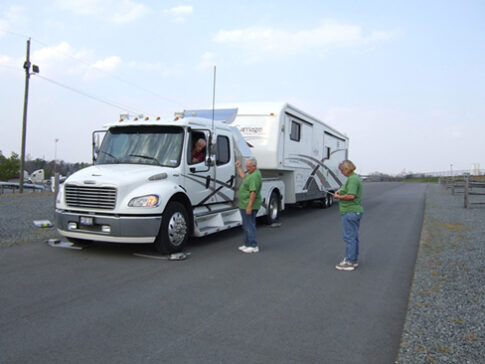
Weigh the tow vehicle with the front axle on the first pad, back axle on the second, and trailer on the third. Then pull around, disconnect the trailer, and weigh just the truck. Subtract that weight from the first weight and you will have the tongue or hitch weight, which will provide the numbers to obtain the percentage.

Here is an example
This truck and trailer had the following weights.
| Hitched to trailer | ||
| Axle | GAWR | Actual at CAT Scale |
| Front | 5,000 lbs. | 3,300 lbs. |
| Rear | 7,050 lbs. | 3,240 lbs. |
Trailer weight – 4,340 lbs.
Combined weight, truck and trailer – 10,880 lbs.
Unhitched
Front – 3,400 lbs.
Rear – 2,580 lbs.
Hitch weight or payload from trailer – 660 lbs. (This is less than 14% of the total trailer weight.)
What can happen with the incorrect weight on the hitch
If you have less than 10% weight on the hitch, the trailer will be more susceptible to sway when hit with a side wind or uneven pavement. If the hitch weight is more than 15%, it will overload the back axle and cause premature wear of the tires and axles bearings. It will also lighten the front of the tow vehicle, which reduces braking effectiveness and steering. It can also attribute to what we call “highway hop” or porpoising.
NOTE: A CAT Scale will only give you axle weights. It is important to have your trailer weighed by individual wheel position as many models are heavier on one side or corner and could be over the recommended tire load capacity. RVSEF has weighing teams that can provide this service. Visit them here to find a weighing team in your area.
You might also enjoy these posts from Dave
- How much cargo can go in this trailer? All about RV weight ratings
- Can my truck tow my trailer based on this weight data?
- Hitch ball on trailer’s anti-sway device is scarring. Should I be worried?
- Our trailer came off hitch ball while being towed. Can grease cause that?
- Should a hitch ball be greased or not?
- Warning: Welded hitch broke loose and “toad” took off! Preventable?
- Can weight distribution hitch bars get weak?
DAVE HAS ANSWERED MORE THAN 1,000 readers’ maintenance and repair questions. Read a directory here. There is so much to learn!
Dave Solberg is a leading expert in the RV industry and the author of the “RV Handbook.”
RVDT2729


Here is my problem. There are no CAT, let alone individual wheel scales within greater than 100 miles of my home. While I live in a tourist area. I don’t see any event in Michigan’s Upper Peninsula. So I load up my trailer & tow vehicle for a trip and I stop at a scale along the way. I’m over loaded. Yeah, I can offload some stuff I want but don’t absolutely need. What do I do with it? Interrupt my trip to hold a roadside auction?
Dave (and Roger)- what we need is something doable while we are loading our rigs. I know how I am handling it given our semi-annual 1600 mile trips, but don’t expect the weekend warriors to think that hard.
Jim,
I believe you have scales near your area, just not familiar with where to look. Grain elevators, quarries that sell rock/gravel/sand, and even larger vegetable producers. I agree that finding the individual wheel position weighing teams is tough but getting at least the GVWR, GAWR, and GCWR is a good start.
Look for a grain elevator, gravel company, moving company, trash company or landfill to see if they have scales and will let you use them. You could also call the state police and see when they will have portable scales set up near you and if they will weigh you. Some alignment and suspension shops may also have scales.
Thank you for explaining the 60/40 “rule,” Dave! Thank you, too, for calling attention to the RVSEF and their availability to weigh each wheel and not just each axle. Have a great day and safe travels!