


I recently returned from conducting seminars for the Ford Towing Bootcamp at the Florida RV SuperShow. Once again, nitrogen-filled tires were a hot topic of discussion. This was largely because the Ford trucks provided by Brandon Ford and the trailers from General RV all featured the familiar green valve stem caps, indicating nitrogen-filled tires.


The debate over nitrogen versus regular compressed air has been ongoing for years, with compelling arguments on both sides.
Reasons you might consider using nitrogen
Nitrogen (chemical symbol N, atomic number 7) consists of larger molecules than oxygen. Because of this, nitrogen is less likely to permeate through tire sidewalls. According to the Tire and Rim Manufacturers Association (TRMA), all tires lose some air pressure through the rubber itself—sometimes as much as 2 psi per week.
Chemical & Engineering News reports that nitrogen permeates through tire rubber approximately 40% less than regular compressed air. Any permeation—whether from air or nitrogen—can contribute to gradual rubber degradation over time.
Another advantage is that nitrogen contains significantly less moisture than compressed air. Moisture inside a tire can contribute to greater pressure fluctuations with temperature changes and may promote corrosion or rust on metal components such as wheels and valve stems.
Racing enthusiasts often advocate for nitrogen-filled tires because they are more stable under extreme temperature changes, helping maintain more consistent tire pressure and potentially improving the integrity of the tire.
Additional claimed benefits include improved fuel economy, reduced internal tire degradation, and enhanced safety.
What the research says
Consumer Reports, in collaboration with the National Highway Traffic Safety Administration (NHTSA), conducted a study comparing nitrogen-filled tires with tires filled with regular air. Their findings are summarized in a report available here.
In a year-long test involving more than 30 vehicle models and a 16,000-mile tread wear evaluation, NHTSA confirmed that nitrogen-filled tires did lose less pressure—about 1.3 psi over 12 months compared to regular air.
They also found that nitrogen reduced tire degradation by limiting oxidation caused by oxygen. However, the benefit was minimal and not significant enough to matter in real-world use, as normal tread wear would require tire replacement long before oxidation became a concern.
Their overall conclusion: While it is acceptable to use nitrogen, the benefits are modest, and regular compressed air performs just fine—at essentially no cost.
Is nitrogen really worth it?
It’s important to remember that regular compressed air already contains about 78% nitrogen. According to tire experts, including the Tire & Rim Manufacturers Association and the RV Safety & Education Foundation (RVSEF), the most critical factor in tire performance and safety is regularly checking tire pressure using a quality tire pressure gauge.
Many nitrogen advocates tend to check their tire pressure more frequently. That alone improves tire performance and longevity—regardless of what gas is used.
RVSEF reports that the leading causes of sudden tire pressure loss or failure are overloaded vehicles and underinflated tires. They note that operating a tire at just 10 psi below the recommended pressure can reduce weight-carrying capacity by 25%.
Alarmingly, more than 50% of RVs they weigh exceed GVWR or GAWR, and more than 50% have underinflated tires. Nitrogen does nothing to address these issues.
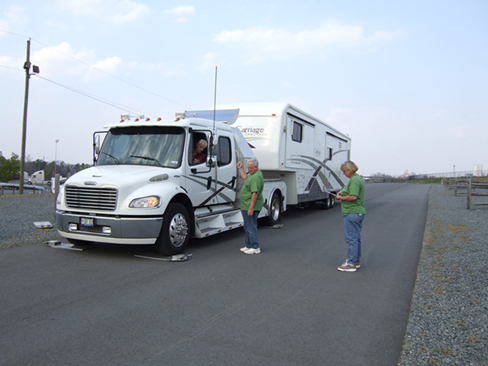
Most tire manufacturers agree that both nitrogen and compressed air are acceptable. Nitrogen does offer advantages in specialized applications such as aviation, mining, and professional racing. However, for the average driver or RV owner who checks tire pressure regularly, nitrogen provides little practical benefit.
Final thoughts
In my opinion, if nitrogen is offered for free, there’s no downside to using it. However, if it comes at a cost compared to free compressor air at a service station, it simply isn’t worth it. And, most importantly, nitrogen does not make tire maintenance unnecessary.
Regular pressure checks, proper inflation, and avoiding overloading will always matter far more than what is used to fill the tire.
However, if you are drag racing with your truck and trailer, it might be good to use nitrogen! 😉
More posts on nitrogen in tires
- Should I use nitrogen in my tires?
- Nitrogen in tires: Why pay for tire air when it is FREE?
- Readers’ questions about nitrogen in tires, and replacing OEM tires
- Why use nitrogen to inflate tires?
- Is inflating tires with nitrogen a good idea?
- Is it worth it to inflate tires with nitrogen?
DAVE HAS ANSWERED MORE THAN 1,000 readers’ maintenance and repair questions. Read a directory here. There is so much to learn!
Dave Solberg is a leading expert in the RV industry and the author of the “RV Handbook.”
HAVE A QUESTION FOR DAVE?
Send your inquiries to him using the form below.
RVDT2834


Nitrogen is used in the tires of aircraft for safety considerations; military aircraft tires can go from 0 to 150 mph in seconds and a blowout of a tire filled with N doesn’t feed any resulting fire. That was the genesis of filling any tires with N, safety during aircraft landings. The likelihood of a land vehicle tire blowout causing a fire seems remote.
Not paying extra for green valve stem caps!!!
As a recent poll showed most of us who read here are in their 70’s, you’ll remember MASH, and I’ll quote Col. Potter, “Horse hockey” to the use of N. As stated above “…the benefit was minimal and not significant.” If you want to put N in my tires for free, feel free to do so, otherwise just use the air I breathe.
Well, I’m of an age that I tend to do anything tht reduces the amount of time that I’m bent over with kneepads adjusting temps – whether from seasonal or elevation changes. Nitrogen does that for me and it’s free with my COSTCO membership. So . . . there’s that! There’s a reason my helicopter tires only use nitrogen. 🤔
Racers like myself use nitrogen to reduce the amount of pressure change from cold to hot. Racing tires run at low pressures, my formula car likes pressures in the high teens hot. Setting the cold pressures depends on track and ambient temp, with 2-3 PSI change when hot not uncommon with nitrogen, around 50% more with air. The lower pressure rise with nitrogen means we can be reasonably certain of what the hot pressures will be.
Speaking to a few close friends working for dealerships I was told that nitrogen is a rip off, just refuse the $200 or so the dealer wants to charge for it in new cars and they will drop the charge. The last 3 cars I purchased I refused to pay it or they could keep the car, the charge was dropped.
Take the savings and put it toward a Tire Pressure Monitoring System (TPMS) if your RV doesn’t have one (most don’t). That way you’ll always know the pressure in your tires and get an alert if any of them drop below the limit you set. It’s a key safety item and a huge comfort on the road.
Two words come to mind…Snake Oil. Nuff said.
I use nitrogen in race car tires because it contains no moisture, which reduces pressure increases due to heat. Race car tires get very hot.
I use nitrogen in car, truck, motorcycle, and trailer tires because of the convenience, because I already have it on hand for the aforementioned race tires.
Otherwise regular air, as long as the moisture content is low, is perfectly fine.
As for claims that nitrogen somehow gives better fuel mileage, inflation pressure is the only factor, whether regular air or some other gas, so that’s pure bunk.
Race car and airplanes only!