


Dear Dave,
I am interested in getting a portable solar power station. I have done research until I am blurry-eyed. I’m leaning heavily toward the Anker SOLIX F3800 (heavy beast). I want this for when shore power goes out. We just had this at the state park we are camp hosting at. All sites in the loop except three and bathrooms didn’t have power for 12 hours until the issue was fixed. It IS HOT! We are in the Texas Grand Canyon. Visitors were put in other camping loops where there were openings. What if there were no openings?
Also, we want this to use at Harvest Host more on our way from one gig to the next. We are taking longer to get from Point A to Point B to enjoy the sites and places we can’t get a work camping gig.
Also, we have one A/C with Soft Start (hoping to do the other two). We have one solar panel that will keep 12-volt refrigerator running for 20 hours (average). We tested it by mistake when we dropped off our RV for ceramic coating three hours from where we located at the time AND forgot our shore plug! It keeps it nice and cold!
I want a solar power station because then we don’t need to haul fuel around. Also, because many times our gigs have us long distances from where we could get fuel (or anything).
My questions are…
Do we need to upgrade to lithium batteries?
How many portable solar panels would be the best and/or minimum to order with power station. During my research it has been repeatedly said to store at 50% to keep longevity. Seems reckless if a power emergency came up.
We are currently in full sun, no shade. We use awning shade screens to help with the afternoon sun, in addition to using foam insulation Reflectix in windows, cabinets on outside walls, etc.
OR would it be wiser to add more roof solar?? —Linda, 2023 Alliance Paradigm 385FL

Dear Linda,
Congratulations on the purchase of your new Alliance 5th wheel. For our readers, Linda had the issue with the Thor not getting warranty coverage on the holding tanks that broke loose as it was in the last 60 days of the warranty period!
To start the conversation, it is important to describe what a portable power station actually is compared to what power you already have in the rig.
Anker SOLIX F3800
The Anker SOLIX F3800 is a 6000W portable 120-volt power backup system used for emergency when the power goes out, as you referenced. It can also be used for dry camping such as the Harvest Host locations. It consists of a Lithium Iron Phosphate (LiFePO4) battery and an inverter to convert the 12-volt power from the battery to 120-volts for use in a home or RV. Also, it has an input for solar panel connection to recharge the battery and the typical MPPT charge controller. You can find one like this on Amazon here for $4000 (at time of publication it is listed at $2,799.)
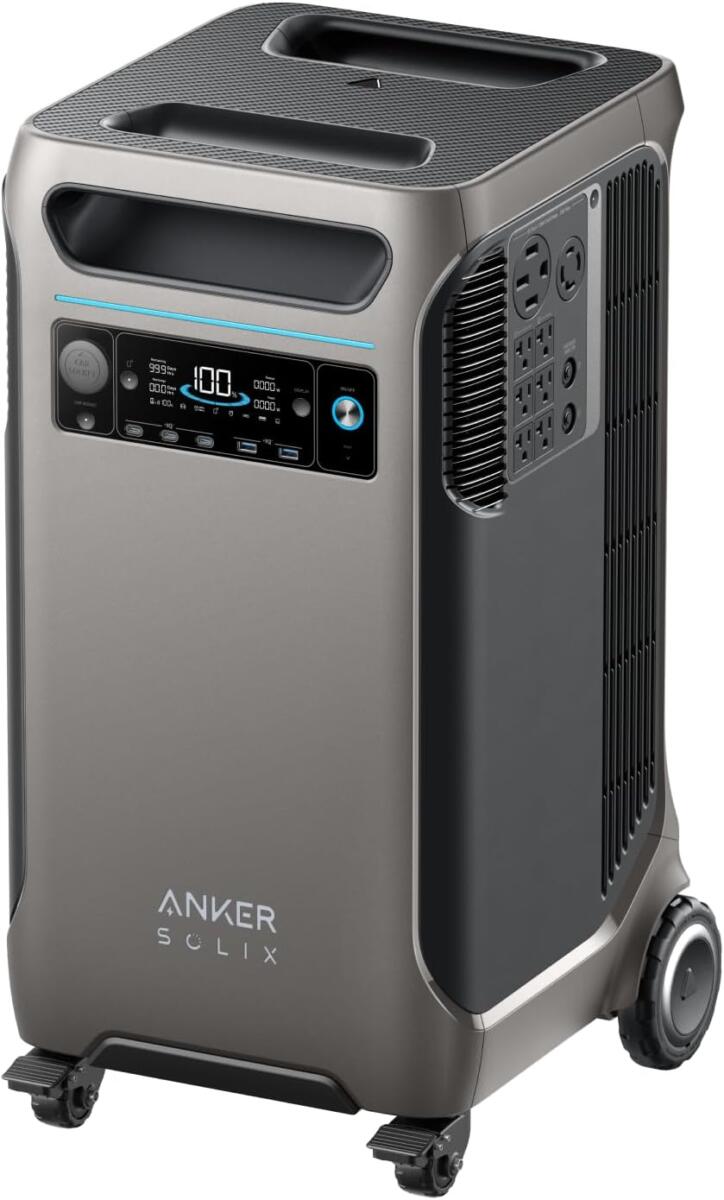
As you can see, it does have quite a few 120-volt outlets as well as USB and others. However, it seems to me that this is designed more for an emergency backup for a home rather than a viable option for your rig. To recharge the battery in this, you would need to plug it in. That means the inverter must also be a charger or it has a built in lithium charger, which it does not list in any of the specs. You can get an optional solar panel charging system, but that is more expensive.
There are several other portable power stations such as Jackery, Bluetti, and EcoFlow. They are all similar in the fact they are a supplemental 120-volt power station using a 12-volt source (batteries) and an inverter. This means you have to find a space for an additional device like this and plug it in to your rig.
How long will you be able to run a roof air conditioner on 6000W
The Anker website states that you can run your window air conditioner in your RV for 3.6 hours with 6000W—which tells me they don’t know jack about RVs! Your roof mounted air conditioners are most likely 15,000 BTU models and will draw much more than a typical residential small window RV. Since you also have a refrigerator that runs on 12-volt power, this will also draw from the “bank” in the Anker portable.
From what I can find on conversion charts is that 6000W is approximately 500 amp hours. But I’m still trying to figure out how many horses it takes to convert to horsepower in cars, so I might be slightly off! I sat through a demonstration in a Keystone with the SolarFlex system that had four 200-watt solar panels on the roof, 600 Ah lithium batteries, and Victron MPPT (Maximum Power Point Tracking) charge controller with a 2000-watt inverter. They were only able to run one roof air conditioner for 3 hours. So I do not think your rig will last much longer since you do not have lithium batteries.
My suggestion
My suggestion would be to install at least 600 amp hours or more of lithium batteries in your rig with a 2000-watt inverter. Also increase your solar panels to at least 600 watts— either roof-mounted or portable—which you can place out in the sun and stay in the shade when possible. Even with all that, at 101 degrees, you will be struggling to keep the unit cool with all you have in a 5th wheel rig. All this would be about the same price or less than getting a portable power station.
I would also suggest a generator to not only help power the roof air conditioners during the peak temperature times, but to help recharge the batteries faster.
You might also enjoy this from Dave
Can I connect my “solar batteries” to use for the RV’s house battery?
Dear Dave,
Instead of replacing the house battery under the hood, can I run a cable from my 600-watt solar system batteries (2 x 100ah) I installed in the basement to the cable that powers the house lights? (There are 3 positive cables going to the under-the-hood house battery. I found which cable powers the house lights.) The space for the original house battery is a very odd size 5.5″ wide x 12.5″ long x 9″ high. —James, 1996 Jayco 295 SB
Dave Solberg is a leading expert in the RV industry and the author of the “RV Handbook.”
Read more from Dave here.
HAVE A QUESTION FOR DAVE?
Send your inquiries to him using the form below.
##RVDT2423


Linda should upgrade her solar panels & go to lithium battery as you suggested, but as you also suggested, that alone will not provide much air conditioning time. She mentioned she did not want to depend on gas for a generator. She should get a dual fuel generator & run it on propane, which she certainly has in her rv. I carry a 2500 watt dual fuel gen, even though I have 950 watts of solar & 736AH of lithium battery plus a 50 amp DC to DC charger. The DC to DC charger only works when we are travelling down the road & solar can be iffy depending on weather & location. So, sometimes we need a generator, but I also don’t like carrying gas.
Thank you, Dave! 🙂 All extremely helpful information; thanks! 🙂 Have a great day, safe travels, and safe stays! 🙂
Congratulations to Linda on her new RV! 🙂 I cannot believe Thor’s behavior regarding her warranty, which transformed it from 12 months to 10. 🤔😯🙁
I’m hoping Linda has a rather LARGE wallet as it may take in the neighborhood of $20K to get what she needs & also have the space for all those lithium battery’s & solar panels. Linda did mention that they have 3 AC’s & only one has a soft start yet another expense to deal with. I’m sure this all doable, just depends on the $$$$ you have to spend! It would probably be a greet idea to find a company that can design a system for you! Good luck & please keep us up to date.
Snoopy
Here is my thought… Get a portable 2500 watt generator that runs on LP & adapters for your 50A shore power inlet. (I have an 1800 watt dual fuel generator and it will run the smaller A/C unit in our 30A TT using propane). Here is my rationale. You don’t need a furnace if you need A/C. And I suspect you have some means of cooking outside your RV. Most of us can turn our water heaters off for most of the day. Use that propane for the generator. Be careful with other electric use to power one A/C as necessary. Not ideal, but it works.
Somebody needs to check on the propane consumption before recommending propane generators. Your 20 gallon propane tank may last weeks when powering the refrigerator and occasional cooking, but running a generator will use it up pretty quickly, like the furnace in really cold weather. Best bet is a gas generator, more power, cheaper, and easy to refuel. Or maybe the car generator. Mike Sokol has done a lot of testing and articles on this subject.
She has a 5th wheel so I would assume two 40 lb cylinders rather than 20#? Also, the refrigerator is 12-volt so not much would use propane in the rig.
Sounds like she needs to upgrade her solar and batteries to lithium. I would suggest using also some portable panels and a solar generator I have 2 x Vtoman solar generators with a combined capacity of over 3k watt hours that cost about $600 each and can also charge from 120v in 60min. Also a mini split AC would consume less power. So for about $3k-$4k this is doable if your handy.