

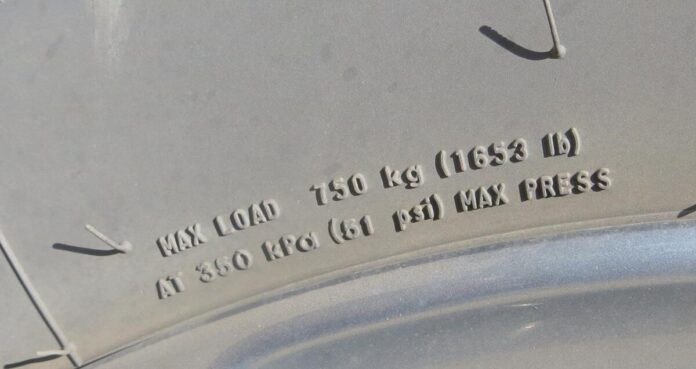
There seems to be a lot of confusion about the “MAX PSI” number on the tire sidewall. That PSI number IS NOT the highest pressure a tire can tolerate. Undamaged tires do not “explode” if you exceed that PSI number.
This may help. Read the words below carefully so you understand what the “MAX PRESS” is referring to. The “AT” is an important part of the statement. Some tires may not have the word “AT” in the statement.
The “MAX PSI” is the pressure required to support the “MAX LOAD,” which is also stated on the tire sidewall.
We tire engineers test our designs at a pressure well above what your tires would get to under normal circumstances.
Tire pressure only increases by about 2% for each increase in ambient temperature of 10°F. So even going up by 90°F or 100°F, you should only see a pressure increase of 45 to 50 PSI.
If you have weighed your RV and consulted the industry tables on Load and Inflation and always inflate your tires to the PSI indicated in the tables for YOUR load, you will probably only see a pressure increase of 20% to 25%.
If your TPMS is reporting a greater increase, you need to confirm your load, your cold inflation pressure and your travel speed, which, in an RV, should never exceed 75 mph.
Related note: I usually recommend that people add 5% to the Minimum inflation found in the tables, to lower the probability of driving while the tires are underinflated.
Roger Marble
Check out my Blog www.RVTireSafety.Net
Read more from Roger Marble on RVtravel.com.
HAVE A QUESTION FOR ROGER?
Send your inquiries to him using the form below.
##RVDT2423

I usually guage 1 psi for every 10 degrees ambient temperature.
Also, check tires cool before driving and in the shade. If in the sun, pressures will be already higher and give a false reading.
The “1 psi” is what TireRack and others said when they were thinking of passenger care tires that were set to about 36 psi. After I contacted TireRack and pointed out that some folks are on tires running 80 to 125 psi and gave TireRack the math they changed the 1 psi figure on their web site to my suggested 2%.
Many “uptowners” do not realize that their gilded coaches they love so much are riding on tires and suspensions…two of the most under maintained items on the road. One look at all the gator tails strewn along the freeways in this country will prove my theory.
I do believe that those “gator tails are from under inflated re-caps found on many over the road 18 wheeler haulers & not from the “gilded coaches” that was mentioned! Just my nickels worth!
Snoopy
Thank you, Roger! Five percent more?! Got it! 🙂 Thank you! Have a great day, safe travels, and safe stays! 🙂
It’s the air pressure that supports the load not the sidewalls. And the max load in lbs you see on those sidewalls is the weight the tire is built to support at it’s optimum air pressure. While there is a fudge factor that will change conditions on the road, when you start out cold in the morning, it’s best to be mindful of those ratings.
Okay Roger – you have frequently written about tire pressure based on load tables. Let’s assume there is no scale within 100 miles of the starting point (and yes, where I live, that is not an exaggeration). Let’s also assume, the trailer’s owner legitimately believes the trailer is below its maximum weight according to the manufacturer’s documentation. Do you recommend a cold tire pressure conservatively guessing weight from the tire table, or just go ahead and inflate to the sidewall placard level?
In the complete absense of any weight information, it’s safe to set cold pressure to the sidewall max. Better to have more than too little. Then make it a priority to get it properly weighed. Preferably an all wheel position weighing analysis. CAT scale if nothing else available.
I agree.
I’ll search again, but I have not been able to find a load/inflation chart for my Carlisle ST 225/75R15 tires. So I just inflate to max.
You can use the Goodyear tables as almost all table numbers from all tire companies have the same information.
If my inflation table recommends, say, 120 PSI for my load, which is within the GVWR of the Class-A coach rear duals, and I add your recommended 5%, that puts me over (by a little) the 120 PSI maximum on the sidewall. Do I go with the 120 PSI, or the +5%, 126 PSI?
The “Maximum” number on the tire sidewall is NOT the highest pressure a tire can tolerate. The wording is confusing but it was written by lawyers not tire engineers. That PSI is just the inflation that will provide the Max LOAD Capacity. You can read more in this post.