

By Chuck Woodbury
Ibet you have never heard of Emilio Meinecke. I hadn’t until recently. If you are in a campground right now, whether in a national park, national forest or a KOA, please stop reading for a moment and walk out your RV’s front door and look around. You will see evidence of his work.
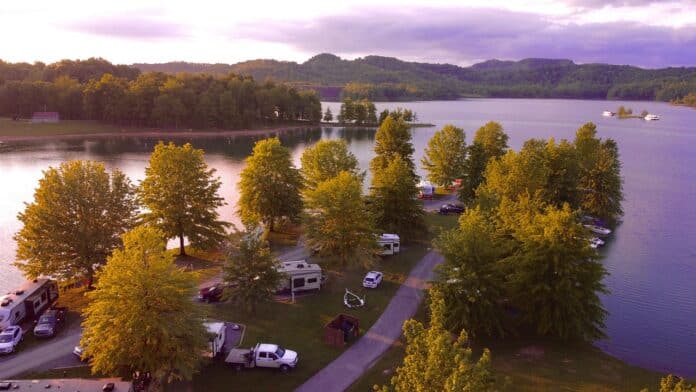
Emilio Meinecke, born in 1869, was a plant pathologist for the U.S. Forest Service. His major claim to fame, however, is as the inventor of the loop campground. It was about 90 years ago, in the early 1930s. His design changed camping forever. You know the design because you’ve seen it too many times to count — a one-way loop road, with auto pullouts every so often that designate individual campsites. In most cases, each site had (and often still does) a fireplace and/or campfire pit, picnic table and space for a tent (or today, an RV).

As the automobile became more a part of the camping experience in the early 20th century, Americans were heading out en masse to escape the messy, noisy cities to the beauty and solitude of nature. Between 1915 and 1930, the number of American campers jumped from 300,000 to 3 million.
The problem was, they were setting up camp anywhere and everywhere, and trampling down the land and flora in the process. In the California redwoods, they camped right next to the giant, 2,000-year-old trees. “One of the deplorable consequences of camping and long-continued milling of tourists around selected favorite [trees],” warned Meinecke, “is the almost complete eradication of undergrowth.” Furthermore, he noted, in a zone adjacent to the biggest trees, the most important and active roots were being destroyed by the simple act of walking.
The campers built campfires wherever they wished, and soon, the land was pockmarked with piles of ashes. Subsequent campers were not interested in camping in ashes, so they moved on, extending the damage farther into the countryside. They cut down trees and bushes to create their perfect campsite. Meinecke’s solution, the permanent loop campground situated away from a park’s main attractions, saved these precious lands from being loved and trampled to death.
MEINECKE’S DESIGN, with space between sites easily identified by barriers like boulders, plants and logs, made it very clear to campers where a campsite began and ended. Individual sites were spaced far enough apart that campers had an illusion of being away from others and “roughing it.”
The loop campground lost some popularity during the 1960s, when Americans’ camping habits changed. Meinecke’s structured “McDonaldization” of camping (a term often used back then to criticize “generic” campsites) provided “the illusion of wilderness,” not wilderness itself. Visiting the real wilderness became hugely popular with backpackers, young Americans who wanted nothing to do in “their wilderness” with cars or, heaven forbid, RVs (Grandma’s and Grandpa’s Playhouse).
Today, as interest in backpacking has waned, the loop campground endures as the standard, where most of us are most comfortable staying. It’s unlikely it will be replaced by something better any time soon.
RELATED
- The history of the glove compartment: What’s in yours?
- All RVers own a “whiskey stick,” but we bet you don’t know its history!
- History: This Ford station wagon had rear lounge, but never got to market
- The history behind Wall Drug – America’s favorite roadside attraction
- The history, popularity, and decline of vehicle hood ornaments
##RVT1193


Hmmm? How well is “Loop Camping” working out when boondocking BLM land? But I suppose the haphazard style of boondocking doesn’t destroy the desert plants and habitat? Oh wait. Wasn’t camping in the early 20th century EXACTLY like current day boondocking? Sorry. Doesn’t apply to a fragile desert environment.
In all my boondocking experience I’ve not seen any destruction of desert plants or habitat. We’re driving on rock. Or really hard dirt. I’ve never seen a living thing while camping in the Quartzsite area. Maybe a few birds in the early morning. I’m amazed, really.
You’re not looking very hard then. Driving through the washes of creosote and rabbitbrush, crushing the microphytic crust, actual carving out pieces of cactus and the fire rings?
Not sure I’m following your process here. I had to look up the term “microphytic” to try and follow your line of thinking. I’m not “carving out pieces of cactus” nor am I doing anything with fire rings. I never build fires, even in campgrounds.
Tom, it’s hard to interpret your comment. Are you dissenting on loops that organize campsites, dispersed camping, cities that paved over playas or ?
If it helps, Class A and Class C RVs weren’t invented until the 1960’s so camping when the loops were adopted wasn’t EXACTLY like current day camping.
Since modern day RVs aren’t reknowned for their off-roading prowess, most boondockers stick to navigable roads and cleared areas. They just lack pavement and predetermined parking direction.
If you feel parking on the playa is more destructive than parking on a loop paved over the playa, please explain. You have captured my curiosity…..
I wish you would put a name to the pictures you put in your articles. The man who drove campers loopy, the first picture is Battle run camp ground Summersville lake in WV. One of the best places to camp in WV….
Thank you for the history lesson. Interesting to learn the genesis of “the loop.” Have a great day and safe travels!
Loved the story Chuck! The modern update is for the campsite to stretch across the loop creating a pull-through.
I’ve tried tent camping, and quickly found it was not my cup of tea. A RV, any RV from a pop tent camper to a class-a is more my style. Also enjoy loop camp grounds, regardless if it’s in Yellowstone, with its narrow tree-lined pull throughs, or back-in sites from Yosemite to Great Basin. They all get my vote.
Thanks for this Chuck!
Great story Chuck! Love learning the history!