

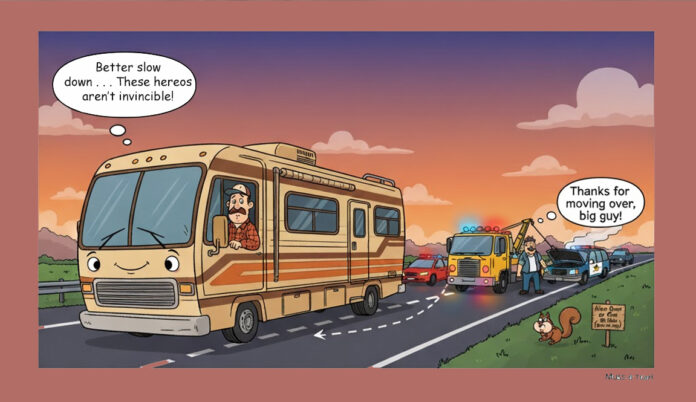
If you’re an RVer, you’ve probably seen it: a flashing light on the shoulder, a tow truck assisting a stranded vehicle, or a police car parked on the roadside. Knowing how to respond isn’t just common sense—it’s the law.
Slow Down, Move Over laws for RVers and other travelers exist to protect emergency responders, roadside workers, and stranded motorists. Yet confusion and state-by-state inconsistencies leave many drivers—and their rigs—at risk. Last year alone, 46 responders never made it home, according to the Emergency Responder Safety Institute.
AAA research shows that more than one-third of drivers fail to slow down or move over when they should. Tow truck operators are especially vulnerable: Only 58% of drivers slowed down or moved over for them, compared with 66% for police vehicles. With long rigs and limited maneuverability, RVers face extra responsibility to get this right.
Slow Down, Move Over laws for RVers—Why it matters
Lives are at stake. Every roadside worker and responder deserves to make it home safely.
State laws vary. Some cover only emergency vehicles; others include tow trucks, utility vehicles, and even disabled motorists. “Move over” can mean changing lanes if possible—or just slowing down, depending on the state.
Legal risks differ. Penalties range from $30 in Florida to $2,500 in Virginia. Confusion isn’t an excuse, especially when your RV is involved.
How RVers can stay safe and legal
- Always err on the side of caution. See flashing lights? Slow down and move over if it’s safe. Don’t wait to figure out if your state law covers that vehicle—assume it does.
- Know the laws where you travel. Check AAA or NHTSA resources for the exact requirements in each state. We’ve included a “cheat sheet” below the story with more details.
- Give your rig extra buffer space. Your length and width mean you may need more than a single lane’s distance to safely pass a roadside incident.
- Lead by example. Your careful driving can encourage other RVers and motorists to do the same.
- Use technology. Systems like HAAS Alert provide advance notice of roadside incidents, giving you extra time to react safely. HAAS is available on the Waze app, and built-in to some vehicle navigation systems.
Bottom line
Slow Down, Move Over laws for drivers exist to protect those who protect us. Because state laws vary and enforcement can be inconsistent, the safest approach is simple: slow down, move over if possible, and always give extra room to anyone working or stranded on the shoulder. Doing so keeps your rig—and lives—safe, and ensures you stay on the right side of the law.
As AAA traffic safety experts put it: “Every responder working on the roadside deserves to make it home safely.” For RVers, following that advice isn’t just smart—it’s the right thing to do.
Sources include AAA
*****
Quick reference for RV Travel readers
| Assumption you should make | Verify the state‑specific law |
| When you see a vehicle on the shoulder with flashing lights (emergency vehicle, tow truck, utility/maintenance vehicle, or disabled vehicle) → slow down and, if safe, move over a lane away from it. | What exactly the law covers in this state: which types of vehicles (emergency only? or tow/utility/disabled too), and what “slow down” means (how much below posted limit? or “reasonable”?) NCSL+2NHTSA+2 |
| If you cannot change lanes safely (traffic, construction, narrow road) → reduce speed and pass with caution. | Whether the law allows “if cannot safely move over, just slow down” or requires the move‑over first. |
| Your RV is long, heavy, has limited maneuverability → give extra buffer space, assume the rig ahead may have to slow and move over too. | Are there higher/more specific requirements for heavy vehicles/RVs? (Few states call this out explicitly; so adopt conservative mindset.) |
| Penalties may be substantial (fines, sanctions) — non‑compliance isn’t just “no big deal.” | What the penalty is for the particular state you’re in. Some are quite stiff. NCSL+1 |
State‑law variation: Key differences to watch (for RVers)
Here are some of the areas where variation is significant — keep these in mind as you travel across states:
- Which vehicles are protected
- Some states cover only “emergency vehicles” (police, fire, ambulance).
- Others include tow trucks, roadside assistance, utility/maintenance vehicles, and even any disabled vehicle with hazard lights. NHTSA+1
- Example: In some recent 2023 bills several states added “all disabled vehicles” to the statute. NCSL
→ For an RVer: If you’re passing a broken‑down RV or trailer being worked on, assume the broad coverage version applies (even if law is narrower) — better to err on side of caution.
- What “move over” means
- Some laws say: change lane to a non‑adjacent lane if safe.
- Others say: if lane change not possible, slow down to a safe/reasonable speed.
- The numerical “slow down” amount (e.g., “20 mph below posted limit”) varies by state. com+1
→ For RVs: Because of your extra length/weight, ensure you begin buffer earlier, signal earlier, reduce speed proactively.
- Road and traffic context
- Multi‑lane highways: many laws specify “when travelling in same direction on a highway with two or more lanes”. Traffic Safety Marketing
- Narrow roads, no shoulder, heavy traffic: The “move over” may be unsafe; then slowdown requirement kicks in.
→ As RVer: Plan ahead for shoulders/shoulder conditions, choose safest lane, try to get out of the main flow if you must stop.
- Penalties and enforcement
- Fines range widely (from modest to substantial). Some states raise fines when the incident results in injury. NCSL+1
→ For RVers: Non‑compliance could not only cost you money but likely attract a traffic stop, which can complicate your trip (especially if you’re in a rental or have multiple towing units).
- Fines range widely (from modest to substantial). Some states raise fines when the incident results in injury. NCSL+1
Sample states (for east/west travel) – what you should assume
Here are a few concrete examples (not exhaustive) to help illustrate how different states handle SDMO laws. Use these as reference points — and always check the law for the specific state you are in.
- Florida: Law includes emergency vehicles and towing/recovery vehicles. If you can’t change lanes, reduce speed by 20 mph below posted limit.
- Montana: Includes towing/recovery vehicles, and if you cannot move over you may have to reduce to “half the posted limit” depending on road type. AAA+1
- California: Covers any vehicle (including tow trucks, Caltrans vehicles, waste service) with flashing/hazard lights. Requires move over or slow down. AAA+1
- Texas: (Recent expansion as of Sept. 1, 2023) Includes utility vehicles, tow trucks, etc. Drivers must move over or slow down 20 mph below posted limit.
What you should carry in your RVer toolkit
- Printed (or mobile) state‑law summary for each state you’ll pass through (or at least the major ones).
- A “standard operating procedure” for your rig when you see a stopped vehicle on shoulder:
- Begin easing speed as soon as you spot flashing lights.
- Signal and move over one lane if safe and traffic allows.
- If you cannot move over safely, reduce speed significantly (even if state law doesn’t specify exact amount, pick a conservative number, e.g., at least 10‑20 mph below posted).
- Once you’ve passed, merge back carefully.
- Make sure your tow vehicle + trailer/RV combination is well‑maintained (so you aren’t the one forced to stop on a shoulder!).
- Install or use alert technologies if available (e.g., apps or systems that warn of roadside incidents ahead) — these help you anticipate when you should slow/move over.
- Post a reminder in your cab: “See flashing lights on shoulder → Move over & slow down.”
RELATED
- Blowing in the wind: Truckers’ tips for safe driving
- Watch in horror as this truck slides down the highway. Know these safe driving tips
- Tips for safe RV driving on snow or ice
- Driving safety: What we’ve learned from highway mishaps
- Road rage is rising; almost all drivers admit to aggressive driving
RVT1234b


Florida basically requires all drivers to move over for all vehicles with flashing lights. If unable you’re required to drive 20 mph under the posted limit for all vehicles unless the posted limit is 20 mph or under; the law is to then decrease speed to 5 mph under. This includes flashing hazard lights
We constantly see the majority of today’s drivers blow past flashing lights, failing to move over even when possible. Even some “professional” drivers in big rigs.
IMO, Virginia has it right at a $2500 fine and Florida @ $30 shows a complete lack of respect for our responders’ lives. On average, over several years, it’s about one responder a week getting killed because of self-absorbed drivers that don’t give a darn.
Personally, I think the fine should also include loss of license for a period of time.
Same in active construction zones.
I agree that you should move over for flashing light vehicles, but it seems like there are too many trucks that have lights on driving down the highway. Or driving on the shoulder of the road for miles at slower speeds. I still slow down but after I go by I wonder why the flashing lights.
Great article Russ and Tina. I always try to move over when possible
“The problem with common sense is it’s not so common.” Mark Twain