

By Dave Solberg
During one of RVtravel.com’s weekly writers’ Zoom meetings recently, we started discussing the issue of RV frame flex and cracking. Dustin Simpson, contributing writer at RVtravel.com and owner of California RV Specialists, indicated he had at least 30 cases of this in his shop in the last month alone. He mentioned how many RV owners across his Facebook groups (with thousands of members) are discussing this hot topic.
He asked me if I had ever seen anything as “catastrophic” as this issue and, honestly, right off the top of my head I could think of at least 10 other RV issues that I consider much worse.
I thought it would be good to feature some of these since most happened before the ability to “sensationalize” them on the internet.
Today we’ll look at the frame flex issue. In Sundays to come we’ll take a look at other manufacturing “catastrophes.”
What is the frame flex issue?
Frame flex is the twisting or torque that is applied to various sections of a frame or chassis while driving and encountering uneven road conditions, potholes, and what I call “highway hop,” which are the 25’–30′ sections on a highway that have a seam or crack that heaves due to temperature changes. It can also happen when pulling your unit into a remote campsite while driving the twisting and turning roads leading to and from that ideal out-of-the-way spot.
Most people do not realize the stress and twisting that a frame or chassis encounters when it is exposed to even less-than-extreme conditions. I conducted a test several years ago with a Chevrolet P30 chassis and drove one wheel on a 10” ramp to show what happened to what most people thought was the utmost solid steel frame rail. The chassis rail twisted more than 3” to the side when the torque of the ramp was applied.
The challenge is for engineers to design the substructure with not only the frame or chassis but also the outriggers and perimeter framework to incorporate and withstand flexing and make it work with the sidewall and other components. The goal is to design the frame and other components that can allow some flex, but not create a weakness such as a crack or failure that would compromise structural integrity.
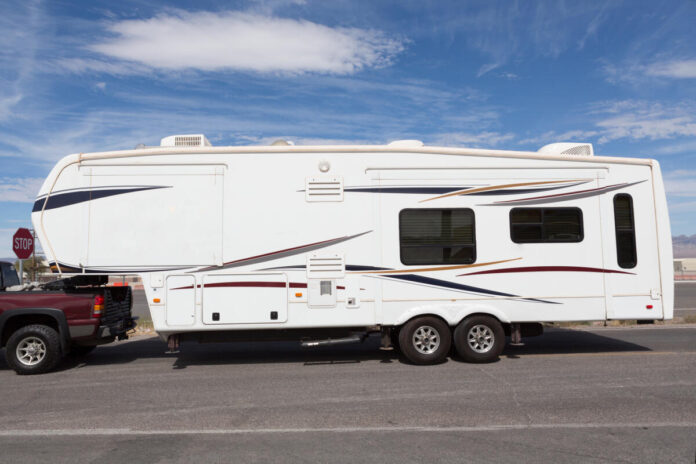
From what I have found, most of the issues have been cracks in welds or the cross-member frame of 5th wheel units under the front overhang.
Grand Design at the height of frame flex problems
Most of the firestorm of the frame flex issues has been devoted to Grand Design’s fifth wheels. Don Clark, president of Grand Design, posted a letter that indicated they are aware of the problem with a select few units and have extended the original 1-year warranty to 5 years. They are taking care of units on an individual basis, as numbers currently show it has been less than 1% of sold units. You can read my original post on the issue and the letter from Don Clark here.
Lippert’s frame
Lippert Components, Inc. manufactures almost every component that goes into an RV these days. One of those components is the frame or “chassis” that most manufacturers purchase to build their rigs on. In fact, most RV manufacturers are actually assemblers, as they purchase almost every component from an outside original equipment manufacturer (OEM). It varies among manufacturers, as some do build their own sidewalls and slide rooms. However, there are many that purchase everything and just put it together like an IKEA cabinet set. Okay, that might not be fair to all RV companies, but you get the idea.
Lippert engineers work with individual RV manufacturers to design a frame that will conform to the floorplan, weight requirements, and other specifications. RV assemblers or manufacturers (I’ll give some the benefit of the doubt) then build the rig on the delivered frame. At this point, Lippert has very little control regarding any changes to the floorplan such as options for heavier appliances, furniture, or other components.
I sent a request to my technical contact at Lippert for an interview and discussion regarding the frame flex issue. I received a very nice and detailed response from Jarod Lippert, Chief Marketing Officer (CMO) of Lippert. He acknowledged the concern. Lippert has been asked by Grand Design to refer all concerns to Grand Design, which is handling each request on an individual basis.
It just makes sense that you don’t have two companies stepping over each other. In my opinion, Grand Design would be the best to address what is causing the stress and frame flex issues such as weight distribution or structural integrity. I would bet few, if any, of the owners or service centers that have classified this as a “catastrophic failure” have weighed the rigs at specific individual points.
What does the actual data show?
I contacted the Executive Director of the RV Safety & Education Foundation (RVSEF). They have been weighing rigs for more than 30 years and educating not only owners but also manufacturers and dealers on weight ratings and tire pressure. In the early years, I worked with the founder, John Anderson, and more than 75% of rigs they weighed were overloaded in one or more weight capacity. He was instrumental in getting RVIA to require manufacturers to post the actual weights and ratings such as dry weight and cargo carrying capacity.

No manufacturer that I know of lists what weight you can put in individual compartments, side to side, or in the overhead of a 5th wheel. That would be sales suicide! Instead, they put huge compartments all over the place and leave it up to the owner to “figure it out.” Even today, the RVSEF weighing data shows that almost 50% of all rigs weighed are overloaded.
However, according to the Executive Director, they have been invited to weigh rigs at recent Grand Design rallies. Although the data is confidential to the individual owners, he stated that Grand Design has been one of the most proactive companies in working with any issues and taking care of its customers.
Are frame flex issues a “catastrophe”?
I don’t think so, as it is an issue on isolated frames and basically is a crack or broken weld that can be repaired in most cases. I believe it can be prevented with an understanding of weight distribution and limitations. How many rigs out there have experienced sidewall cracks around slide rooms, entrance doors and even windows? In fact, I believe that if there was a thorough inspection of the outriggers, compartment frames, and other welded and weight-supporting metal components in the substructure of other RVs, you would find stress cracks and broken welds in just about every RV out there.
If you take a closer look at the posts and YouTube videos that are calling this a “catastrophe,” you will notice several are from influencers or others looking to sensationalize an issue for “clicks” and views for money—they are not based on facts. There also appear to be some service centers attempting to create a “panic situation” in that your unit has to be inspected and fixed at $200+ per hour labor rate.

If you want to hear about what I feel are actual catastrophic failures in the RV industry, follow me over the weeks to come as we look at how opening a gas cap on your RV could drench you in gasoline, and tire failures so common that owners were swapping out new tires for other brands.
If you want to learn more, here’s another deep dive into the frame flex issue.
Return next Sunday for another RV “catastrophe.”
Dave Solberg is a leading expert in the RV industry and the author of the “RV Handbook.”
Read more from Dave here.
HAVE A QUESTION FOR DAVE?
Send your inquiries to him using the form below.
##RVT1165


Nice perspective. I am looking forward to reading the rest of your articles
Excellent article.
I think it safe to say the frame flex issue seen today is a design flaw. The frame simply isn’t always robust enough to withstand the rigors it experiences on the road. Some of the blame could be operator overload for sure, given the storage space provided. I find it ironic that Grand Design is the name chosen for the RV that most exemplifies the issue.
Thank you, Dave! 🙂 I guess the most “unfortunate” aspect of all this is the difficulty in getting ones RV four-cornered (corner?) weighed. We are fortunate in that we have been to rallies with both RVs and paid to have them weighed. Similarly, a couple who weigh RVs through the Recreation Vehicle Safety Education Foundation are just up the road a piece. We can schedule a mutually acceptable time and place to have our RV weighed. I imagine that it is much harder for others to get their rig weighed. The most important aspect of the “frame flex” hullabaloo is convincing RVers to weigh their rigs when fully loaded for travel. Thanks again, have a great day, safe travels, and safe stays! 🙂
I have a DRV FullHouse, my frame cracked. Our owners FB page has probably 40 other people with DRV’s that had cracked frames. It’s a Lippert issue. At least DRV in conjunction with Lippert has repaired all cracked frames without charging owners anything out of pocket, we just had to get to the factory in Indiana.
We too have a DRV Fullhouse; same issue, same experience – DRV covered it, however the lead time for the factory repair was 6 months. Owing largely to the Grand Design debacle and Lipperts refusal to farm-out the frame welding.
Dave,
I have experienced 3 Lippert frame failures on my Springdale travel trailer.
1- The below floor water tank dropped out when the supports fatigued
2- I tubular steel on the A frame cracked
3- An outrigger fatigued where it attached to the main frame rail.
Luckily I have a wire feed welder at home!
Dave H
I guess frame flex/cracking isn’t a catastrophe until it happens to you. Even worse if the manufacturer doesn’t step up and offer a repair.
Concerns with possible frame failure led us to the motor home side of RVing. The F-53 chassis does seem to be a bit sturdier, but I am sure it can be wracked out of square if the user is careless. That’s why the jacks are set to operate in pairs.
Now, I will say that our last fifth wheel was very sturdy. It was a 2004 Fleetwood Terry Quantum 285RLS. Fit and finish was excellent, and the pin box area was not hidden under sheet metal. You could inspect it before each time you hooked-up. I think at the time the frames were still being made Fleetwood.
So I know most engineers over-engineer most designs, so they don’t have issues later. for instance bridges or air planes. There is a safety factor built into the calculations. But not for RV weights??? Talk about prioritizing profits over safety……………
Dave-this is a catastrophe when you experience it. My family bought a rig (full time rated) to travel for a season. We had a failure from flex and had it repaired following a factory TSB. 4 months later it cracked again. Currently at the factory for evaluation and repair. 8 months out of service. I assure you this IS the worst thing that happens with our rig. After this repair we are out of warranty-now what?The bumpy road line is an excuse. Every rv travels on the highway-they should handle it. How many semi trailers crack in half? The reality is they are cheaply made and overpriced and articles like this allow it to continue. BTW I scaled my unit-within all gross and axel/pin limits.