

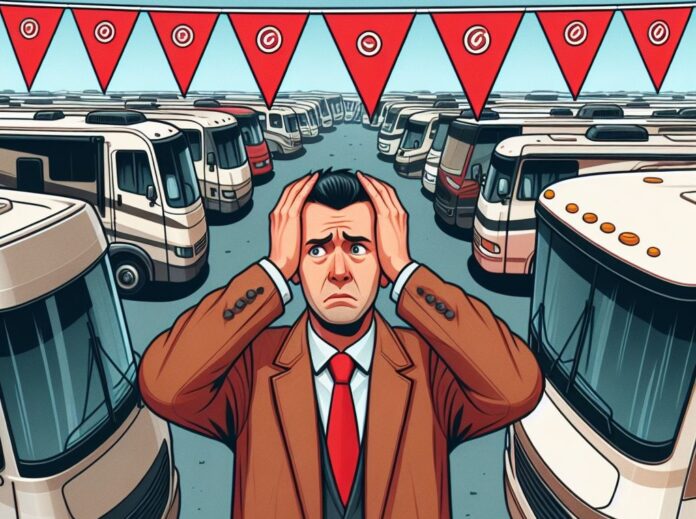
Representatives of RV manufacturers and campground owners keep radiating good cheer about the upcoming season, paying extravagant notice to every uptick in sales and reservations. And indeed there is cause for cautious optimism, with new RV shipments having arrested last year’s free-fall and notching slight gains, while KOA has reported that 64% of campers already have made reservations “for some sort of trip” in 2024. So maybe the first day of spring truly was a sunny one.
Yet it’s also clear that industry participants remain leery of what lies just over the horizon, and there’s good reason for that, too. Short-seller interest in Thor Industries and Winnebago Industries, the two 800-pound gorillas in the RV manufacturing segment, has been piqued, not least because Thor earlier this month slashed its 2024 outlook based on soft demand and high interest rates. Winnebago, more ominously, recently announced an 18.8% drop in revenues for its second quarter, ending Feb. 24—a decline, it should be noted, from an already weak second quarter last year.
Then there’s the mid-March decision by Marcus Lemonis, chief executive officer of Camping World Holdings, to unload nearly a fifth of his company’s stock holdings on a Friday afternoon, when public notice might be minimized. His $2.56 million payday came several weeks after Camping World announced a 10.6% decline in revenues for 2023, with new vehicles sales for the year down 16.6%. Investor interest in this company also has grown increasingly bearish.
Post-pandemic hangover in the RV industry
As the Camping World example illustrates, the industry’s ongoing problem is a post-pandemic hangover that just won’t quit. The explosion in RV sales that started in 2020, while a short-term windfall for manufacturers and dealers, has proven to be too much of a good thing. Too many units were cranked out in too short a time, resulting in significant production quality issues, while unceasing demand drove prices way too high. When the wind dropped out of the industry’s sails, dealers were left with too much outdated inventory that is still clogging their lots even as newer—and lower-priced—models are being delivered.
Lemonis tried to put a bright face on his company’s year-end report by noting that used vehicle sales were up even as new vehicle sales dropped. But as overall revenue figures suggest, that wasn’t nearly enough. While used vehicle revenue increased $102 million, new vehicle revenue dropped $651.8 million. And the average selling price of both new and used RVs declined—4.3% and 4.8%, respectively—further underscoring how greatly inflated the industry’s entire pricing structure had become. Indeed, the monthly Black Book reports on wholesale auctions have recorded six consecutive months of price declines for towables, while motorhome value trends have trended downwards since October of 2021, albeit in seesaw fashion.
General economic outlook guarded
Meanwhile, general economic news provides little to no reason to think demand will pick up significantly. With interest rates still high because of ongoing inflation anxieties, Americans are either tapped out or turning to deficit spending to sustain their lifestyles. Credit card debt is up and is taking longer to get paid down, with unpaid balances surpassing 2019 for the first time and delinquency rates continuing a steady rise since 2021.
With record numbers of Americans unable to afford their rent, and many costs related to car ownership outpacing the consumer price index—AAA calculates that the total annual cost of owning a new car was $12,182 last year, up from $10,728 in 2022—more people are using their 401(k) accounts as piggybanks. As reported by The Wall Street Journal, 3.6% of Vanguard’s 401(k) plan holders took early withdrawals last year for financial emergencies, nearly double the pre-pandemic average of about 2%.
All of which explains why the nearly 200 respondents to a recent Wells Fargo/RVBusiness survey of RV dealers had, at best, a tepid outlook for the coming year. More than a third (39%) expect a flat-to-down year, while an almost equal percentage (38%) expect growth of 0-10%. Asked to describe the general state of the RV market, only 14% agreed “it’s solid, despite increasing interest rates, soft demand and other headwinds.” At the other extreme, 19% said it’s the “worst it’s been since the 2008-09 recession,” while 39% admitted to being “nervous about inflation, potential recession and other challenges.”
RV industry executives under false impressions
Some of the dealers’ comments, meanwhile, echoed what many RV campers have been saying for several years. When it comes to repairs, for example, “parts and service has only gotten worse and the factories do not care at all,” while “manufacturers underpaying for warranty work is a major problem.” Or as another respondent observed, “It appears most RV industry executives, both suppliers and builders, are under the impression their quality is good. In most cases this is laughable.”
And on a more poignant note that should touch a nerve in all corners of the RV and campground ecosystem, there’s this: “I think the industry has lost touch [with] what camping was all about. Where has affordable family fun gone?”
Andy Zipser is the author of Renting Dirt, the story of his family’s experiences owning and operating a Virginia RV park, and of Turning Dirt, a step-by-step guide for finding, buying and operating an RV park and campground. Both books are available through bookstores or at Amazon.com.
##RVT1150b


We all knew this was coming. Now comes the pain of getting past it. It’s going to hurt every facet of the RV business- manufacturers, dealers, consumers, and RV parks and campgrounds.
How are RV parks and CGs going to be impacted? We are stuck with their fee increase so they are making out. There is no longer a supply and demand with the RV manufacturers, there is however with parks and campgrounds.
Part of why we bought a used larger DP with a toad-also used was the ability to stay 5-count them 5 days self contained and not have to deal with “over priced campgrounds”. Rent “this and no DEF”.
Sorry, what’s a DP and a Toad? Newbie here.
Hi, Kelly. DP = Diesel pusher Class A motorhome. Toad = towed = car that the DP tows. (I’m replying in case Jesse doesn’t notice your comment.) Have a great day! 😀 –Diane at RVtravel.com
Thanks Diane! I should have guessed on the DP but I would have still been trying to figure out what accessory a toad was. 😆
You’re welcome, Kelly. I had to learn a lot of terminology that was completely foreign to me when I started here 10+ years ago. But sometimes someone will still write something that I’ve never heard of before and I have to look it up. So you’re not the only one that’s learning.😉 Take care. 😀 –Diane
See above
Thanks Diane. Sometimes us RV vets forget not everyone understands RVese. A welcome to Kelly B. We were all newbie’s once upon a time.
Thanks, Jesse. I remember when I first started moderating comments, and someone had said something about their TV. I thought they meant their television, which didn’t fit in with their comment. So, with a grin on my face, I asked them what they really meant. Nope, not a television. They were referring to their tow vehicle.🫢 Have a good night.🤗 –Diane
Inflation is here, except in certain bubbles. Plus higher and higher interest rates will still desire.
Andy, this is a great article but, in my little opinion, the RV industry as a whole is GROSSLY NOT listening to what customers want. For example, people go camping to get back to a simpler way, to unwind, yet RV manufacturers keep pumping out gargantuan rigs with their bland grey and white interiors attempting to emulate classy townhouses rather than functional camping rigs. Another way the RV industry is ignoring customer wishes is the vast number of single campers, yet very few campers today are designed with that in mind. An entire segment ignored. I think those factors are as much a reason why sales are flat as the economy but you can’t get them to recognize that.
Bullseye on several levels. One is the bland interiors. I am an architect that has worked with many young interior designers. They all seem to have gone to the same school. “Baby diaper browns” + greyish flooring + grey’s and other shades of greys. Sometimes I think the Gen Zero generation is incapable of seeing any other colors. I think the skinny jeans and man buns have affected the ability to visualize these other options. And now the skinny jeans / man bun market has dried up after the pandemic experiment with RVing has ended in failure or at least dissatisfaction.
Andy, you need a haircut and a shave but you can write. Good article! Thank you.
At my age, I’m just glad I have hair of any length.
And in spots we like and want.
Thank you, Andy! 🙂 Great article! Yes, all is not well on the bridge of the Titanic despite those dancing in the ballroom. Thanks again, safe travels, and happy Easter! 🙂
Where has affordable family fun gone? … needs to ring out far and wide on many levels.
What Lies Ahead? Perhaps evaluating the lies of the past will shed some light.
The RV industry signed it’s own death warrant via years of shoddy workmanship and a warranty processes that leaves the customer wishing they’d bought a cabin on a lake. Now they find themselves with a market that has cooled off. If they had a reputation for delivering quality products, they could weather some rough sledding, but their collective greed and horrible after the sale support has tarnished their reps.
Couldn’t have said it better, myself!
A well sourced example of excellent journalism. Well sourced thought provoking article.