


(Updated version of previous post.) Tires fail from two basic causes: low air pressure and/or long-term degradation of the rubber, usually from excess heat.
Low air pressure
Low air pressure (active leak from puncture, or loose valve stem or valve core are most common reasons) can lead to a sidewall flex failure—more commonly called a “blowout”. The sidewall cord can melt (polyester) or fatigue (steel). Many trailer owners fail to realize that they will never “feel” the results of a tire losing air until it is too late. They are surprised when the sidewall lets go. The rapid air loss “Bang,” even if the tire only has about 10 to 20 psi in it, is a big surprise—if they even hear it.
HERE is a post on how to know if you had a run low flex failure. A tire pressure monitoring system (TPMS) can provide warning of air loss, so it is good insurance and can easily pay for itself. If the owner of the tire in the (linked) post was running a TPMS, there is a good chance he would have been warned 50 miles earlier when the leak started.
FYI: The reason we know the leak started 50 miles earlier is that the owner reported that he had checked the air 50 miles before, when starting on the trip. The physical evidence is the proof that the tire was run at highway speeds with maybe only 20% of the air pressure required to support the tire load. With this information, I suspect a leaking valve core, as no valve cap is seen on the failed tire.
Long-term degradation of rubber on a tire
The long-term degradation of the rubber at the edges of the belts can lead to a belt and/or tread separation. Even if the tire keeps its air you can have this type of failure, so a TPMS will not provide a warning of this condition. This degradation comes with age, as rubber is always losing flexibility.
The technical term is “increased cross-link density.” Just think of those rubber bands you found in the back of the desk drawer. The “cross links” are the bonds formed at the molecular level. Even in cool and dark conditions, they get brittle and hard as a rock. However, running at, near or above the load capacity will result in accelerated increase in heat generation. This extra heat increases the bond growth rate. This increased heat actually can accelerate the aging process with a doubling of the rate for each increase of 18F. Running a margin of at least 15% between capacity and measured load is a good first step. Running at higher speed will also generate excess heat.
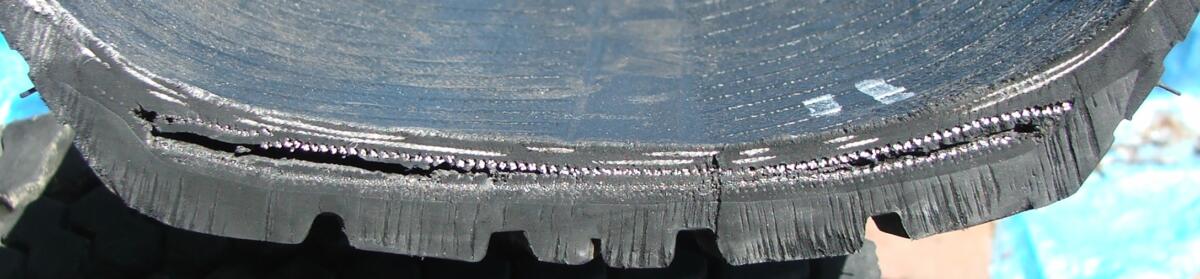
Here is a picture of a tire that still held air and had not “come apart.” However, a forensic examination discovered “belt edge cracks” that had grown significantly and certainly would have come apart if driven many more miles.
Realizing that more than half of the RVs on the road have one or more tires in overload is one main contributor to the high tire failure rate. This fact is confirmed by thousands of measurements by the RV Safety Education Foundation.
I firmly believe that if a “free-spin inspection” had been done by the owner, the irregularity caused by these cracks would have been discovered and the tire would have been removed from service before it became a “blowout”.
Tires don’t fail because of the location of the tire manufacturer
Every month, I read RV forum posts where people claim the tire failed because of the location of the tire company. In my opinion, this makes as much sense as claiming a tire will fail because the tire plant building is painted blue rather than green. This is just not logical.
Buying the lowest cost “no-name” tires is, in my opinion, a major contributor to poor results. If the main objective is the lowest cost tire, why would anyone be surprised with short tire life? Just paying more, however, is no guarantee of better quality.
What to consider when purchasing new tires
Can you get multi-year warranty on the tires? Is it possible to get road hazard coverage? Is there a nationwide network of dealers who stock the brand, size and load range you are considering? I believe the best tool available is comparing warranty and service support. If I can not get a warranty when purchasing new tires, I would go to a different dealer or tire brand.
Roger Marble
*****
If you have tire questions, check out Roger’s Blog as well as his posts on RVtravel.com. There are hundreds of posts covering everything to do with tires.
If you still have a question for Roger after searching the above posts, send your inquiries to him using the form below.
##RVT1194


I have Sailun tires on my 2020 Montana 5th wheel. Last fall I thought I would change them as they were coming up on five years old and have extensive miles on them.
I contacted Sailun directly for their closest dealer to me and explained my reasoning for replacement and my desire to use their tires again. I sent them the tread wear and even though I wanted to buy new tires from them, the rep. said that I have at least one or two more years of good, safe use left. He went on to explain that their tires are of higher quality than most and it was silly to just change them at five years of age. How is that for customer service?
There is a good reason you will see Sailun tires on so many semi trailers. Comes down to quality and long life. I have used them for years on all of my trailers.
Excellent to hear! Thank-you.
I decided to switch tire brands last time I needed tires on our trailer. I went to Les Schwab (an extensive dealer chain out west). I bought four tires and almost immediately headed up into Oregon. Got to La Grande, OR and while stopped for quick break, I could hear air leaking from someplace. Discovered one of my brandy new tires was leaking. We found Les Schwab close by and drove over. The place was packed but they dropped everything and quickly fixed my leaking tire. No charge, of course. They’ll even fix your flats for free even if you didn’t buy the tire from them!
Thank you, Roger, for this informative discussion! We have a TPMS with sensors on the rims and pay attention to the readings. We also have our rig 4-corner weighed to determine the appropriate pressures for the tires, but also to be aware of when we need to redistribute weight inside tbe RV or in the storage bays. Thank you for relentlessly harping on the need to run tires at correct pressures and to not drive too fast. Have a great week and safe travels!