

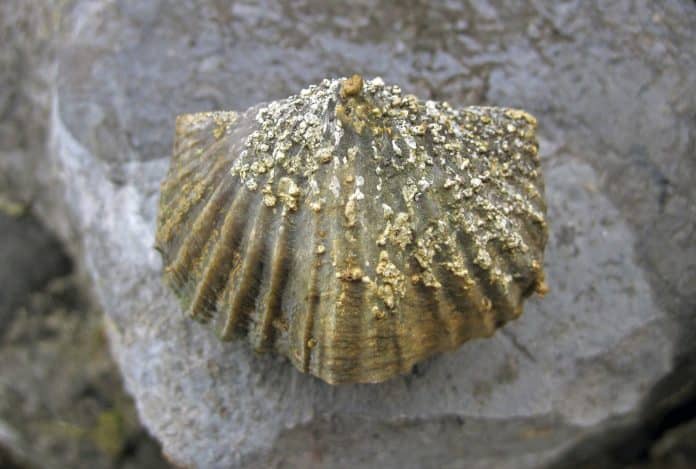
Do you know a budding paleontologist? We do! Our grandkids love digging, searching, and finding things in the earth. When they recently found “weird-looking marks on a rock” they showed it to me. It was a brachiopod. (We looked it up on the internet.) That’s when a light bulb flashed in my head: Let’s take the grandkids and go RVing for fossils!
Pick a date
This year’s vacation is already planned, so we’re looking at RVing for fossils next year. I vote for going over the children’s spring break. The temperatures will be much cooler than if we fossil-hunt during summer vacation.
Anticipation time
There are advantages to planning so far in advance. It gives both the g’kids (and my husband and me) what I like to call “anticipation time.” Preparing for this trip means researching fossils, discovering the reasons why the fossils formed, and so much more! Excitement builds each time we discuss our trip. We all have time to prepare for our first dig: locating necessary tools, supplies, clothing, etc. The “anticipation time” also provides time for researching other activities in and around the area. I’m hoping that planning so far in advance will ensure that we can reserve our first choice in RV campgrounds, too.
Choose a location to go RVing for fossils
There are many places to search for fossils throughout the country. Because anticipation is so high for our trip, I’m also interested in a location where the kiddos are sure to easily find some fossils. We also need to find “dig locations” that have RV campgrounds nearby. And because we won’t be fossil hunting all day, every day, we want to choose locations that offer additional activities that appeal to our g’kids. Here are three locations we’re considering.
Caesar Creek Lake – Ohio
This site, near Waynesville, Ohio, looks promising. It’s located in the southwestern part of the state within the emergency spillway of the Caesar Creek Lake Dam. A permit is required if you plan to keep any fossils you find, but the permits are free of charge. The best part? There’s an Army Corps of Engineers campground and Caesar Creek State Park Campground in the vicinity. Both have great RV reviews! More information, along with the fossil-collecting rules, can be found here.
Montour Preserve – Pennsylvania
Outside Danville, PA, is another potential fossil dig. Montour Preserve is located in central/eastern Pennsylvania along the North Branch of the Susquehanna River. This area was once covered by a shallow sea and now features a plethora of fossils to find. With free admission and the ability to keep any fossils we find, I think this site has exciting potential. What’s more, there are several highly rated RV campgrounds nearby. Click here for more information.
Mineral Wells – Texas
This site is fairly primitive and located just outside Mineral Wells, Texas. While only surface fossil hunting is allowed and only in designated areas, there is free admission. You can keep the fossils you find, too. There are many privately owned campgrounds near this fossil site and two state parks, as well. Find out more here.
Things to bring when RVing for fossils
Since we’re new to the world of RVing for fossil-finding, I’ve been researching things to bring for our upcoming trip. Here’s what I’ve found:
Protective clothing
- Sturdy shoes
- Hat (for sun protection)
- Gloves (some shale can have sharp edges)
- Knee pads or cushions (like a garden “kneeler” pad)
- Goggles or safety glasses
Tools
- Small hammer (for use where permitted)
- Soft brush (I found several cheap makeup brushes online, but an old toothbrush would work too.)
Additional items you’ll need when RVing for fossils
- Spray bottle of water (to wash off potential fossils).
- Roll of toilet tissue (to wrap fragile fossils for safekeeping).
- Nail apron or zip-type plastic bags (to contain found “treasures”).
- Umbrella (for sun protection).
I’m excited about our upcoming trip! Have you ever gone RVing for fossils? Share your advice and where you went in the comments below, please!
If you’re not into fossils, what about panning for gold? It’s a great activity for RVers! Learn more in this article.
##RVT1061

Fossil butte national monument. Kemmerer Wyoming. Check with private company to dig in their quarry. We spent 3 hours and got 15 fossils. I would post a picture if I knew how.
For kids enthralled by dinosaurs, there is no place better than Dinosaur Ridge National Natural Landmark, just west of Denver. There budding young paleontologists can actually touch Jurassic bone fossils still encased in their original Morrison Formation sandstone, climb a Cretaceous beach sandstone covered with hundreds of duckbill dinosaur, ornithopod, and crocodile tracks, and see dinosaur mating dance grooves (see “prairie chicken mating dance” on Youtube) in a flood-deposited mudstone. The small, very nearby Morrison Natural History Museum and the relatively expensive, but very worthwhile, Denver Museum of Nature and Science have mounted dinosaur fossils that are amazing in their huge size.
Just for clarification, I am a retired geological engineer and was a volunteer tour guide at Dinosaur Ridge for 10 years. But I am receiving no financial rewards from this unpaid advertisement!
Utah has some of the best trilobite beds in the US. Most are found west of the city of Delta in west-central Utah. There are also some great areas in the north-east area of the State. Sites range from paid access to free-use. Some of the paid sites are well known for gem quality discoveries. Commercial RV campgrounds are distant and sparse. But several of the sites border or reside on BLM land which offers free boondock camping. For the more adventurous, there are sites only available to backpackers or those with off road vehicles. Most sites are in high-desert country so be sure to research and go prepared.
Loved Delta area. Found several trilobites. And don’t forget nearby Topaz mountain. There are so many topaz chips that the mountain sparkles in the sun. If you are lucky you will find larger topaz bearing rocks.
Thanks for including Mineral Wells Fossil Park in your article! Hope you enjoyed your visit.
Thanks for the article, Gail. A spot I have had success is the Santa Ynez River near Lake Cahuilla, CA. Shell fossils in white limestone and some dark brown petrified wood. Just a few miles from Rancho Oso campground and not too far from Santa Barbara.
Just remember that removing fossils, or any natural articles for that matter, from state and national parks is illegal. Photos will have to do. The park Naturalist/Interpreter might be interested in the photo and the location of the fossil. They often have collections for display purposes.
Allegheny State Park (100 sq. mi.) in New York was a place where we found and brought home sea-life fossils. We camped there when my boys were small (5 and 9). They were so excited, it was the highlight of the week. There are lots of family activities on the park activity schedule and fossil hunting at a dig site was one of them.
Sounds like a good time; have a great time, Emily. Our farm here in east Tennessee has lots of rocks (and rock outcroppings) loaded with fossils. If you want to bring the g’kids to east Tennessee to be rock hounds, do it in the winter when the snakes are hibernating. We do host a Boondockers Welcome site — Davis Farm — if you have interest in checking out our rocks and the Chattanooga, Tennessee vicinity. Safe travels.