


In this week’s look back at some of the headlines in the RV industry, we’re taking a look at something making the RV industry cooler, why some folks think RVing is less cool and a look at a couple of RVs that are… pretty cool.
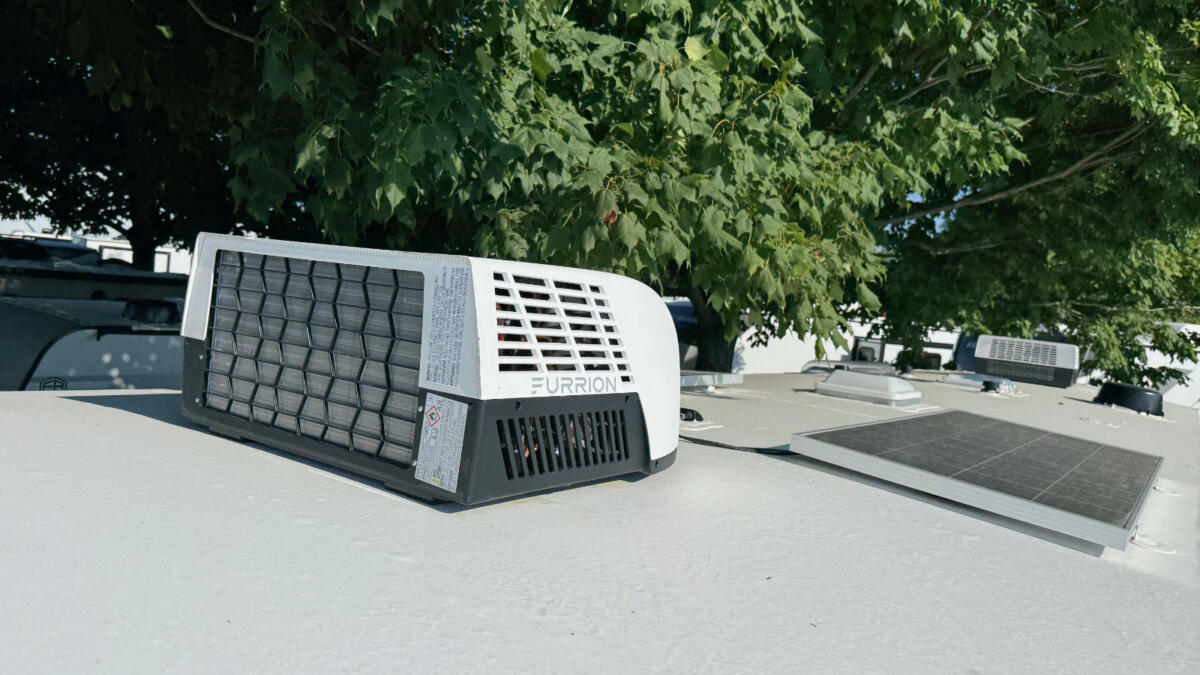
A/C units are getting cooler
I added a comment to Russ and Tiña’s article about RV air conditioners and how most of them have barely changed in many, many years. I have no issues with that, as most RVs nowadays are shipped with whatever’s the least expensive thing they can get by with. Knowing my buddies in the Hoosier State, they would gladly ship RVs with no air conditioners if they thought people wouldn’t notice.
But here’s a funny thing about buying an RV. When you’re wandering the dealer’s lot, the RVs themselves aren’t plugged in or running, so many buyers have no idea how noisy RV A/C systems are, especially if they haven’t had an RV before. But change is in the air. 🥶
I shared an article a while back about the Furrion Chill Cube, which has found a home on the roof of a number of RVs now, including the Alliance Paradigm 312RK that I review in tomorrow’s newsletter. With the modern systems inside the Chill Cube plus just good design, it has taken the industry by storm, and you’ll find it on more and more RVs. In fact, the articles I’ve written here and elsewhere have sold a ton of these units.
But that unit is about to get some real competition. Arguably, the leader in RV air conditioning by sales volume is the Coleman Mach product, and that company has now officially introduced their 18K variable-speed IntelliCool RV A/C unit. The thing is, I’ve been talking to the folks at Airxcel, which has been making this unit for a while now. And here’s a little secret: I’m going to have a full test of the unit in the next couple of months.
So, before you buy an A/C, you might want to hold off to see how this new Coleman Mach unit compares to the Furrion Chill Cube. But it’s good to see that things are progressing. I’ll report back.
Is traveling by RV getting less cool?
Another good article from Russ and Tiña this week is the reflection on the RVIA’s report that RV travel can be much less expensive than flying and staying in lodging, with all the costs associated with that. There are some good points in the article and, as always, I love the comments.
What I’d like to add is that I think the RV industry is missing an opportunity here. While many of us travel because we prefer RVing, that’s not universally true.
As RVers, we know that many of the times we hit the road, there’s going to be something that needs to be fixed—minor and sometimes major. With most vehicles nowadays, except RVs, being so very bulletproof, I think the industry should do a lot more to mitigate the frustrations many feel. I see a lot of comments on social media where people are frustrated with all the repairs brought about by this constant covering over repairs.
I had shared that RV sales had seemed to stall, and, of course, many things factor into this. But the drumbeat I’m sensing based on social media posts is that there is a fair amount of frustration in newer RVers with the combination of costs and the maintenance required that has put a noteworthy number of these people off.
And I believe it’s a contributing factor in people choosing other types of vacations, especially as campgrounds become more difficult to book and more expensive.
How long is it? Fifth wheel length
There has been some ambiguity about measuring the length of a fifth wheel, but House Bill 2467 passed and was signed into law on Monday in Washington state. Interestingly, while you and I might figure the length of a thing is how long it is, this states that a fifth wheel is measured from the kingpin to the absolute end of the rig.
So what about all the hangy-over bits?
I guess the length of a fifth wheel isn’t really the length of a fifth wheel in Washington. Strange and, of course, this was encouraged by dealerships, with Tacoma RV spearheading this.

The 1970s and RVs today
Before I got into writing about RVs, I wrote about cars. The point being that in the 1960s, car companies were generally operated by enthusiasts. By the 1970s, quality had suffered, and cars were pretty poorly made. This created an opportunity, and the Japanese gladly came in and took it with better products. In the 1960s, GM had so much market share that the government considered breaking it up. Today, the go-to car company is now really Toyota for many.
The point of all this is that the RV industry, to me, seems like the auto industry of the 1970s. Instead of being run by enthusiasts, many RV decision makers never go RVing. And I think that’s creating an opportunity.
I’m seeing companies start to step up with Lightship and Evotrex already showing up with different ideas, and now there’s China-based Skydream jumping on the bandwagon. But somehow, these all seem to be niche products. Thus far. But it shows that the RV industry is on the radar for some different thinking.
I’ve already shared that the RV industry could use a grumpy old guy who is an actual RV enthusiast, and I was surprised by the attention that got. I think I struck a nerve.
But as I watch sales stall and people complain on social media, it makes me sad. It doesn’t have to be this way. And I also see that there are some companies that are more proactive about listening to customers. It’s not too late just yet.
Stay up to date with all the news headlines for RVers. Click here.
To read more from Tony, click here.
RVT1253b

If only the rv manufacturers would use their products, they would understand how inadequate the ac’s are for summer use. Keep up the good work, Tony.
Thank you, Ron! I think you do see some changes with companies like Alliance and Brinkley using triple direct-dump AC units which are far more efficient. The more I look at RVs the more I see some brands that are just not worth considering and some that absolutely are and it’s clear which designers/manufacturers listen to customers and which prioritize what the dealers tell them. You know – another group that doesn’t go RVing.
Amen!
I, for one, would definitely like to see manufacturers ship RVs to dealers without AC, but with both 120vac and 12vdc wiring to the 14″ vents. Then a buyer could buy the unit as-is and have the aftermarket AC of his choice installed (like a 12v TurboKool evaporative cooler in the arid SW). Or have the dealer install a single Furrion or Coleman-Mach in the northern US and southern Canada, two ACs in the SE US, or just 12″ vent fans in Alaska and coastal Canada. And choose between a good 10-12″ vs. a useless, but cheap 4″, fan in the 14″ bathroom vent. The more choices, the better!
That’s an interesting idea with real potential benefits, but it leaves the customer at the mercy of the dealer, both in terms of the price of the A/C installation and the quality of the work. With some dealers, that could be a risky proposition.
Many RV companies will allow you to order an RV with a variety of AC options. For example, you could order one with multiple ACs in Texas or no AC in the Pacific Northwest (you’d get a vent fan instead).
With the Chill Cube and the new Coleman Mach Everest VS18 I am very pleased with the performance of those. I’m still not convinced that 12vdc AC units are a viable solution just because the wiring to get that much 12 volt amperage to the roof.
This is why you shop your RV dealership first – a good one will work with you on a custom order – otherwise it just makes sense to have what the majority of buyers will buy in stock.
As long as they push “junk” out the door and sell it “nothing will change”. The bonus babies will be long gone with their “golden parachutes” and it will be too late to turn most manufacturers around so they can “obsolete or discontinue” the crap that is out there.
Smaller trailers and Popups often use the Dometic Cool Cat, which is built in, not on the roof or side. I regret A/C units for RV’s are not energy rated. I hope Tony road test the new Airstream with the built in (not roof mounted) A/c.
So the portion ahead of the kingpin is held on with velcro and has nothing to do with how much room you need to park it? “Liar, liar pants on fire”. Just tell the truth!
Right? It seems weird, to me, that there even needs to be any legislation about measuring the length of any vehicle. Basically end-to-end but this is what happens when the government gets involved in almost anything. Truly goofy.
Any comments on the Truma A/C vs Chill Cube?
I have tried the Furrion Chill Cube personally but haven’t had as much experience with the Truma Aventa. That being written, I think the Aventa is a really good product and has been proven in a number of RVs.
If you’re thinking an aftermarket install I would look further into the Aventa but know that, I believe, only authorized Truma installers can put one in. The Chill Cube is now very readily available.
I would also wait and see how the new Coleman Mach Everest VS18 fits into the comparison – it’s just starting to become available.
If you’re getting an RV with any of these three installed I think your RV company is doing a good job of paying attention to what’s out there.