


A recent study commissioned by the RV Industry Association (RVIA) concerning electric vehicles (EVs) and EV owners revealed the following:
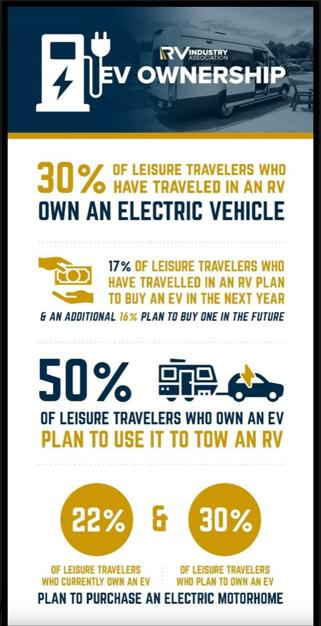
- 30% of leisure travelers who have used an RV already own an electric vehicle.
- An astonishing 17% of leisure travelers who have used an RV plan to buy an electric vehicle within a year.
- An additional 16% of RV users plan to purchase an electric vehicle sometime in the future.
- 50% of leisure travelers who own an electric vehicle intend to tow an RV with it.
- Remarkably, 22% of current electric vehicle owners and 30% of those planning to buy an electric vehicle are considering purchasing an electric motorhome.
Per the study, “Leisure travelers are defined as any U.S. residents who has taken some type of leisure trip in the past 12 months.”
Expect another surge of new RVers, just like Covid
If those numbers are correct, then the surge of new RVers to enter the RV lifestyle will greatly exceed those during Covid.
While I am no statistician, let’s throw a few numbers around to get an idea how many new RV owners this could be.
Let’s just focus on the last two bullet points above.
- “50% of leisure travelers who own an electric vehicle intend to tow an RV with it.”
According to Statista.com, nearly 80 percent of U.S. adults said that they planned some form of domestic leisure travel in the next 12 months. (Emphasis added by author.) The 2020 census tells us that there are 258.3 million adults in the United States. That equates to potentially over 206 million leisure travelers (258.3 million X .80).
This study states that 0.86% of the U.S. population currently own an EV. If the percentage holds true to leisure travelers, that will equate to over 1.7 million (206,000,000 X .0086) American leisure travelers owning an EV. If 50% of those 1.7 million leisure travelers intend to tow a towable RV, as the RVIA study claims, that would equate to over 650,000 towable RVs needed to satisfy the demand.
But wait, there’s more!
- “Remarkably, 22% of current electric vehicle owners and 30% of those planning to buy an electric vehicle are considering purchasing an electric motorhome.”
Per this report, there are currently 2,442,270 electric vehicles registered in the United States. As the RVIA study states, 22% of current electric vehicle owners and 30% of those planning to buy an electric vehicle are considering purchasing an electric motorhome. If just those 22% of current EV owners follow through on their intentions, that equates to nearly 550,000 EV motorhomes. That may not sound like a lot until you consider less than 50,000 motorhomes were built and shipped in the United States in 2023.
1.1 million more leisure travelers may soon own RVs
650,000 towable RVs combined with 550,000 motorized RVs equates to 1.1 million additional RVs on the road from this new wave of leisure travelers. By my estimate, this would be 3 to 4 times larger than the surge of new RVers brought about by the pandemic.
What I find interesting is RVIA’s study concerning EV purchases is in sharp contrast to a recent survey conducted by RVtravel.com where the readers were asked, “Will your next passenger vehicle be powered by electricity?” 67% of those responding said, “No,” and 15% said, “Probably not.”
Does this mean RVtravel.com readers aren’t considered “leisure travelers”? Or is this more wishful thinking from RVIA?
“If any of you out there think the future of RVing is in electric powered vehicles you are being led astray.” Comment per an RVtravel.com reader
What are your thoughts? Please share in the comment section below.
Dave will be speaking at the 2024 Knoxville RV Show February 10th and 11th. He would love to meet RVtravel.com readers that will be attending. Feel free to introduce yourself at one of his seminars.
##RVT1142b


By the time there are 550,000 EV motor homes on the road, my wife and sons will have said I am too old to drive and taken my keys away! So, that number is meaningless to me.
AMEN
“Intend to buy”, “plan to buy”, etc. only mean “I haven’t completely excluded the possibility.” Has anyone ever done a follow-up study on what percentage of those people actually buy an EV?
also, how many of the current EV owners have it as a second or third vehicle that they use for short drives only?
sorry for my skepticism, but you can make opinion polls and even statistics say anything you want.
Agree with the second or third vehicle being an EV. Seems it’s more of a status symbol by owning one.
I do see some heading into the big city near us, but they are driving less than 30 miles one way to get to work.
This seems like an outcome based study thru a bunch of outcome bssed surveys. They needed an outcome and did a study to support a desired outcome using survey questions that could help support the desired outcome.
When you do the math on the assertions and assumptions made, this is the craziest study and data imaginable to make business decisions…. unless of course you are going to a bank for financing your CAPEX budget and are short on actual supporting data sets to provide the banker. This is just nutty.
Doubtful many surveyed have researched their future purchases in detail. I am not against EV’s. Drove a GM EV1 for two years before it was recalled and crushed. It was a lot of fun to drive. Range anxiety was a real issue. And no one brings out a gallon of gas when the battery is dead, it gets loaded on a flatbed. EV’s are not maintenance free just as RV’s are not. And they have the same road noise as similar cars. Many retired and senior folks will have no real need to buy or own an EV unless by choice.
If this is true, why are the RV dealers lot’s overflowing with new units? And the prices are plunging.
Even if people are buying used units, the numbers remain the same since the seller no longer has it.
The storage lot I use has 4 or 5 with for sale signs on them. 3 of them look to be less than 2 years old.
The ones buying EV’s, probably aren’t traveling very far. I can drive my gas pickup truck, pulling my 28ft trailer, about 180 miles before needing to stop 15 minutes to fuel it up and be on my way.
Thanks for the report Dave. RVIA using statistical numbers to come up with their own conclusions, what could be wrong with that
I don’t think your conclusions are what this article is really pointing out
I’m thankful Dave shared this nutty data with us. Incomplete and unrealistic conclusions, not by Dave but by RVIA. Someone wanted the conclusions and paid good money to acheive them. Instead of looking at real, conclusive data for industry outlook, projections and forward looking strategies, let’s just tell the researchers the outcome we desire and pay them to get us to that desired outcome. No idea why, but that is what this is, without question.
Thank you, Dave! My goodness, I wonder if RVIA’s surveyors have finished 6th grade yet? 😉 Well, maybe they are a bit more sophisticated than that, but I do find these results rather improbable. 🤔 They did pay for the “survey,” but I wonder if they gave the final conclusion to their contractors so they could work backwards and justify the hard-wired conclusion? I guess we’ll see. If they ARE right, then somebody needs to get to work on expanding both the earth and the number of campsites. 🙂
If you tell a lie long enough, people will believe it’s true. Now that I’m retired I wonder if people still work with so many cars driving around and very few are electric. Most electric vehicles I see are Teslas.
yeap, no thanks not buying into the hype of EV’s unless it’s an rc vehicle as a hobby. all these folks not having a clue of how the material is found, removed, manufactured and disposed of thinking they are saving the planet by buying an EV, really? I certainly can’t afford the cost or payments for one, so who’s really making out here? that’s not hard to figure out!
I own an EV. I intend to buy an RV. I won’t tow it because EVs are still a few years away from being able to have that range. But can’t wait for a 350 that has a 600mi range to tow a brinkley
I am an RV Transporter with one of the larger transport companies & deliver new RVs from factory to Dealers all over the US and Canada.
When you understand that the RVIA is an organization which primarily serves the RV Mfgrs and provides them the cover to make whatever sales strategies they need or want. I can assure you that these projections are NOT what the transport companies are using. Our 2023 projections were about half of the 2022 projections and only grow by about 2-3% for 2024. When I read the National media stories about the number of EV programs being shut down or greatly reduced, it’s easy to see that the RVIA is using this study to sway the minds of the marketplace.
In the tests I’ve seen, the range of Ford/Chevy etc electric trucks have been around 100 miles with a 7000 lb trailer. They may intend to go camping but they may not actually get there. But, if/when the ranges are better and if/when there’s charging infrastructure close to places that we camp I’d certainly consider. I doubt that will happen by the time I hang up RVing though.
This survey was micro-targeted, and I feel that it did not include parameters necessary to reach valid conclusions.
Best LAUGH and load of BS I heard this week!
Now that the EV market has done a 180 in the last few months, after the reality of the shortcomings of EV’s has become apparent, the results of this survey is meaningless. EVs becoming a majority of the vehicles on the road is still many years off in the future.
I don’t believe any of this. RVIA has obviously been pressured to join in the EV charade. EV stupidity is being abandoned all around the world, from government programs to private companies. Doesn’t work.
When I see words like “remarkable” and “astonishing” in a report about a supposedly scientifically created study, I tune out because it is obviously biased. A professor once told me there are lies, d#$n lies, and then there are statistics. 😁
An EV RV? What a great idea! Unless you want to camp further away than the end of your driveway. These things will be about as useful as lawyers and politicians.
This article is simply balderdash click-bait
I wonder how they defined Electric Motorhome. Was it having an electric drivetrain or merely using all electric for appliances since there are a few travel trailer manufacturers out there touting their “electric” travel trailers?
It seems it depends on who is writing the article on EVs. Since the major players in automotive manufacturing have effectively pulled the plug on EVs for the next few years due to lack of infrastructure supporting EVs now this article talks about the RVIA touting how great the EV RV market is going to be. Makes me wonder how old this article is, it’s obvious it’s not recent. Makes me think this article may have written a couple of years ago when everyone was going crazy over EVs except people with common sense that knew better. The problems this winter that plagued EV owners hadn’t surfaced yet where batteries die in the cold, and recharger’s quit working in the cold temperatures.
While searching for RV parks this year, you could infer by some park rules that EVs are not very welcome especially if it’s a second vehicle. They don’t want 2 vehicles on the same electric hookup. One park absolutely did not allow EVs to charge at the site at all and one said you could charge an EV by reserving a second site for it. First time I had ever seen that.
i live in Cali and i see more and more Teslas on the road. that’s a fact. i wont buy one, but the facts are that they are going to squeeze us out of gas powered if they have their way. its even happening with mower and lawn equipment. none will be sold after a while. I’m not sure where its all going but being 62, I’m thinking my kids and grandkids will be the ones burdened with it.