

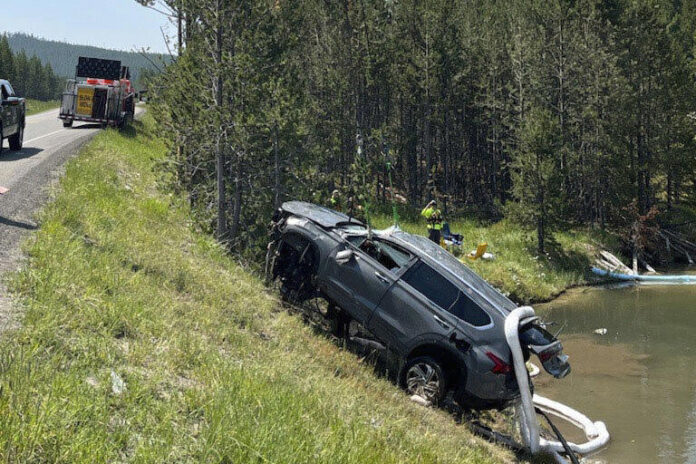
So far, no word on exactly what caused a sports utility vehicle (SUV) carrying five passengers to veer off the road between Mammoth Hot Springs and Norris Junction in Yellowstone National Park, causing the vehicle to plunge into the inactive Semi-Centennial Geyser. The geyser, known for its acidic water with temperatures hovering around 105 degrees Fahrenheit, has not erupted since 1922.
The incident
Around 10:40 a.m. on Thursday, July 11, the SUV ran off the Grand Loop Road near Roaring Mountain and became fully submerged in approximately nine feet of water. Despite the dangerous conditions, all five occupants managed to escape the hot, acidic water on their own. They were transported to a nearby hospital with non-life-threatening injuries.
Rescue and recovery
Authorities closed Grand Loop Road for about two hours last Friday to extract the vehicle. The U.S. Water Rescue Dive Team, along with other park services and contractors, conducted the recovery operation efficiently, ensuring the vehicle was safely removed from the geyser’s depths.
Geyser’s history
The Semi-Centennial Geyser, discovered in 1922 during Yellowstone’s 50th anniversary, once erupted to heights of 300 feet. Over the years, its activity has waned, partly due to nearby Obsidian Creek which merges with it, resulting in a deep pool within the crater.
Ongoing investigation
Park officials are still investigating the cause of the incident and have not released the names of those involved. The quick response and professionalism of the rescue teams were crucial to ensure the safety of the passengers and minimize disruption to park operations.
Escape techniques
In North America each year, 400 people drown in a submerged vehicle. Accidents like the one just detailed, flash floods, and vehicular accidents can happen in an instant. It’s important to know what to do in order to save yourself and those riding with you, should your vehicle be in danger of becoming submerged.
Safety experts have studied these accidents and have potentially life-saving tips for you. Remember that you may have only a few seconds to react. Remembering the SWOC acronym can help you make quick and accurate decisions that may well save your life and the lives of those with you.
S—Seat belts off
W—Windows open
O—Out immediately
C—Children first
##RVT1166b


Great info with the “SWOC” , thanks for sharing it.
Thank you, Gail! 🙂 The information on the escape technique for a submerged vehicle was worth far more than the price of admission; thank you! 🙂 Have a great day, safe travels, and safe stays! 🙂
Carry a glass breaker/seatbelt slicer in every vehicle. Mine is in the map pocket of the drivers door. I can grab it to extricate myself or to help someone else. I recently watched a video of a car on fire where people were trying to get the driver out but the door was pinned by the guard rail. Hitting and kicking the window didn’t work. If they had one of these they could have easily broken the window and gotten him out. Finally the door was opened enough to pull him out but it took a long time.