


Dear Dave,
I’m changing to lithium phosphate batteries, two 12V 300Ah, in parallel. Is that enough power for off-grid? Will that run everything? I have a 200W solar system. —Christopher, 2006 Winnebago Sightseer R29
Dear Christopher,
There are several variables when it comes to calculating the battery bank you will require and ultimately the solar panel array. Several boondocking experts have stated that the “average” RV uses 75-150 amp hours of battery power when boondocking. However, I have found that there typically is no average RVer.
Information from Winnebago
According to the information listed on the Winnebago website, your Sightseer came originally with an absorption refrigerator. That means it will run on 120-volt AC or LP mode, which is boondocking. However, since your unit is just shy of 20 years old, it might not have the original refrigerator, so you need to look at your appliances and calculate the power needed.
If the refrigerator has been replaced with a residential model, that would require a larger inverter and much more battery power and solar charging than you are planning to have.
The challenge when it comes to calculating how much battery power you need is determining how many items you are going to use, how often, and how long you are going to be off-grid.
First, I do think 600Ah of lithium battery power is enough to run for several days before needing to recharge. However, a 200-watt solar panel will not be able to do much of anything for sustaining the batteries longer than 2-3 days.
A general rule of thumb is 200 watts of solar charging capacity for every 100Ah battery, so you are way short in charging capacity. I’m not saying you need 1200 watts of solar panel capacity, as it also depends on how long you plan to stay off grid.
Calculating power needs
One of the best tools I have found for calculating power needs for boondocking or dry camping is the Go Power! Solar Calculator on their website here.
So, if I run through the steps of your rig and components, it looks like this:
Motorhome, 600Ah lithium batteries, roof-mounted solar panels, expand a current system.
Spring/summer travel for 2-3 days.
Now, I need to calculate what components will be running and how long. This is the challenging part, as who really knows how often the refrigerator cycles or how many lights and how long they are on. However, it does give us a starting point, so here is what I chose:
- Refrigerator running for 10 hours
- 3 lights on for 2 hours
- Ceiling fan on for 2 hours
- Water pump running for 30 minutes
- LP leak detector on full time
The next page lists all the comforts of home such as blender, air pot, microwave, and even a wine cooler. We will leave all these off for this example. However, there are a few other items we need to consider:
- Cell phone charge – 1 hour x 2 phones
- Flat screen TV – 1 hour
- Laptop charge – 1 hour
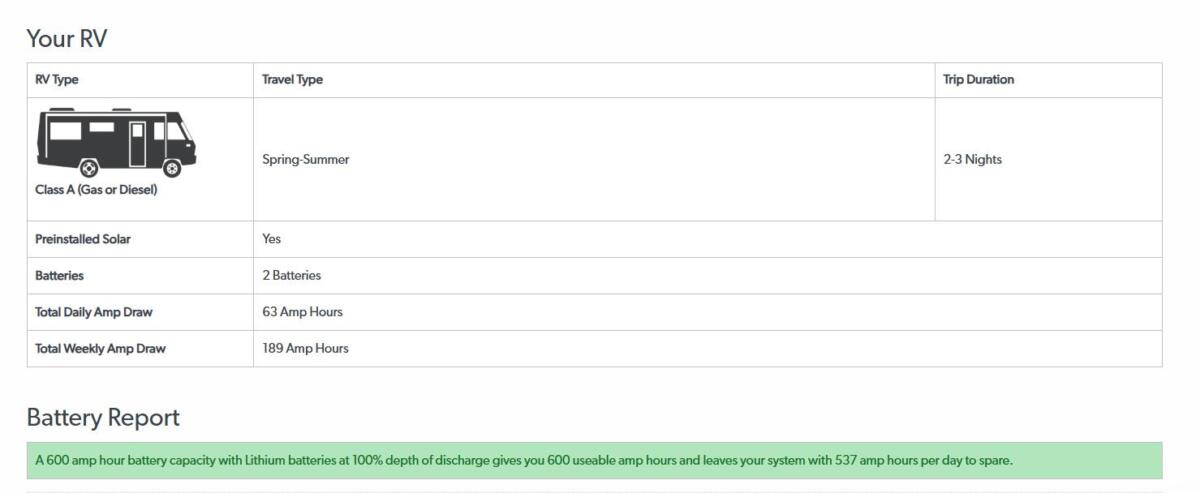
According to the calculation, this setup will only use 63Ah of battery power, and you can get by with the 200-watt panel for 2-3 days, IF you get good sun for at least 6 hours AND you are not running anything else.
Plus, keep in mind that to get a solar charge from your panels, you need to be in direct line of sight to the sun, which means raising the interior temperature 20–30 degrees. Since you are dry camping, that generally means no air conditioning. And if you go under shade to cool it down, no solar charging.
I would recommend supplementing your 200-watt panel with a 200-watt portable panel from Go Power!, which can be positioned early in the morning and out in direct sunlight while your rig sits cool and comfortable under shade.

You might also enjoy these posts from Dave
- Should I upgrade RV house battery system to 48-volt for boondocking?
- Can different type and age RV batteries be mixed? Can I add a lithium battery?
- My RV’s “larger” batteries are dead. Can I replace them with lithium?
- Will RV’s house batteries ‘play nice together’ if I replace chassis battery with lithium?
- What can I power with one solar panel and one battery?
- Will my RV’s charger be sufficient for new lithium batteries?
DAVE HAS ANSWERED MORE THAN 1,000 readers’ maintenance and repair questions. Read a directory here. There is so much to learn!
Dave Solberg is a leading expert in the RV industry and the author of the “RV Handbook.”
HAVE A QUESTION FOR DAVE?
Send your inquiries to him using the form below.
RVDT2889


I estimate an average of 5 amps to the batteries per 100 watts of panel for an average of 5 usable solar hours. That comes out to a total of 25 amps per panel per day. 2 panels will put about 50 amps per day back into the batteries. That sounds like a lot but it isn’t.
For every 100 watt panel you have, you get 1 amp per hour to use over a 24 hour period. 10 100 watt panels (1,000 watts) gives you roughly 10 amps per hour to consume each day.
For perspective- My cheap Mr. Coffee drip coffee maker consumes roughly 80 amps of inverted DC per hour. One hour of use means 4 panels are needed for a full day to replenish just what my coffee pot used being on for an hour.
95% of my camping is boondocking or what I just call camping. I have 2 100 amp hour li batteries and I can camp for 6-7 days without charging the batteries. I spent 2 weeks camping in January with 2 100 watt solar panels and never got below 80% charge.
I don’t run any 120 volt appliances. Coffee is made on a propane stove. Meals are cooked on a BBQ or the propane stove. I see your RV is a 2006 if you haven’t done it change all the lights to LED.