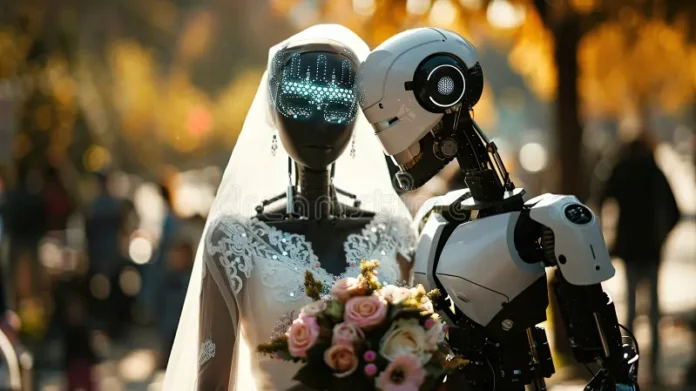
This week, I spotted a news article that left me feeling less than optimistic about the future. The headline read: Russia marries the first humanoid couple. Translation? Two robots were “married.” (Ugh.)
Details
A pair of humanoid robots named Robert and Matilda recently participated in what organizers called Russia’s first robot wedding.
The symbolic ceremony featured many of the traditions of a real wedding. It included vows, a ring exchange, dancing, and even a robotic dog serving as the ring bearer.
The event was held at Moscow’s Pushkin Library during Russia’s annual Day of Family, Love and Fidelity celebration.
Organizers stressed that the ceremony had no legal standing. Rather, it was intended to highlight advances in robotics and artificial intelligence—not suggest robots are capable of genuine love or marriage.
The “ceremony”
According to reports, the “groom,” Robert, was presented as an office worker and blogger. His “better half,” Matilda, was introduced as a ballerina.🙄
The robots exchanged symbolic bracelets instead of wedding rings. They recited pre-programmed vows about supporting one another through “life’s algorithms.” Both promised to maintain a stable connection between their processors. Their robotic dog, Dogmatik, delivered the bracelets before an officiant declared them “robot spouses.”
You can watch a brief video here.
Purpose?
Developers behind the event said the ceremony was designed to attract attention to modern robotics. Promoters hoped to encourage people to think about how humanoid robots may eventually assist humans in everyday life.
By combining a technology demonstration in the familiar setting of a wedding, the event generated worldwide headlines almost overnight. From a marketing standpoint, the stunt worked exactly as intended.
My take
For me (and perhaps others), this media event raises an important question: Just because something can generate clicks and social media attention, does that make it a good idea?
Marriage has long represented one of humanity’s deepest commitments. Regardless of culture or religious belief, weddings traditionally celebrate the voluntary union of two people who love one another and choose to build a life together. (My husband and I recently celebrated 51 years of marriage. We’ve lived together through the best of times as well as the very worst. Perhaps my own deeply fulfilling marriage skews my view of the robot wedding.)
Robots, no matter how sophisticated, do not experience emotions, devotion, sacrifice, or lifelong commitment. They follow programming. That’s it.
There’s certainly nothing wrong with celebrating advances in engineering. Humanoid robots continue to become more and more capable.
Using marriage as a marketing vehicle, however, is another matter to me.
I see marriage as a serious and sacred occasion centered on love, trust, commitment, and lifelong partnership. Turning those traditions into entertainment for machines can come across as reducing a deeply personal human institution to little more than clickbait. Instead of highlighting what makes marriage meaningful, the spectacle risks trivializing it.
Of course, others will see the event simply as harmless fun or theatrical performance. Everyone is free to draw their own conclusions.
For RV travelers who meet real people and experience authentic communities, one lesson stands out: Technology can be fascinating, but some traditions still derive their value from genuine human connection. For me, marriage is one of them.
The robot wedding may have succeeded as advertising, but no amount of artificial intelligence can replace the love, commitment, sacrifice, and shared experiences that define a real marriage. In the end, that’s something no algorithm can replicate. Ever.
RVT1271b