


I found a discussion on tire load range in a forum where the question “How strong of a tire do I need?” was being discussed. Here is some of the discussion:
Below you see what is stamped on my tire sidewall:
The Load Range is rated at “H” 4940# single tire. That’s at max pressure!!
Load Range 4675 Dual tires. The tread is 5 ply of steel. Good puncture protection with 5 steel treads. The sidewall is 1 ply of steel. Maybe this is why they ride smoother with only 1 steel side wall. Am I missing something since your Load Rating info is not the same as mine? There’s not enough plies to be rated an “H” tire???
Well, I felt that a better understanding of the “strength” of the steel ply, in the subject tires, might help people understand the concept of different tire constructions.
Tire strength
The number of “ply” or layers of cord (textile or steel) is not in and of themselves any proof of strength. Individual cords of steel are made up of many strands. The steel or other material used to make the strands can have a wide range of strength. Also, the number of strands and even the “twist” of the strands can affect the strength and flexibility of the end product. Here are some basic examples of steel cords and /or cables.
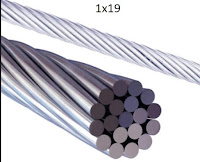
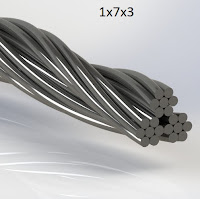
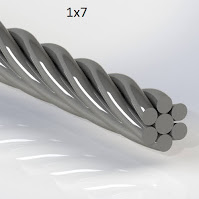
Each has a different configuration. Without more information, it would be impossible to know which is “stronger.” Don’t forget, tires have to flex and bend millions of times, so max strength may not be the best choice as you need flexibility too.
If we get to more complex cords, we “twist” cords together and can get different properties, as seen here:
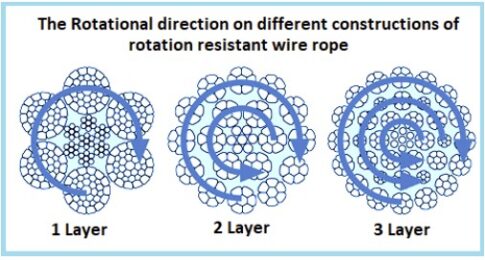
So an obvious question is, how is the material selected by the tire engineer?
Establishing a tire’s “strength” rating
There are a number of different tests conducted on tires to establish their “strength” rating. The different materials can help a tire meet the different tests. It is completely possible for a given tire to pass some tests associated with a given level—let’s say “G”. BUT if a given tire only passes the “F” level of one test, then the tire would be rated as “F” even if it passed the “G” level in the other tests. I know of no test or requirement that simply lines up with “Load Range” or “Ply Rating.”
Now, if the sales department wanted a “G”-rated tire, then they would ask the engineer to change the specification so the tire could pass all the “G”-level testing. This change or “improvement” may or may not result in more layers of steel.
I can relate to an actual example of such a process in a tire I developed. It turned out, in this case, that the only change I needed to make was the wire in the “bead” of the tire. This is the “cable” of wire that holds the tire on the wheel. It is kind of an anchor for the body ply. Here is a very basic image of tire components. The feature I want you to understand is where the “bead” is located.
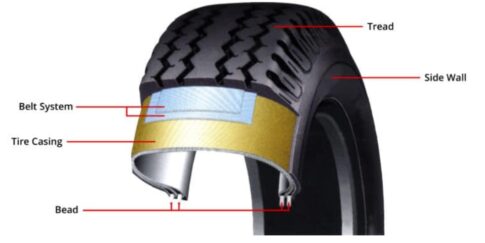
As you can see, the “ply” can be very complex. Simply looking at the number but not the Load Range can be misleading.
You need to know the Load Capacity in pounds
The bottom line is, you need to know the Load Capacity in pounds that you need for your specific application. In the same size, you may have different Load Range such as E, F, or G. Each Load Range has a different inflation level for the size tire you are considering and a different load capacity. So you need to consider much more than just the number and type of “Ply”.
Roger Marble
Check out my Blog www.RVTireSafety.Net
Read more from Roger Marble on RVtravel.com.
##RVT1133


Thank you, Roger, for your relentless effort to educate your readers. I don’t always understand fully, but I always read and, usually, eventually “get it.” Thank you!