

By Cheri Sicard
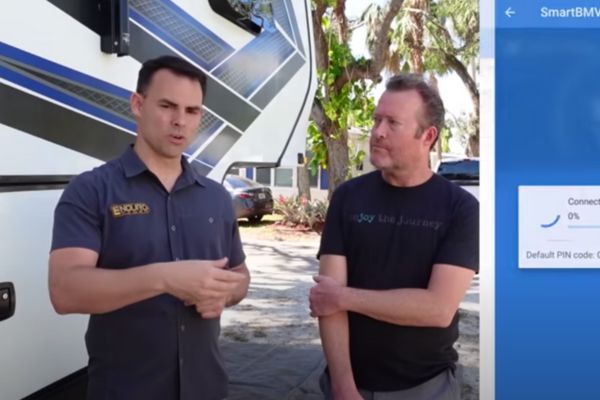
I was once under the mistaken impression that swapping out my trailer’s lead acid batteries for lithium involved nothing more than swapping out the battery. Not so. If you thought so, too, the RV lithium upgrade for beginners video below from Tom and Cheri at EnjoyTheJourney.Life [205K subscribers, 27M views] will give you three important things you need to know before starting such a project.
A lithium battery expert from Enduro joins. He says whenever you are considering an RV lithium battery upgrade these are the three most important things to look at when beginning your journey.
#1 What is the right battery bank size for you?
When it comes to a lithium battery upgrade for beginners, this will be the very first question to answer. While there is no one-size-fits-all, most RVers who just want basic power and to run a 12-volt fridge will need 200 amp hours as a base point. Beyond that, it will depend on your personal electrical consumption levels and how long you plan to spend off-grid.
#2 Is your converter lithium-compatible?
If your RV is from 2022 or newer, most likely your converter will be lithium-compatible. The older your RV, the less likely that is. According to the video, however, it’s a very simple swap-out.
#3 Adding a battery monitor
While adding a lithium battery monitor with a shunt is optional, the video’s expert highly recommends it. The reason is that in lithium batteries the voltage profile starts at a higher voltage than lead acid or AGM batteries—12.8 as opposed to 13.6. This means that lithium batteries deliver far more efficient power and remain at a steady voltage for far longer than a lead acid battery before dropping off. The battery monitor allows you to keep track of the amount of power you have, the amount of load you are drawing off your batteries, or how much you are putting back in via charging, at any given time.
If you are not sure how much battery power you actually need, you can also use the battery monitor with your current lead acid batteries and determine just what you need in your lithium battery bank. It can also help manage your battery use, which with lead acid batteries means never going below 50%.
##RVDT2226

Does a trailer need a DC to DC converter between the AGM battery in a tow vehicle? If so, where does that converter get placed relative to the electric brakes?
Great question. That point always gets ignored.
Robert, I’ve never even given a second thought to that question. My truck battery has no bearing on my trailer battery, or my disc braking system.
Within the Tow Vehicle, the “12v” operating voltage under the hood will typically be varied (via electronic control of the alternator). Immediately following engine startup, a short boost to more than 14v is typically present to assist the Tow Vehicle battery in recovery from running the starter. But that is boost is pretty quickly regulated down a a running voltage between 13.5 volts and 13.8 volts (it varies, from one manufacturer to another).
A DC->DC converter increases that voltage, to provide for more power into trailer batteries when the trailer batteries would “like” to receive more charging power. They should be installed in the trailer, and tuned for the trailer batteries.
“Lithium Compatible” power converters vary widely in their battery management schemes. The “bad” ones perform a simple single-stage constant voltage charge, typically around 14.6 volts, and wear out Lithium batteries too quickly. The “better ones” perform two stage charge, but the boost return voltage is typically lower than you’d like to have during an actual trip. The best ones are programmable, but they tend to have lower output power.
Thank you, Cheri! We anticipate switching from AGM to lithium house batteries when it is time to replace the AGMs. Our 2022 Newmar New Aire has the necessary hardware for the switch, I think. But, I anticipate hiring someone to do the upgrade to ensure that it is done well. Meanwhile, I’m beginning to research battery manufacturers to make an informed decision.